
Moving image reproduction method and moving image reproduction system
a technology of moving image and reproduction method, which is applied in the field of moving image reproduction method and moving image reproduction system, can solve the problems of not being versatile, unable to reproduce a portion of a webpage or plural moving images simultaneously, and unable to achieve automatic moving image reproduction, etc., to achieve the effect of less dependence on terminals, sufficient compression ratio, and lightening the necessary advance processing
- Summary
- Abstract
- Description
- Claims
- Application Information
AI Technical Summary
Benefits of technology
Problems solved by technology
Method used
Image

Examples
embodiment 1
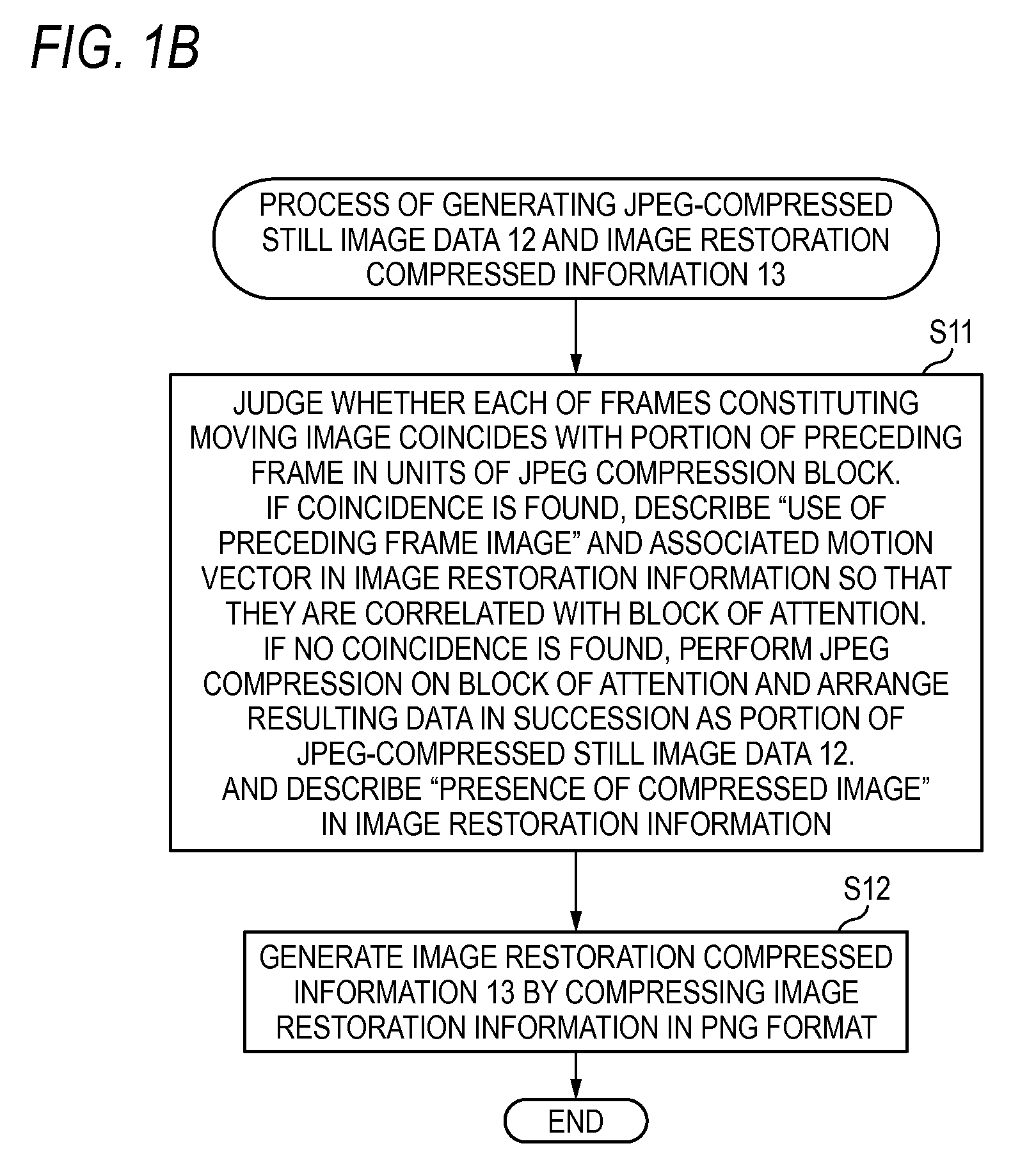
[0051]FIG. 2 is a flowchart of a process of generating JPEG-compressed still image data 12 and image restoration compressed information 13 in a moving image reproduction method and a moving image reproduction system according to a first embodiment of the invention using what is called the moving image constituent images JPEG compression method with interframe motion compensation. FIGS. 3A and 3B illustrate the process of generating JPEG-compressed still image data 12 and image restoration compressed information 13.
[0052]As outlined above, for the purpose of handling moving image data formed of plural frames as JPEG-compressed still images, the frames are processed sequentially starting from the head frame in units of a block of 8×8 pixels which is a unit of processing of JPEG. First, at step S111, to secure motion compensation, a motion vector MV is determined from a relationship between the preceding frame and the block of attention CB. A motion vector MV can be determined on the b...
embodiment 2
[0066]In the above-described first embodiment, whether the preceding frame can be used or not is judged in units of the minimum block (i.e., the block formed of 8×8 pixels which is the basic unit of JPEG compression). However, it is preferable to use as large a region of the preceding frame as possible; it is preferable to use data of 2×2 blocks or 4×4 blocks of the preceding frame if coincidence is found in a region having that size. This makes it possible to simplify the process of generating JPEG-compressed still image data 12 and image restoration compressed information 13 and to reduce the information amount of the image restoration compressed information 13. In view of this, the second embodiment employs a four-branch tree process with three block sizes. However, the number of block sizes is not limited to three.
[0067]FIG. 5 is a flowchart of a four-branch tree process with three block sizes which is executed in the second embodiment to generate JPEG-compressed still image dat...
embodiment 3
[0082]FIG. 7 is for description of a moving image reproduction method and a moving image reproduction system according to a third embodiment of the invention. The third embodiment is a modification of the first or second embodiment. More specifically, the third embodiment introduces transparency information. As shown in FIGS. 3A and 3B, a web server 1b used in the third embodiment is provided with transparency information compressed information 14 in addition to a display program 11, JPEG-compressed still image data 12, and image restoration compressed information 13.
[0083]Like the image restoration compressed information 13, the transparency information compressed information 14 is compressed information obtained by encoding in PNG format. And the transparency information compressed information 14 can provide transparency information in the form of an alpha channel. The display program 11 is written so as to decode the transparency information compressed information 14 using the sa...
PUM
 Login to View More
 Abstract
Description
Claims
Application Information
 Login to View More