Check patentability & draft patents in minutes with Patsnap Eureka AI!

Chest compression devices for augmented cpr

a compression device and chest compression technology, applied in the field of cpr, can solve the problems of difficult to achieve and the recommendation of active decompression for pediatric use, and achieve the effect of accelerating the natural resilient expansion of the chest and facilitating the use of active decompression forces

Active Publication Date: 2016-11-03
ZOLL MEDICAL CORPORATION
View PDF3 Cites 6 Cited by
  • Summary
  • Abstract
  • Description
  • Claims
  • Application Information

AI Technical Summary

Benefits of technology

The patent describes additional devices and methods that help to improve the release phase of chest compressions during CPR. These devices have curved bands that can fit around a patient's chest and tighten or relax depending on the pressure applied during rescue. These devices not only help to speed up the expansion of the chest during the release phase, but also provide beneficial active decompression forces to help restore the patient's breathing.

Problems solved by technology

This is difficult to accomplish, especially over a long course of CPR.
Active decompression is not yet recommended for pediatric use.

Method used

the structure of the environmentally friendly knitted fabric provided by the present invention; figure 2 Flow chart of the yarn wrapping machine for environmentally friendly knitted fabrics and storage devices; image 3 Is the parameter map of the yarn covering machine
View more

Image

Smart Image Click on the blue labels to locate them in the text.
Viewing Examples
Smart Image
  • Chest compression devices for augmented cpr
  • Chest compression devices for augmented cpr
  • Chest compression devices for augmented cpr

Examples

Experimental program
Comparison scheme
Effect test

Embodiment Construction

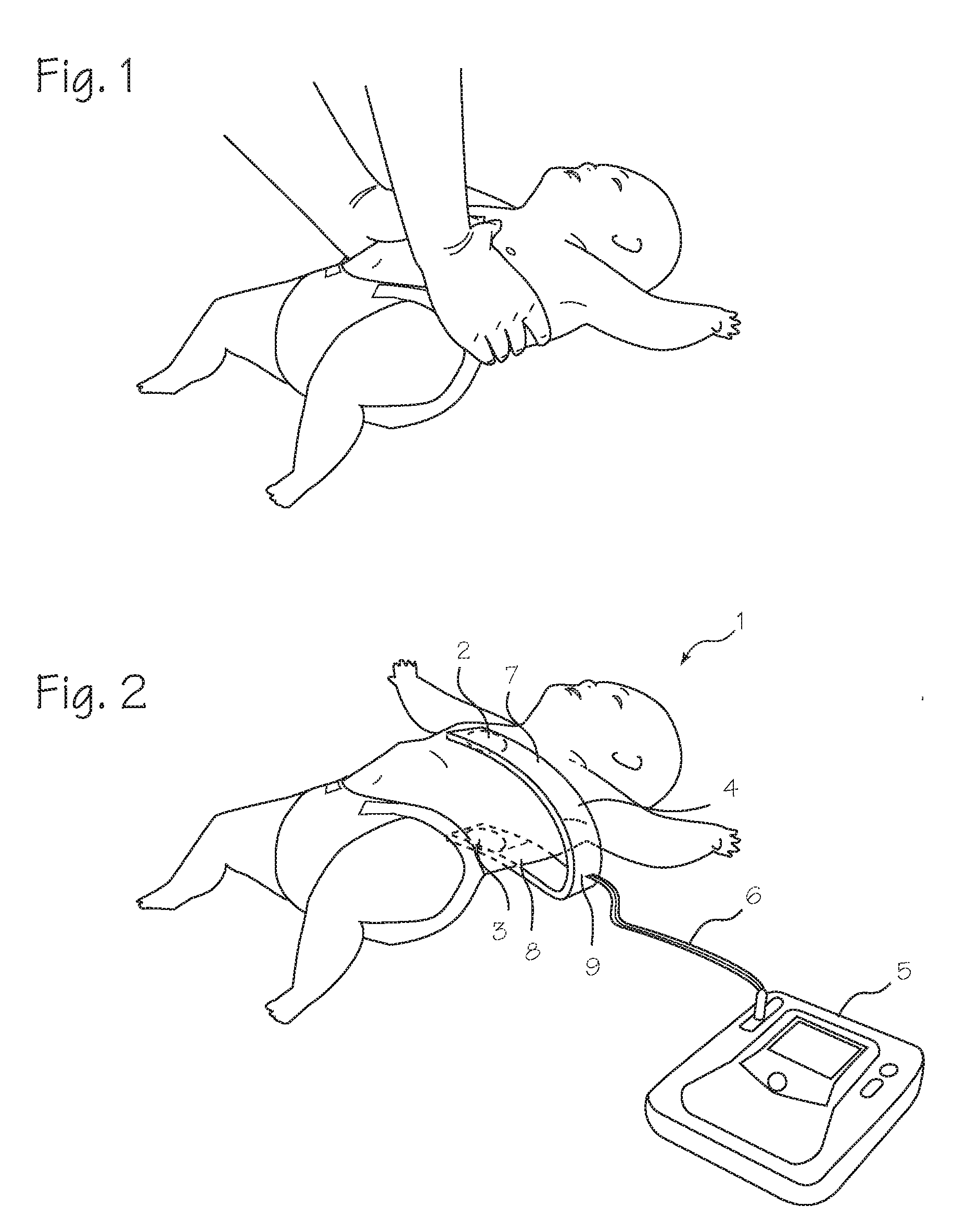
[0036]FIG. 1 illustrates the two-thumb technique for accomplishing CPR compressions on an infant. The infant is shown supine, supported on a surface. A CPR provider has placed his hands around the infant's thorax, placing his thumbs over the infant's sternum with his fingers wrapping over the axillary area under the infant's arms and around the infant's back. In this method, the CPR provider squeezes the infant's thorax, with the thumbs pressing on the sternum, to push the sternum toward the spine. These compression should be accomplished at a rate of 100 compressions per minute and a depth of 1.5 inches (3.8 cm)(or about one-third of the total thickness of the thorax).

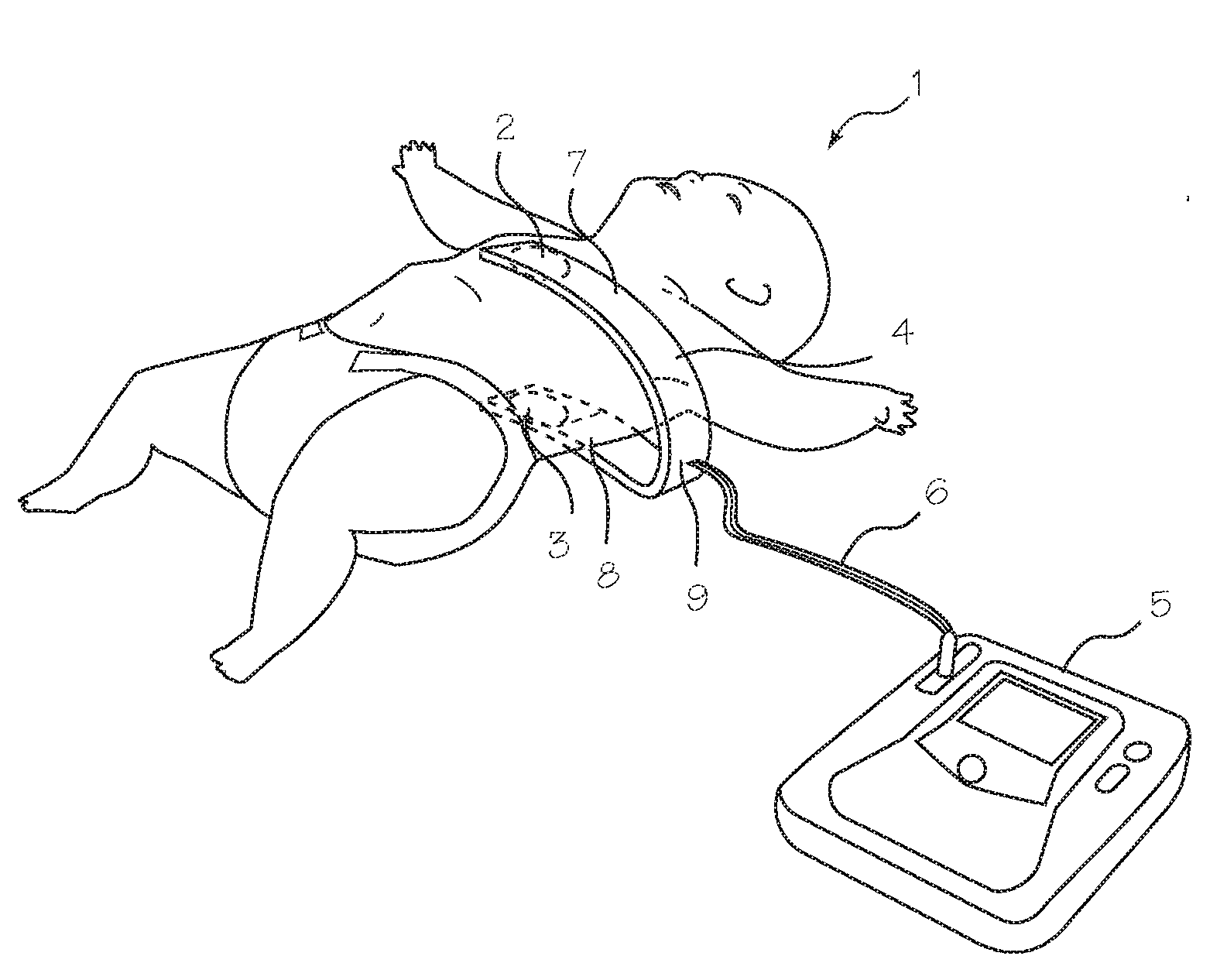
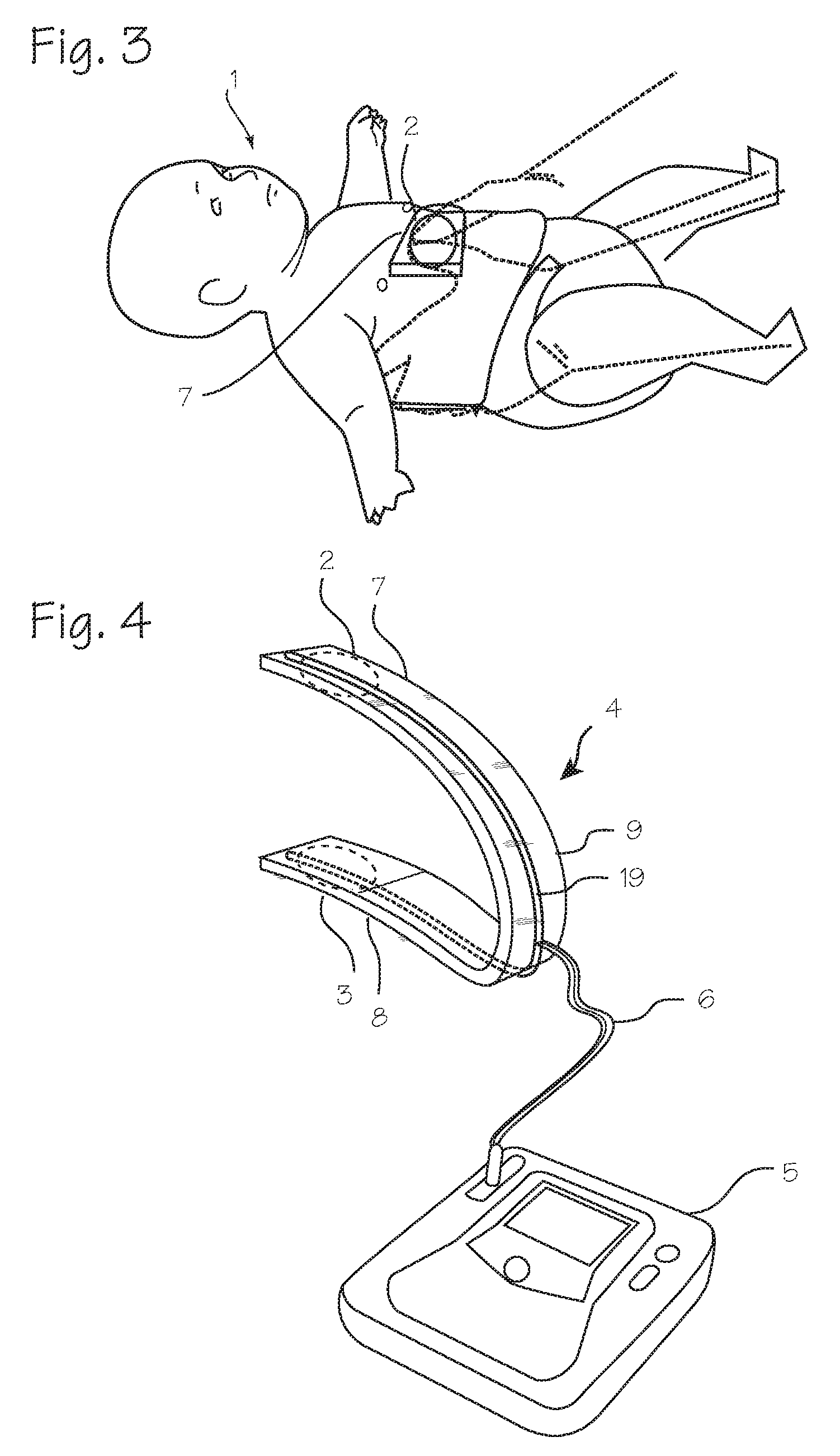
[0037]FIG. 2 illustrates placement of the new chest compression depth monitoring system on an infant cardiac arrest victim 1. The system includes a first sensor 2 located over the sternum and a second sensor 3 located on the back. These two sensors are mounted on a frame 4, which, as illustrated, is a U-shaped frame d...

the structure of the environmentally friendly knitted fabric provided by the present invention; figure 2 Flow chart of the yarn wrapping machine for environmentally friendly knitted fabrics and storage devices; image 3 Is the parameter map of the yarn covering machine
Login to View More

PUM

No PUM Login to View More

Abstract

Devices and methods for CPR chest compression with active decompression.

Description

[0001]This application claims priority to U.S. Provisional Application 62 / 154,648, filed Apr. 29, 2015, which is hereby incorporated by reference in its entirety.FIELD OF THE INVENTIONS[0002]The inventions described below relate the field of CPR.BACKGROUND OF THE INVENTIONS[0003]Chest compressions provided as a component of cardiopulmonary resuscitation (CPR) should be accomplished at a consistent depth of about 2 inches, according to the CPR Guidelines 2010. This is difficult to accomplish, especially over a long course of CPR. Chest compression monitors, such as those used in ZOLL Medical Corporation's CPR D Padz® and Real CPR chest compression monitor, give real time feedback to a CPR provider, measuring the depth and rate of compressions achieved during CPR and providing immediate reports of achieved chest compression depth to the CPR provider. This helps the CPR provider achieve the desired compression depth and also helps the CPR provider realize when he is too fatigued to pro...

Claims

the structure of the environmentally friendly knitted fabric provided by the present invention; figure 2 Flow chart of the yarn wrapping machine for environmentally friendly knitted fabrics and storage devices; image 3 Is the parameter map of the yarn covering machine
Login to View More

Application Information

Patent Timeline
no application Login to View More
Patent Type & Authority Applications(United States)
IPC IPC(8): A61H31/00
CPCA61H31/005A61H31/007A61H2201/1253A61H2201/1664A61H2205/084A61H31/008A61H2031/002A61H2031/003A61H2201/5043A61H2201/5079A61H2201/5084A61H2201/1445A61H2201/1207A61H2201/1436A61H2201/1619A61H2201/1645A61H2201/5048A61H2201/5076A61H2230/04A61N1/3937A61N1/3968
Inventor SILVER, ANNEMARIE E.JOHNSON, GUY R.FREEMAN, GARY A.HERKEN, ULRICH R.
Owner ZOLL MEDICAL CORPORATION
Features
  • R&D
  • Intellectual Property
  • Life Sciences
  • Materials
  • Tech Scout
Why Patsnap Eureka
  • Unparalleled Data Quality
  • Higher Quality Content
  • 60% Fewer Hallucinations
Social media
Patsnap Eureka Blog
Learn More