
Mobile electronic device
a mobile electronic device and electronic device technology, applied in the field of telephones, can solve the problems of unauthorized people's inability to access communications carried out over cellular phones, add so much noise, and distance between the telephone, and achieve the effect of easy entry of alphanumeric data and transmission
- Summary
- Abstract
- Description
- Claims
- Application Information
AI Technical Summary
Benefits of technology
Problems solved by technology
Method used
Image

Examples
Embodiment Construction
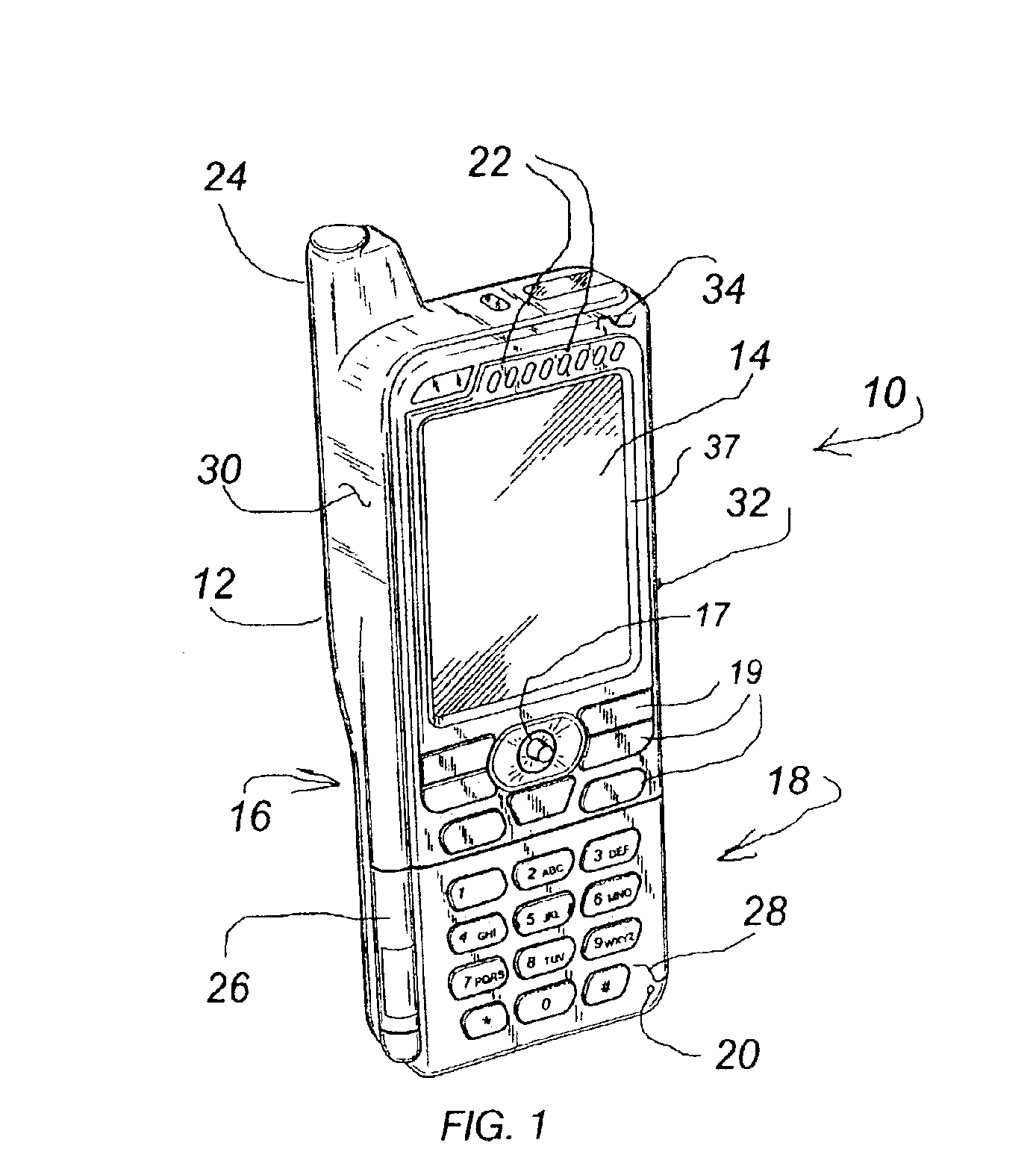
[0029]FIG. 1 shows a front view of a preferred embodiment wherein the extendable keyboard is folded closed and hidden underneath number pad 5. Electronic device 10 comprises housing 12, display 14, navigational pad 16, numeric keyboard 18, microphone 20, speaker 22, and antenna 24. The housing 12 is generally rectangular and has a left side 30, a right side 32, a front 34 and a back, which is not shown in this Figure. A hinge 26 is connected to the housing 12 and to a panel 28 comprising an extendable keyboard. The navigational pad 16 includes a joystick 17 and a plurality of navigation keys 19 which allow the user to perform certain functions on the display 14, including moving a cursor on the display. The joystick 17 and the navigation keys 19 can be considered to be pointing devices.
[0030]Display 14 provides visual output to the user. A display backlight 37 located around the periphery of the display 14 provides backlighting for use of the device at night. Display output can be t...
PUM
 Login to View More
 Abstract
Description
Claims
Application Information
 Login to View More