[0008]I have invented an improved hoist that will elevate a platform from the ground to an open bed of a truck such as a
pickup truck. A vehicle such as a snowmobile, an A.T.V. and a riding
mower can be driven onto the platform while the platform is resting solidly on the ground. The driver can then get off the vehicle and the platform. The hoist will then safely elevate the platform, bearing the vehicle resting on the platform and place these onto the open bed of the
pickup. The vehicle is then In position to be transported on the pickup. Reversing the action of the hoist allows the vehicle to be unloaded from the pickup.
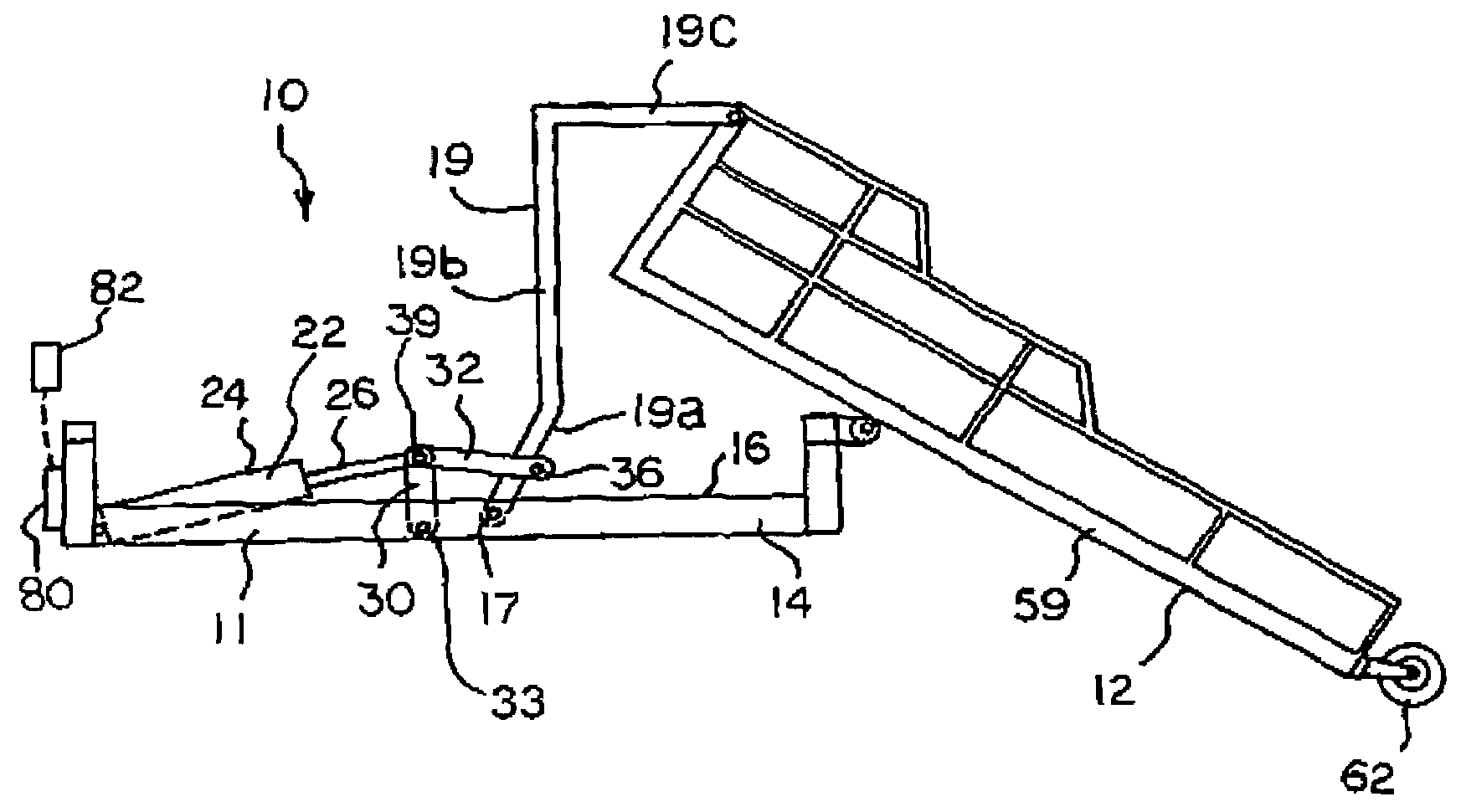
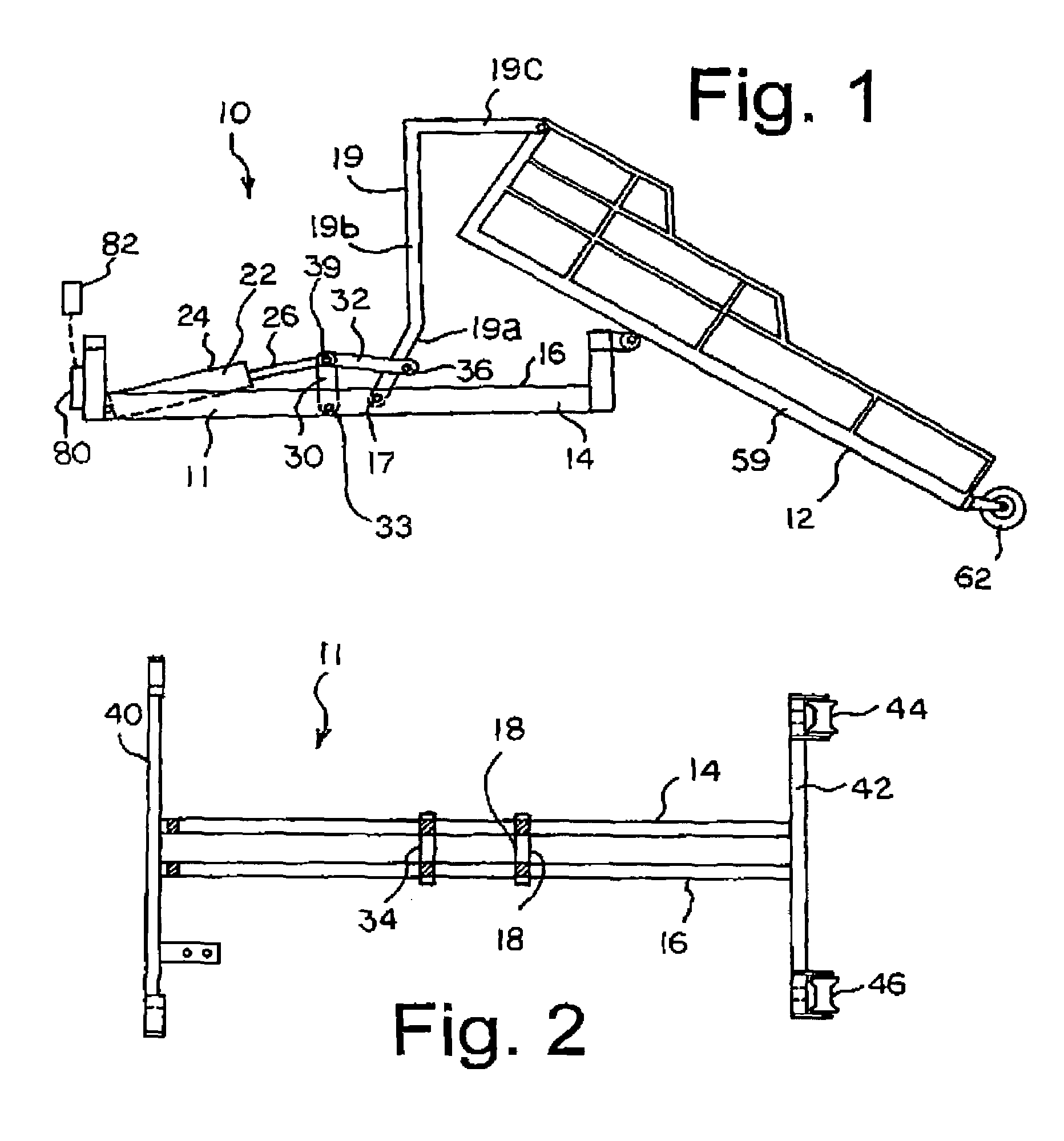
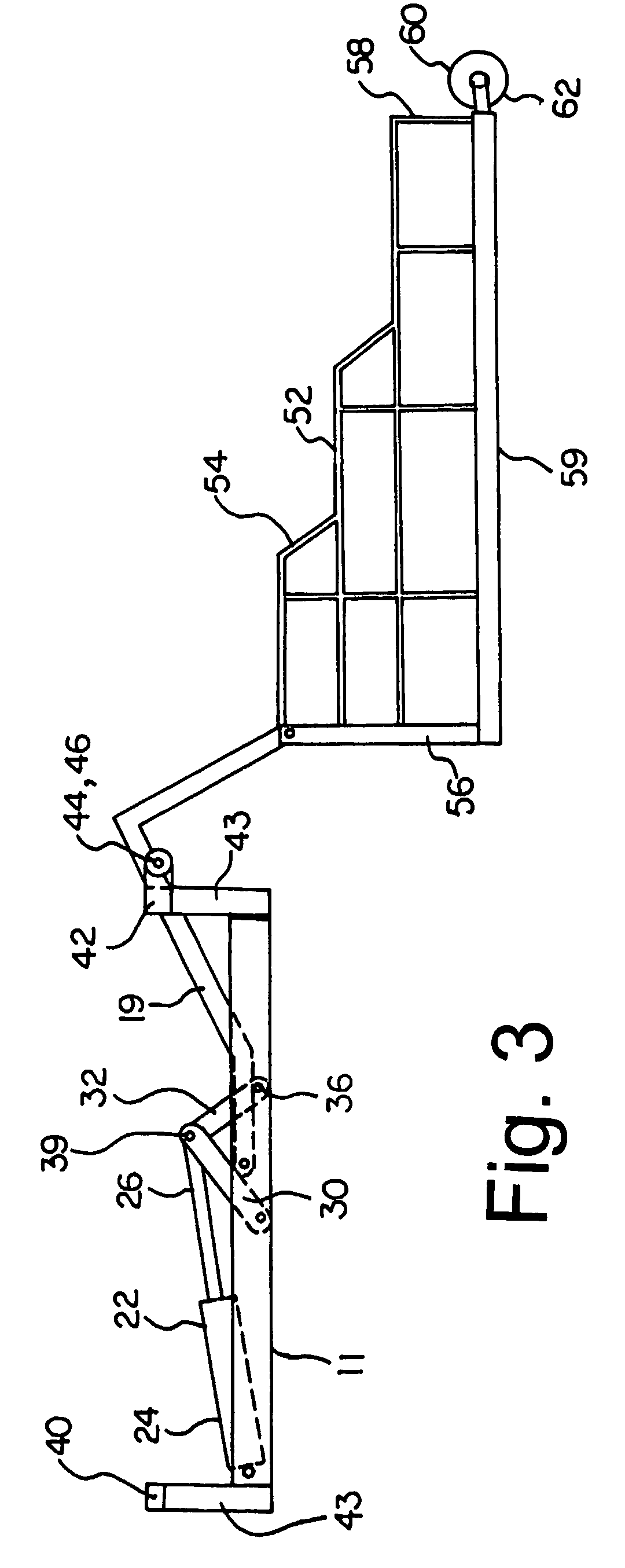
[0009]Briefly the hoist of my Invention includes a moveable load-bearing platform, a framework adapted to be mounted on the open bed of a truck and having a longitudinally extending
stringer; a
cantilever arm pivotal relative to the
stringer and being pivotally interconnected to the platform; and an
actuator which is pivotal relative to the
stringer and which, when retracting, causes the
cantilever to pivot toward the
actuator with resulting raising of the platform. The
actuator comprises a longitudinally extending member such as a
hydraulic ram. An arrangement of linkages connects the actuator with the
cantilever arm to increase the leverage and “reach” of the actuator thereby permitting the actuator to be relatively short in comparison with the travel distance required of the cantilever arm. For example, it is desirable to provide a sufficient movement of the cantilever arm to lower the platform significantly below the truck wheels. This permits loading of
watercraft, or of the platform on an irregular surface. The linkage arrangement comprises a first connecting link member interposed between the actuator and the cantilever arm, this first link member being pivotally joined at a first end to the actuator. The second end of the link member is pivotally engaged to the cantilever arm, at a point close to the pivot
mount of the cantilever arm to the stringer. A second, generally upstanding anchoring link is pivotally mounted at its lower end to the stringer, at a point between the actuator and the cantilever arm. At its upper end the upstanding link is pivotally joined to the pivot
mount joining the actuator and the first link. The actuator and first link form a scissors-like arrangement which unfolds as the actuator extends, thus increasing the “reach” and lifting force of the actuator. The second link serves to maintain longitudinal rigidity of the link
system, i.e. to permit the horizontal thrust of the actuator to be transmitted to the cantilever arm.
[0010]In one preferable version, the links are arranged such that they meet at an
elbow junction at approximately a 90 degree angle when the actuator and cantilever arm are extended for depositing the platform at
ground level. In this position, a retractive force of the actuator may be translated into an upward lifting action of the second link arm acting on the main cantilever arm. The second link arm joins with the cantilever arm at an angle of between 45 and 90 degrees when in this extended position, thereby enhancing the upward lifting and Inertial action of the actuator. This shallow angle is desirable to permit the first link to transfer the weight of the cantilever arm against the frame when the actuator retracts or extends.
[0011]Preferably, the platform includes a at least one roller or wheel mounted at its distal end, to facilitate fore and aft movement of platform as the same as loaded and unloaded. A further desirable feature is fore and aft upstanding members at the respective fore and aft ends of the frame, for elevating and supporting the platform above the truck bed, thus permitting space between the truck bed and the platform for the various linkages and actuator. The rearward (aft) member desirably includes one or more rollers to ease the sliding of the platform over the rearward supporting member.


 Login to View More
  Login to View More