Method and apparatus for robustly locating user barge-ins in voice-activated command systems
a voice-activated command and user barge-in technology, applied in speech analysis, speech recognition, instruments, etc., can solve the problems of difficult to determine the location of the user barge-in in many instances, the intention of the caller may have been misrecognized, and the majority of speech platforms either cannot provide robust and accurate prompt bookmarks
- Summary
- Abstract
- Description
- Claims
- Application Information
AI Technical Summary
Problems solved by technology
Method used
Image



Examples
example 1
[0043]System: “Please select one from the following five people.”[0044]System: “Number one, Jeffrey Olson”[0045]System: “Number two, Jeffrey Ollason”[0046]System: . . .[0047]User: “Yes” (Barged-in)
The user might think he / she barged-in on the second item (Jeffrey Ollason) in response to the second phrase “Number two, Jeffrey Ollason”. However, at that time the system has started the third prompt (even though the caller hasn't heard the “Number three” portion of the third phrase yet). As a result, the intention of the caller was misrecognized.
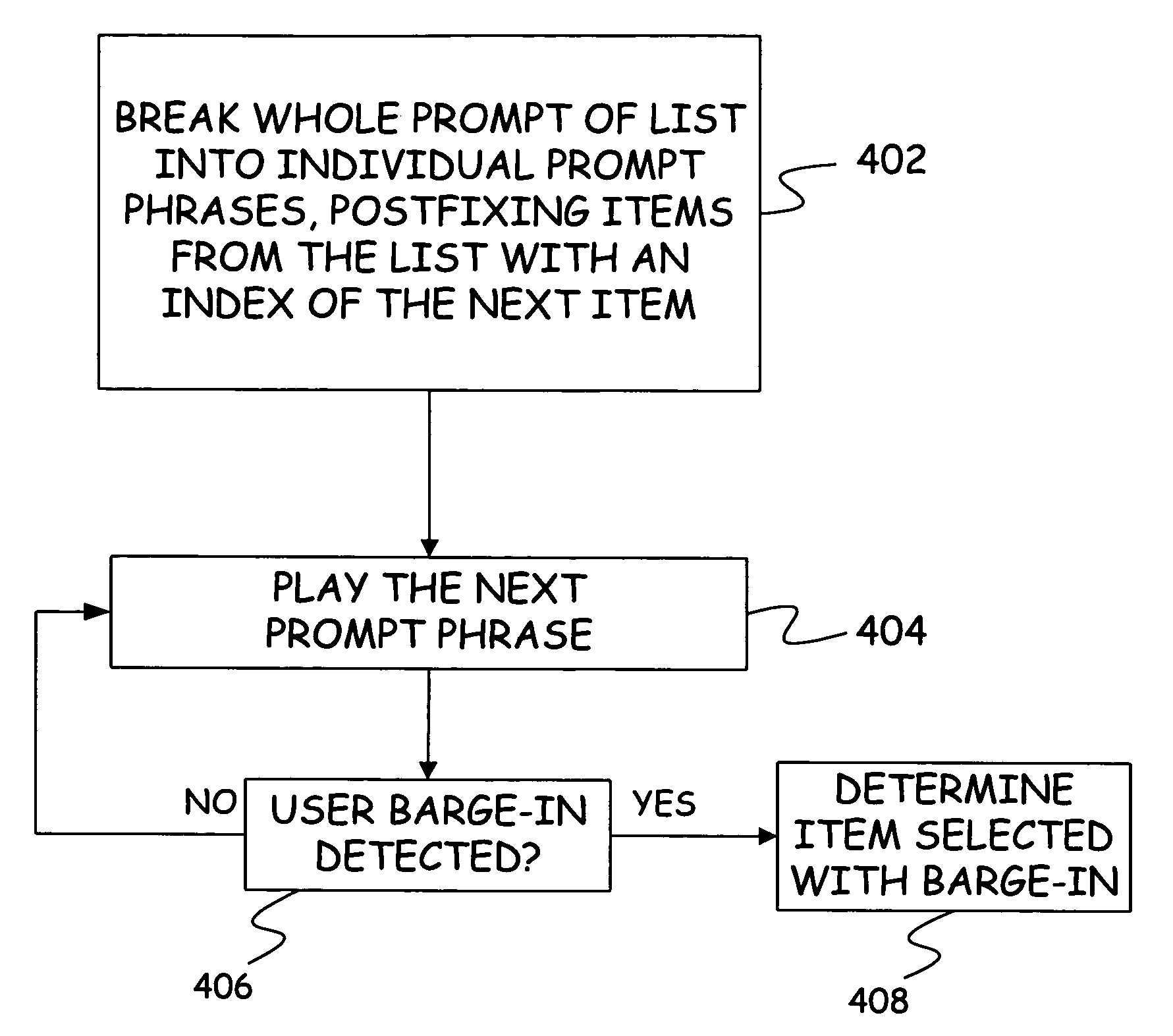
[0048]In accordance with embodiments of the present invention, the sensibility of the race condition is greatly reduced by breaking the list into phrases at slightly different locations to provide longer windows for the caller to make up his / her mind. For example, consider the following set of phrases to present the same list as was presented in the first example:
example 2
[0049]System: “Please select one from the following five people. Number one”[0050]System: “Jeffrey Olson, Number two”[0051]System: “Jeffrey Ollason, Number . . . ”[0052]User: “Yes” (Barged-in)
The correct handling of the critical timing around the window “ Number . . . ” in the second phrase or prompt (following the introductory phrase or prompt) completely eliminates the race condition in a usability study. In other words, for a particular item in a list (for example Jeffrey Ollason), by setting a barge-in response window for this item to include both the time it takes to say this item and the time it takes to say an item index number or designation for the next item in the list, the occurrence of misrecognization is greatly reduced. The item index number or designation for the first item in the list can be included in the introductory phrase or prompt (i.e., “Please select one from the following five people. Number one”).
[0053]C. Navigation and Prompt Adjustment
[0054]To support n...
example 3
[0055]System: “Please select one from the following 5 people. Number one”[0056]System: “Jeffrey Olson, Number two”[0057]User: “Repeat”[0058]System: “Number One, Jeffrey Olson, Number two”
As can be seen in this example, index “Number One” of the previous command prompt phrase is added to the current command prompt phrase “Jeffrey Olson, Number two” to aid in providing an easily understandable navigation prompt process.
[0059]D. Example Algorithm
[0060]The above-described methods and aspects of the present invention can be implemented in a wide variety of voice-command systems using a variety of different algorithms. For illustrative purposes, one such algorithm is illustrated in FIG. 3. In FIG. 3, a navigation algorithm is shown, including steps 0) through 9). This algorithm is described with reference to Example 4 as follows.
PUM
 Login to View More
 Abstract
Description
Claims
Application Information
 Login to View More