
Carbon fiber reinforced prepreg of gas barrier properties, carbon fiber reinforced plastic and methods of producing the same
a technology of gas barrier properties, which is applied in the direction of woodworking apparatus, packaging, synthetic resin layered products, etc., can solve the problems of preventing practical applications, low barrier properties of organic plastics, and almost impossible to use carbon fiber reinforced plastics in a conventional manner simply as hydrogen vessels, etc., and achieves high gas barrier properties.
- Summary
- Abstract
- Description
- Claims
- Application Information
AI Technical Summary
Benefits of technology
Problems solved by technology
Method used
Image

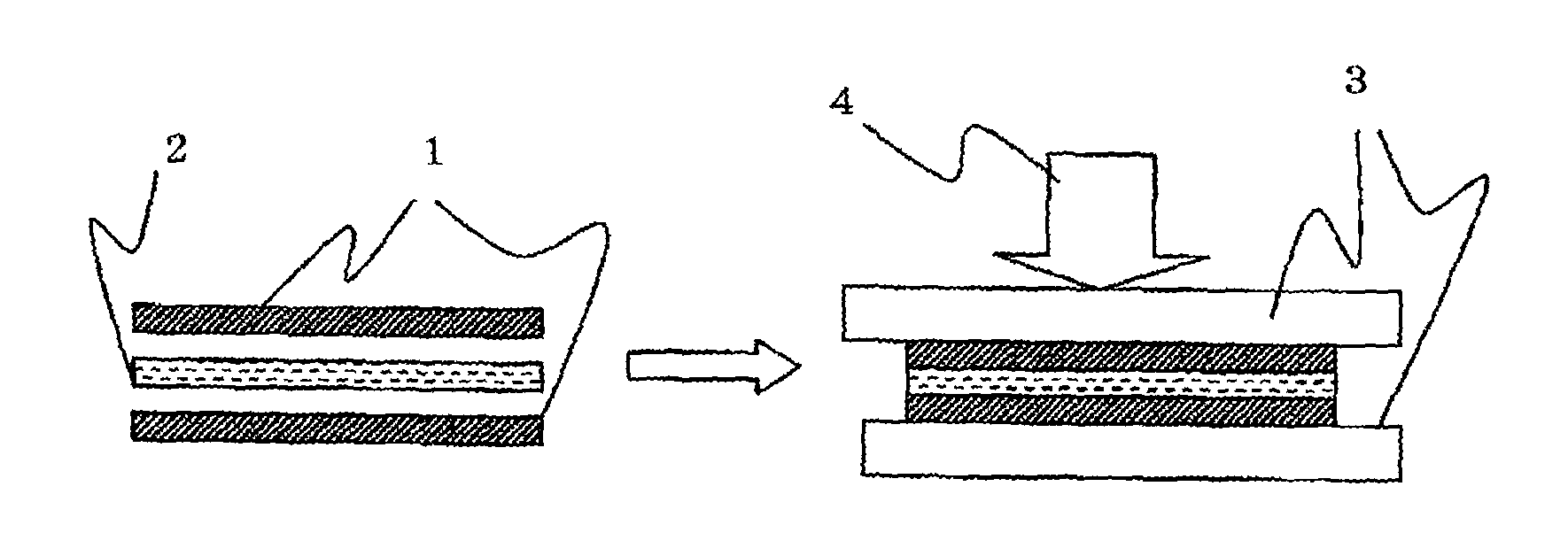
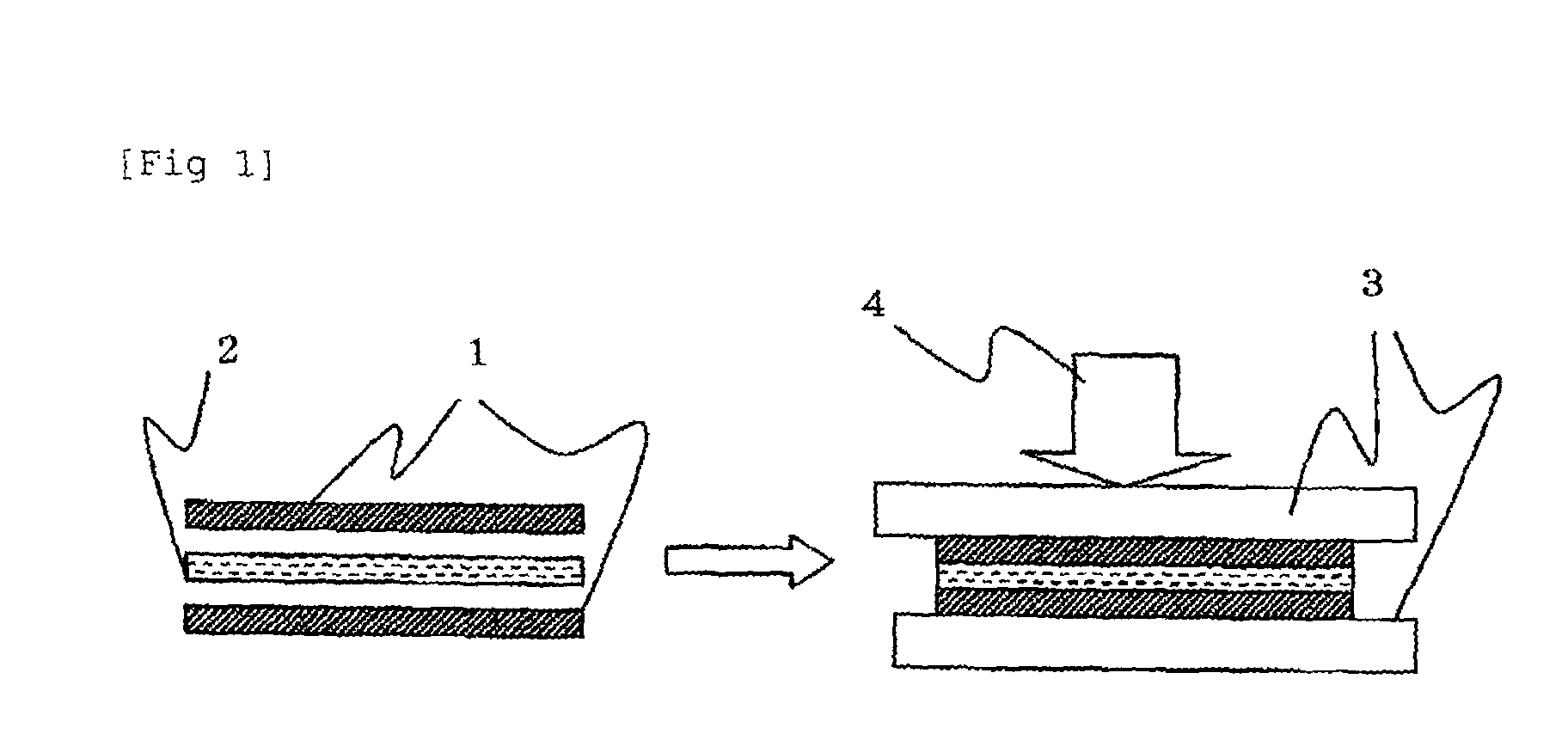
Examples
example 1
(1) Production of Clay Membrane S
[0047]Two g of natural montmorillonite (Kunipia P, available from KUNIMINE INDUSTRIES CO., LTD.) added as clay with 60 cc of distilled water was placed in a plastic hermetically sealed vessel together with a Teflon (registered trademark of Du Pont Corp.) rotator and the material was vigorously agitated to obtain a uniform dispersion liquid. Next, this clay dispersion liquid was deaerated by a vacuum deaerator. This dispersion liquid was applied onto a brass plate with a length of about 30 cm and a width of 20 cm at a thickness of 2 mm, and this was left to stand horizontally and dried for 30 min at a temperature of 60° C. in a forced blowing oven to obtain a clay layer with a thickness of about 40 μm, which was peeled from the brass plate to obtain a clay free standing film. Thereafter, the film was heat-treated for 30 min at 110° C. in a blowing constant temperature thermostat to obtain a clay film (clay film S).
(2) Production of Clay Film H
[0048]2....
example 2
[0057]In this Example, the production of a cylindrical clay film will be described.
(1) Production of Clay Paste
[0058]30.4 g of natural montmorillonite (Kunipia P, available from KUNIMINE INDUSTRIES CO., LTD.) as clay and 8.1 g of synthetic mica (Somasif ME-100, available from CO-op Chemical Co., Ltd.) added with 859.5 cc of distilled water was placed in a plastic hermetically sealed vessel together with a Teflon (registered trademark of Du Pont Corp.) rotator and the material was vigorously agitated at 25° C. for two hr to obtain a uniform dispersion liquid. To this dispersion liquid was added 2.0 g of Epsilon-caprolactam as an organic additive and the resulting material was further agitated to obtain 4.5% by mass in solid component of a clay dispersion liquid. This was gradually dried to produce a clay paste with a solid component of 9% by mass.
(2) Production of Cylindrical Clay Film
[0059]Teflon (registered trademark of Du Pont Corp.) fine plates with a width of 10 mm and a thickne...
PUM
| Property | Measurement | Unit |
|---|---|---|
| particle diameter | aaaaa | aaaaa |
| particle diameter | aaaaa | aaaaa |
| aspect ratio | aaaaa | aaaaa |
Abstract
Description
Claims
Application Information
 Login to View More