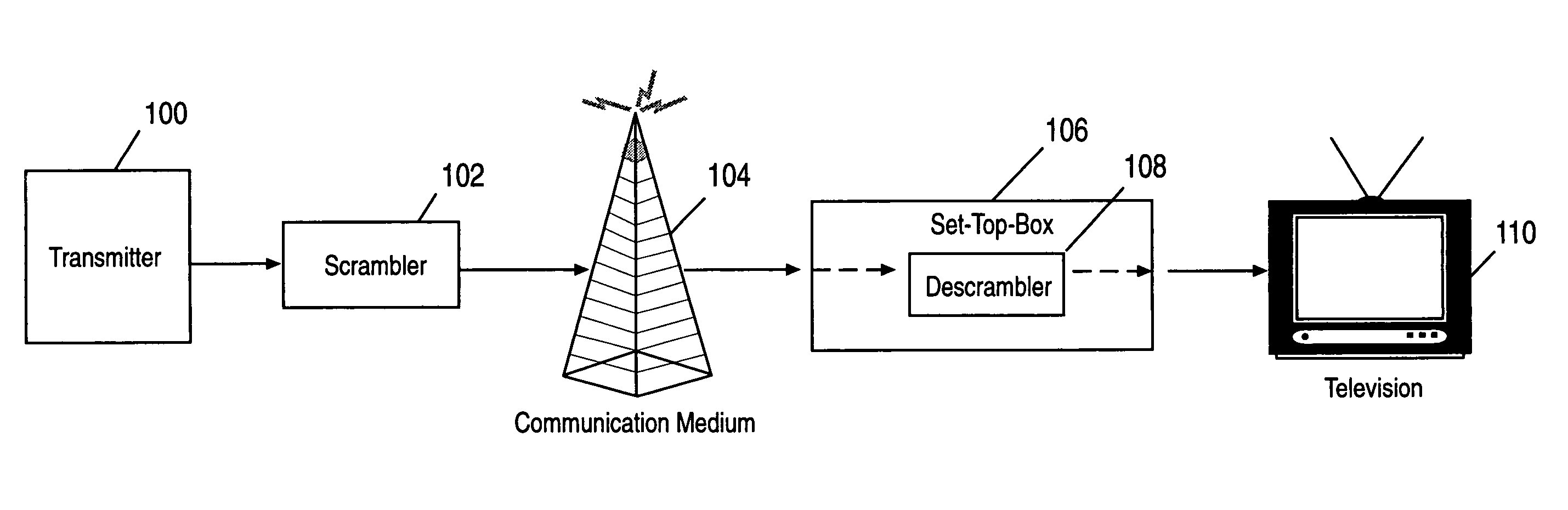
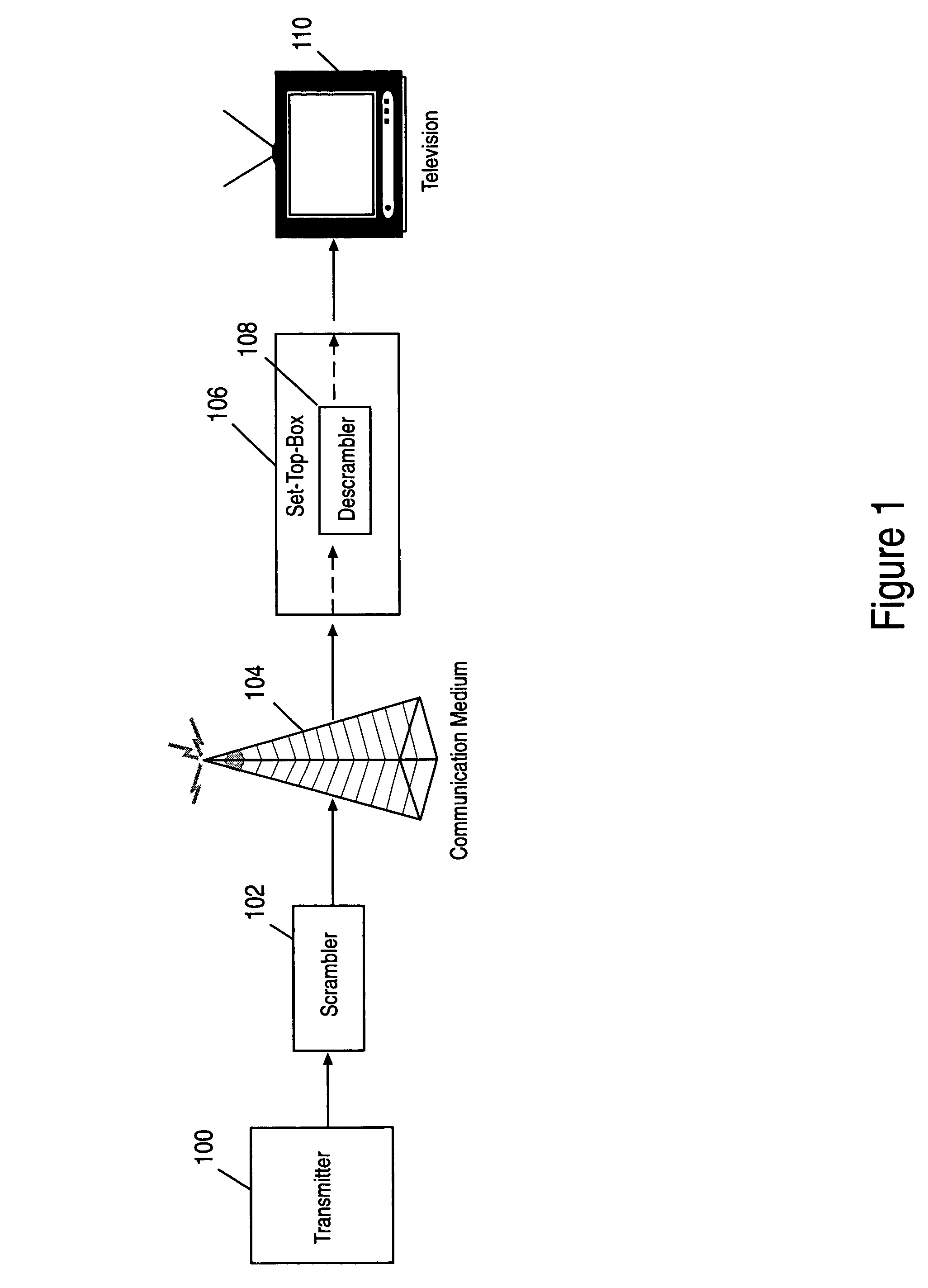
[0019]A method and apparatus for controlling access to information over a network. Data streams (that may include media streams such as television signals, and information streams such as web pages) are transmitted across a network by a head end (e.g., a local cable company) and received by a member space manager or set-top box (also referred to as a cable box) that enables the information to be utilized or viewed on a television. Data streams may be transmitted on a variety of frequencies across cable (or other transmission mediums such as satellite). Prior art methods restrict the transmission of a particular channel to a set frequency (e.g., 110 MHz). Thus, channel 2 is always transmitted across a particular frequency, channel four on another particular frequency, channel 7 on another particular frequency, etc. To prevent unauthorized viewing, the prior art scrambles the transmitted signal. However, an illegal cable box merely has to descramble the information on a particular frequency to view a given channel / program.
[0020]One or more embodiments of the invention provide for rotating or switching the frequency that a given data stream is transmitted based on a switching algorithm. For example, a given data stream (e.g., a motion picture on a pay-per-view station) may be transmitted on one frequency for a specified time interval (e.g., 1 / 10th of a second, 10 seconds, 25 seconds, 1 minute, etc.), then switched to another frequency for a specified time interval (e.g., 1 / 10th of a second, 10 seconds, 25 seconds, 1 minute, etc.), then switched to another frequency for a specified time interval, etc. Additionally, the switching algorithm may be changed arbitrarily. By switching the frequency, an illegal cable box has to know the frequency order (which can be changed at any time) that a channel is being transmitted on, thereby making it more difficult to view a continuous program.
[0021]To enable the member space manager to determine which frequency a given stream of information is transmitted on at a particular point in time, switching software may be provided by the head end server to the member space manager (or set-top box). Switching software may be specific to a particular data stream and may specify which frequency will contain the given stream at a particular point in time. In one or more embodiments, the switching software may be encrypted prior to transmission to the member space manager and decrypted upon arrival. Further, in one or more embodiments of the invention, the switching software is an object oriented object that is dynamically generated by the member space manager (with information received from the head end server) and maintains the ability to communicate with the head end, e.g., via a remote procedure call (RPC) mechanism such as the Java Remote Method Invocation (RMI) system.
[0022]According to one or more embodiments of the invention, a mapping that defines which frequency a particular stream maps / corresponds to is determined, the mapping is transmitted to the member space manager where it is installed and executed, the data stream is transmitted on varying frequencies to the member space manager, and the member space manager tunes into the appropriate frequency to receive and utilize a continuous stream of information. By transmitting information in this manner, all encryption, frequency / channel switching, configuration issues, etc. are transparent to the end user who merely has to select a virtual channel (e.g., NBC, ABC, CBS, etc.) to view. Further, illegal viewing of a particular channel is more difficult because once a frequency is tuned into, 1 / 10th of a second or 10 seconds later, the selected channel is transmitted on a different frequency.


 Login to View More
  Login to View More