Check patentability & draft patents in minutes with Patsnap Eureka AI!

System for and method of combining CMOS inverters of multiple drive strengths to create tune-able clock inverters of variable drive strengths in hybrid tree-mesh clock distribution networks

a technology of variable drive strengths and clock inverters, which is applied in the field of integrated circuits, can solve the problems of increasing clock skew, compromising the integrity of data transmitted along the device, and increasing clock skew, so as to reduce the effect of skew

Active Publication Date: 2016-07-12
MARVELL ASIA PTE LTD
View PDF54 Cites 0 Cited by
  • Summary
  • Abstract
  • Description
  • Claims
  • Application Information

AI Technical Summary

Benefits of technology

This approach reduces the cost and time of designing clock distribution networks, ensures low skew, and allows for quicker market release of semiconductor devices by using standardized components that are more predictably functional.

Problems solved by technology

When clock signals arrive at these parallel elements at different times, the resulting “clock skew” can cause a variety of problems, including setup and hold violations, which can jeopardize the integrity of data transmitted along the device.
This divergence of the clock network and the insertion of CMOS inverters in the clock cause the clock skew to increase.
The clock skew can increase for other reasons, such as structural problems, variations in loads along the clock distribution network, variations in process, voltages, or temperature of the inverters, and other effects in the interconnects in the clock distribution network.
It may not be possible to guarantee that inverters of a clock distribution network whose outputs are shorted with a cross-link have the same load characteristics.
This approach is expensive and time-consuming for many design teams, especially those that purchase standard cells.

Method used

the structure of the environmentally friendly knitted fabric provided by the present invention; figure 2 Flow chart of the yarn wrapping machine for environmentally friendly knitted fabrics and storage devices; image 3 Is the parameter map of the yarn covering machine
View more

Image

Smart Image Click on the blue labels to locate them in the text.
Viewing Examples
Smart Image
  • System for and method of combining CMOS inverters of multiple drive strengths to create tune-able clock inverters of variable drive strengths in hybrid tree-mesh clock distribution networks
  • System for and method of combining CMOS inverters of multiple drive strengths to create tune-able clock inverters of variable drive strengths in hybrid tree-mesh clock distribution networks
  • System for and method of combining CMOS inverters of multiple drive strengths to create tune-able clock inverters of variable drive strengths in hybrid tree-mesh clock distribution networks

Examples

Experimental program
Comparison scheme
Effect test

Embodiment Construction

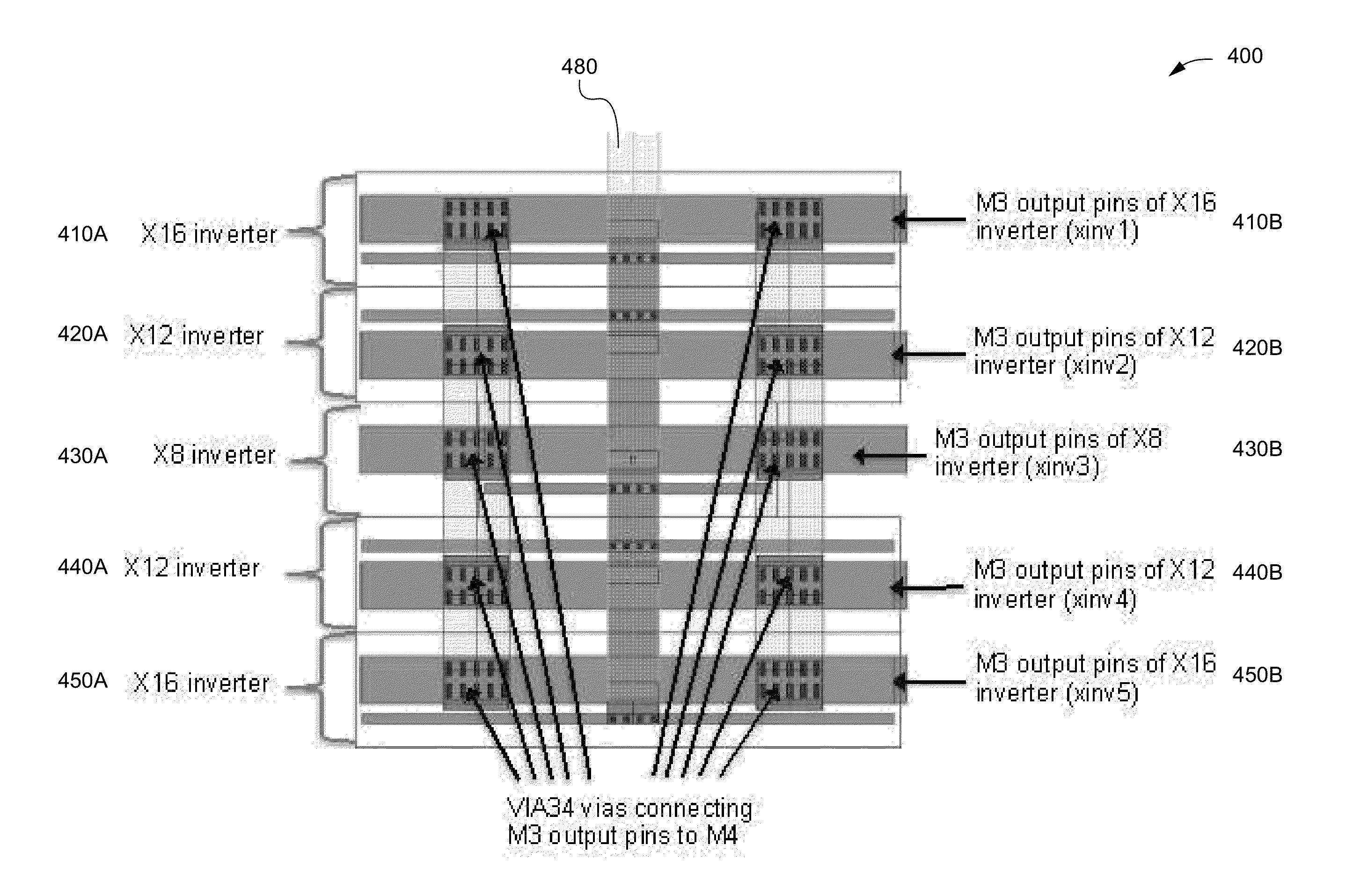
[0023]In accordance with the principles of the invention, a semiconductor-device clock-distribution network uses only standard sized inverters, regardless of the drive strengths needed to drive sequential (clock-receiving) elements on the device. Because custom-sized inverters do not have to be fabricated or purchased from third parties, the design process is less expensive than prior art processes. Furthermore, because these standard-sized inverters have been more thoroughly tested and function more predictably, the time for debugging semiconductor devices using these clock distribution networks is reduced, allowing products to be brought to market more quickly.

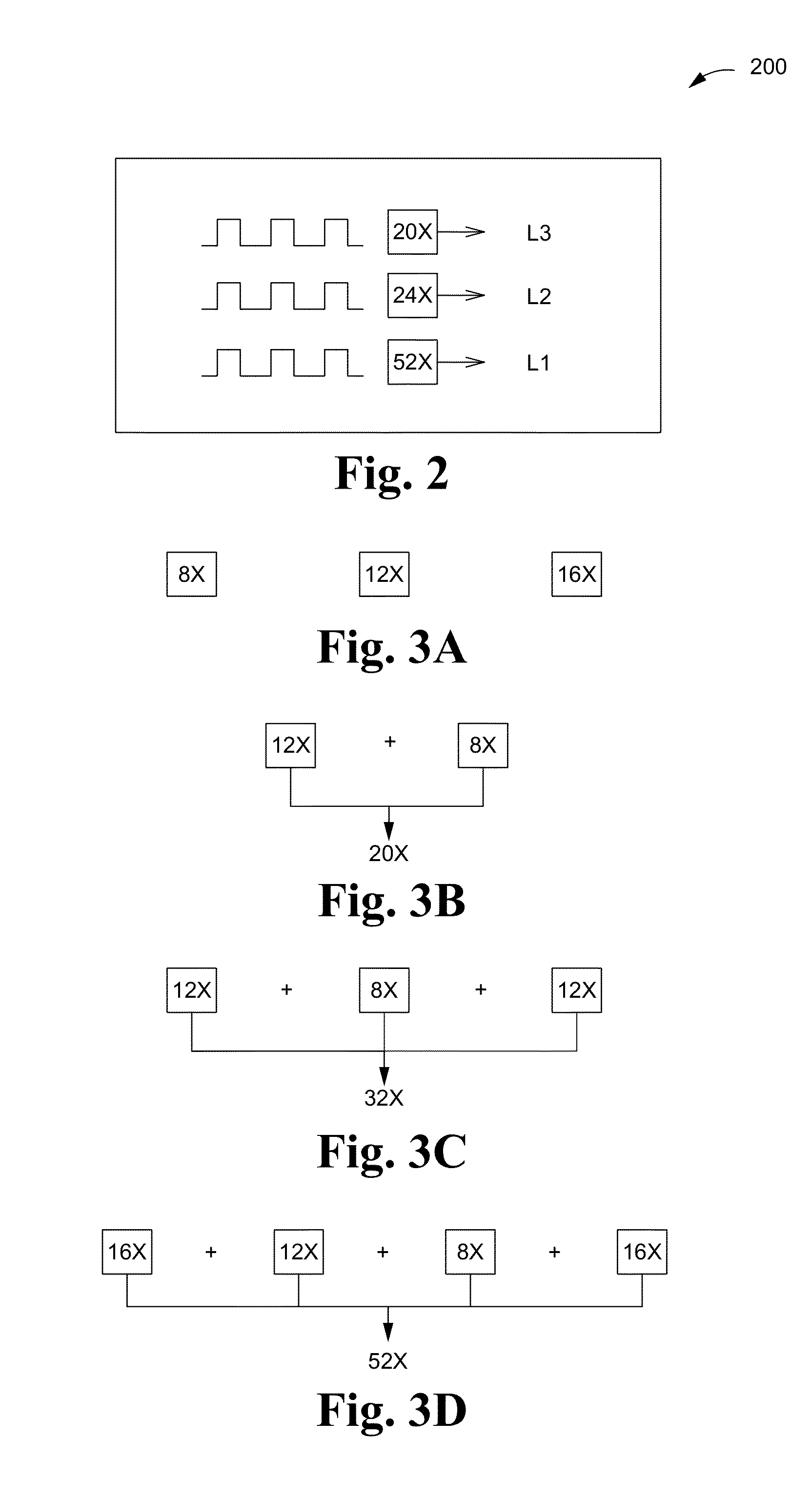
[0024]As one example, during the electronic design automation, a drive strength for a clock-receiving component is determined. The system determines a combination of the custom-sized CMOS inverters, such that their combined drive strength is large enough to drive the sequential element yet small enough to minimize short-circ...

the structure of the environmentally friendly knitted fabric provided by the present invention; figure 2 Flow chart of the yarn wrapping machine for environmentally friendly knitted fabrics and storage devices; image 3 Is the parameter map of the yarn covering machine
Login to View More

PUM

No PUM Login to View More

Abstract

An electronic device fabrication tool uses only standard-size cells from a cell library to fabricate a clock distribution network on a semiconductor device, thereby reducing the cost of the fabrication process. Target clock drive strengths are determined to reduce skew along the clock-distribution network, and the standard size cells are combined to produce clock-driving components substantially equal to the target clock drive strengths. The cells are combined using VIA programming, by electrically coupling them by adding or removing vias connecting the cells. In hybrid tree-mesh clock distribution networks, VIA programming ensures that the binary tree portions of the network are not affected by the tuning. Preferably, the clock-driving elements are clock inverters or buffers, though other elements are able to be used to drive clock signals on the clock distribution network.

Description

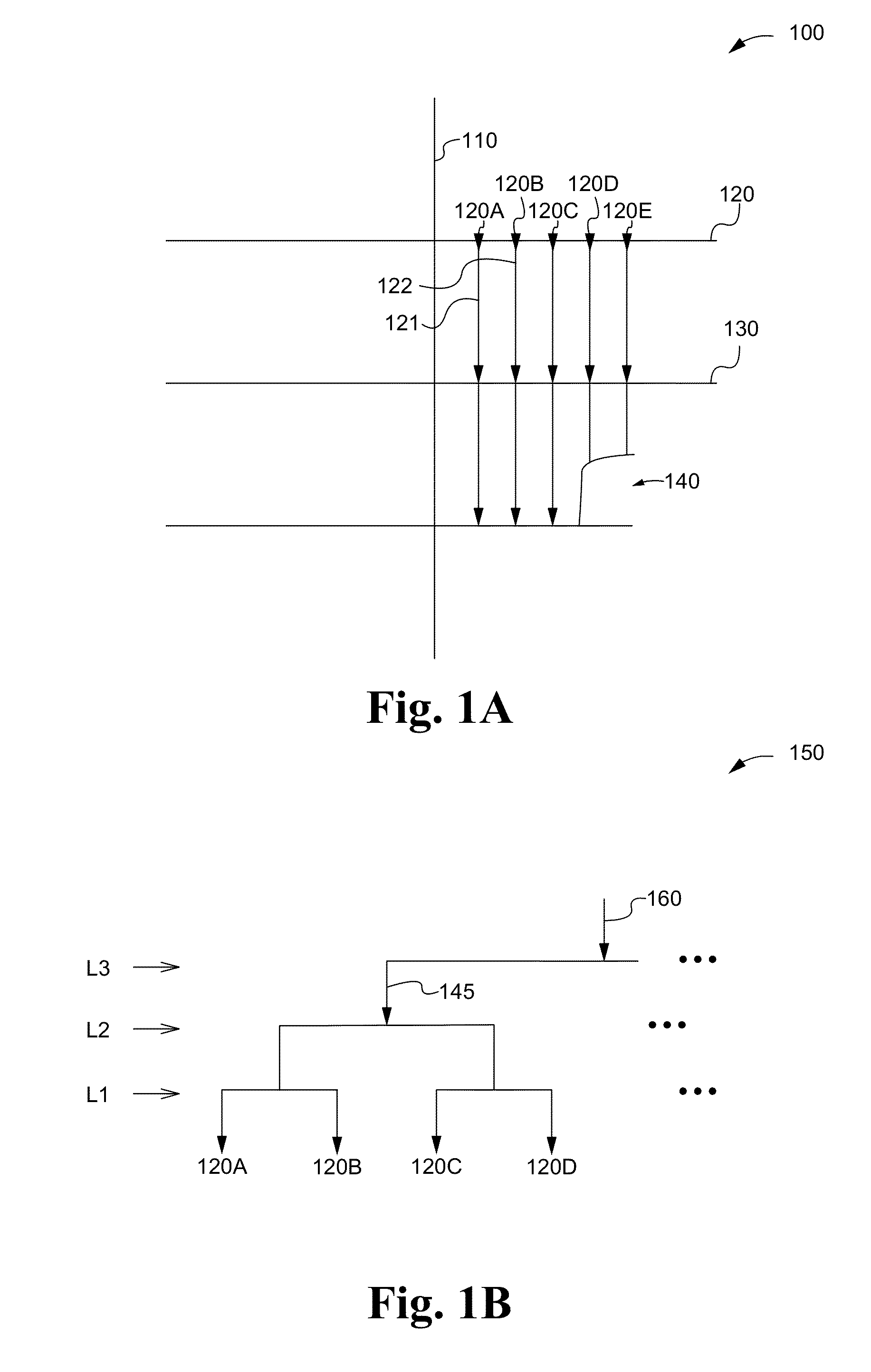
FIELD OF THE INVENTION[0001]This invention relates to integrated circuits. More particularly, this invention relates to clock distribution networks on semiconductor devices.BACKGROUND OF THE INVENTION[0002]For a semiconductor device to function properly, it must distribute clock signals to its parallel “sequential elements,” such as flip-flops, latches, and memory, at approximately the same time. When clock signals arrive at these parallel elements at different times, the resulting “clock skew” can cause a variety of problems, including setup and hold violations, which can jeopardize the integrity of data transmitted along the device.[0003]Large-scale semiconductor devices reduce skew by using clock distribution networks to distribute clock signals to the elements on the device. To ensure that the rise times and fall times of the clock signals meet design requirements, CMOS inverters or buffers are inserted at regular intervals. (Because inverters and buffers have similar functions ...

Claims

the structure of the environmentally friendly knitted fabric provided by the present invention; figure 2 Flow chart of the yarn wrapping machine for environmentally friendly knitted fabrics and storage devices; image 3 Is the parameter map of the yarn covering machine
Login to View More

Application Information

Patent Timeline
no application Login to View More
Patent Type & Authority Patents(United States)
IPC IPC(8): G06F17/00G06F17/50H03K5/15
CPCG06F17/505G06F17/5031G06F17/5081H03K5/15G06F2217/06G06F2217/08G06F2217/12G06F2217/62G06F2217/78G06F2217/84G06F2111/06G06F2111/04G06F30/3312G06F2119/18G06F30/398G06F30/396G06F30/327G06F30/394G06F2119/12G06F2119/06Y02P90/02
Inventor JAYAKUMAR, NIKHILTRIVEDI, VIVEKPALISETTI, VASANT K.MULA, BHAGAVATI R.AHLUWALIA, DAMANMOTAMEDI, AMIR H.
Owner MARVELL ASIA PTE LTD
Features
  • R&D
  • Intellectual Property
  • Life Sciences
  • Materials
  • Tech Scout
Why Patsnap Eureka
  • Unparalleled Data Quality
  • Higher Quality Content
  • 60% Fewer Hallucinations
Social media
Patsnap Eureka Blog
Learn More