
Cell size enlargers for polystyrene foams
a polystyrene foam and cell size technology, applied in the field of extruded foam products, can solve the problems of increasing the number of governments worldwide mandated the elimination of cfc, reducing the insulative value of foam, and potentially contributing to global warming potential, and achieves the effects of increasing the average cell size of foamed products, low global warming potential, and little or no ozone depletion potential
- Summary
- Abstract
- Description
- Claims
- Application Information
AI Technical Summary
Benefits of technology
Problems solved by technology
Method used
Image

Examples
example 1
Cell Size Enlarging Agent on Average Cell Size
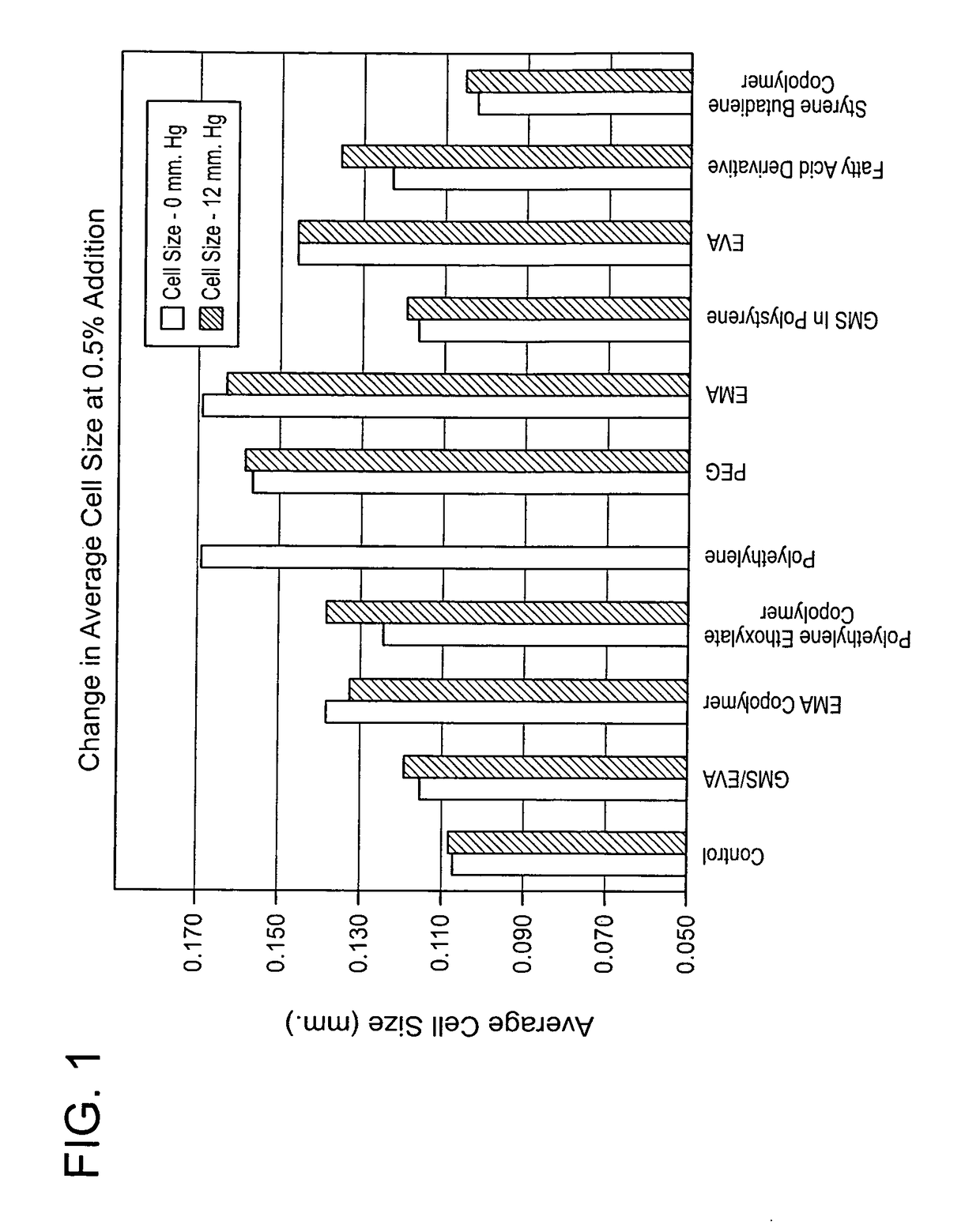
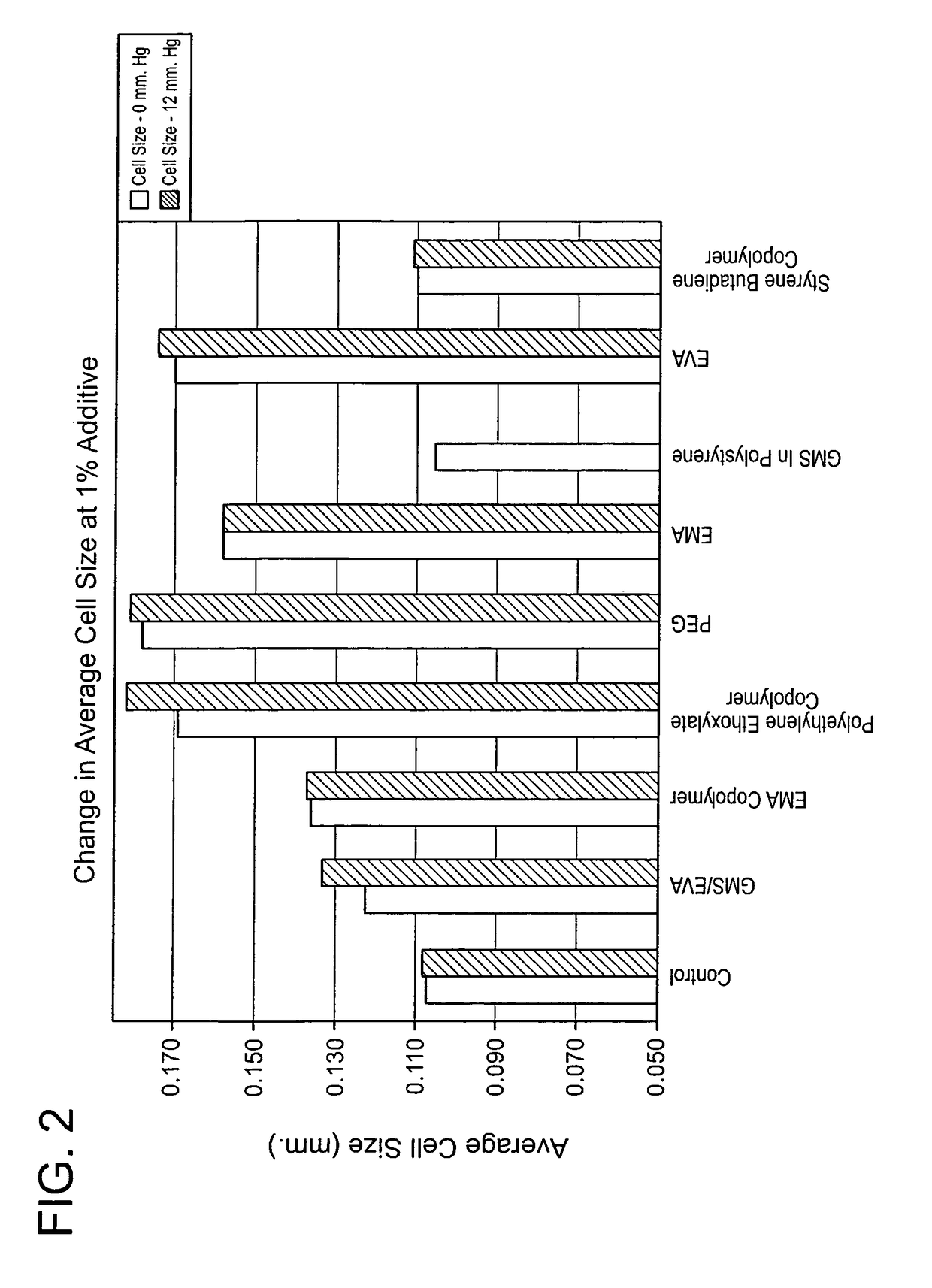
[0052]Compositions containing polystyrene, a non-ozone depleting blowing agent, and the cell size enlarging agents depicted in FIG. 1 were formed according to the method described in detail above. In particular, the polystyrene and cell size enlarging agent were heated to a temperature of 250° C. (i.e., above the melt temperature of the polystyrene) to form a melt polymer material. The desired blowing agent was then mixed into the melt polymer to form a foamable gel. The foamable gel was cooled to 110° C.-130° C. The foamable gel was then extruded through a die to a zone of reduced pressure to produce the foam. A similar method was used to form the compositions set forth in FIGS. 5 and 6, but with a 1.0% by weight addition of the cell size enlarging agent.
[0053]As shown in FIGS. 1 and 2, polyethylene ethoxylate copolymer, polyethylene glycol (PEG), ethylene vinyl acetate (EVA), and ethylene methyl acrylate (EMA) demonstrated the greatest...
example 2
Cell Size Enlarging Agents on Average Cell Size
[0055]In this Example, a glycerol monostearate / ethylene vinyl acetate mixture (GMS / EVA), a glycerol monostearate and polystyrene mixture, and ethylene vinyl acetate (EVA) were utilized as cell size enlarging agents in a foamable composition according to the present invention. The foamable composition containing the desired cell size enlarging agent were run at two different concentrations, namely, 0.5% and 1.0% by weight cell size enlarging agent. In addition, the foamable compositions were run under two atmospheric conditions, specifically, at no vacuum and at 12 mm Hg. The results of the testing are illustrated in FIG. 7 and in Tables 1-4. As shown in FIG. 7, the results indicated a slight increase in cell size at a 0.5% by weight addition of the glycerol monostearate / ethylene vinyl acetate mixture (GMS / EVA) and a moderate increase in cell size with the glycerol monostearate and polystyrene mixture (e.g., approximately 7-8% increase i...
PUM
| Property | Measurement | Unit |
|---|---|---|
| density | aaaaa | aaaaa |
| weight percent | aaaaa | aaaaa |
| weight percent | aaaaa | aaaaa |
Abstract
Description
Claims
Application Information
 Login to View More