Unlock instant, AI-driven research and patent intelligence for your innovation.

Quadrature spatial modulation system

a spatial modulation and quadrilateral technology, applied in the field of quadrilateral spatial modulation system, can solve the problems of linear increase, increase in signal processing complexity, and requirement of inter-antenna synchronization, so as to improve the overall performance of space modulation techniques, increase the overall system complexity, and degrade system performance

Active Publication Date: 2017-11-07
SENSOR NETWORKS & CELLULAR SYST RES CENT
View PDF6 Cites 21 Cited by
  • Summary
  • Abstract
  • Description
  • Claims
  • Application Information

AI Technical Summary

Benefits of technology

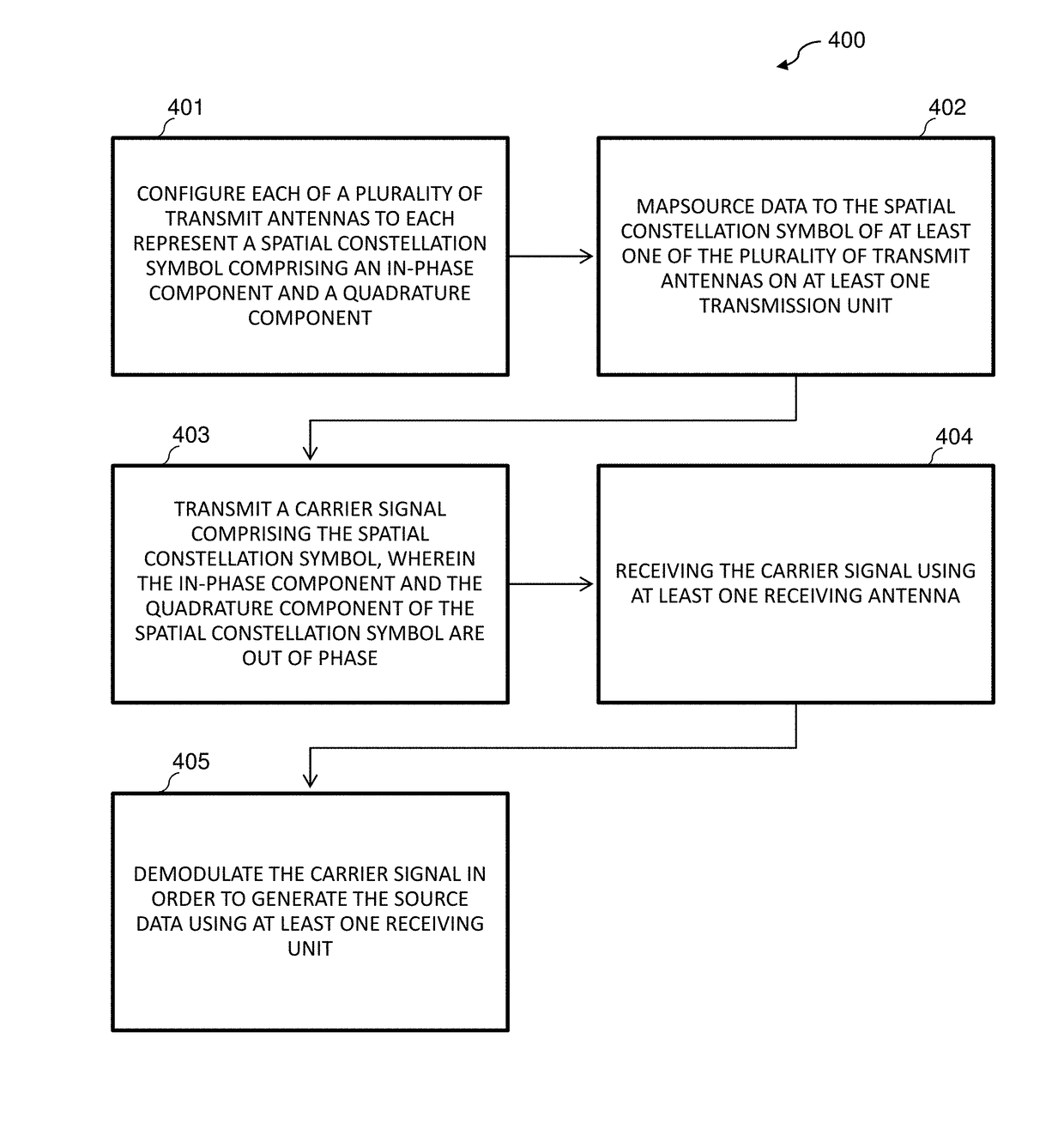
The present invention introduces a system and process to enhance space modulation techniques by using both in-phase and quadrature dimensions of the spatial modulation constellation. This results in a higher transmission data rate without inflicting interference or increasing complexity of the system.

Problems solved by technology

Accordingly, one of the drawbacks of conventional MIMOs includes inter-channel interference, which is introduced by coupling multiple symbols in time and space, which increases signal processing complexity.
A second drawback is the requirement of inter-antenna synchronization, as detection algorithms require that all symbols are transmitted at the same time.
A third drawback is the added energy consumption, which increases linearly along with the number of active antennas required.
Accordingly, space modulation techniques involve the use of one (or few) active RF chains, and thus fewer active antennas, which alleviates problems such as unnecessary complexity, inter-channel interference, the necessity of synchronization, and increased power consumption.
Despite these advantages, one of the major criticisms of space modulation techniques is that the data rate enhancement is limited to the base-two logarithm of the number of transmit antennas available.

Method used

the structure of the environmentally friendly knitted fabric provided by the present invention; figure 2 Flow chart of the yarn wrapping machine for environmentally friendly knitted fabrics and storage devices; image 3 Is the parameter map of the yarn covering machine
View more

Image

Smart Image Click on the blue labels to locate them in the text.
Viewing Examples
Smart Image
  • Quadrature spatial modulation system
  • Quadrature spatial modulation system
  • Quadrature spatial modulation system

Examples

Experimental program
Comparison scheme
Effect test

Embodiment Construction

[0024]As shown in the accompanying drawings, the present invention is generally directed to a system and method for increasing spectral efficiency in MIMO wireless networks by utilizing both in-phase and quadrature components of each transmitting antenna's constellation symbols. However, before discussing the invention in detail, some background on MIMO wireless networks and space modulation techniques is helpful.

[0025]1. Overview

[0026]MIMO technique is one of the most important contributions to the progress in wireless communications in recent years. As such, it has been considered in many recent standards such as 3rd Generation Partnership Project, Wireless World Initiative New Radio, Long Term Evolution, 802.11n, 802.11ac, and other standards. The aim of MIMO techniques is to improve power efficiency by maximizing spatial diversity (as in space-time coding), or to boost the data rate by transmitting independent streams from each transmit antenna, for example in V-BLAST (vertical ...

the structure of the environmentally friendly knitted fabric provided by the present invention; figure 2 Flow chart of the yarn wrapping machine for environmentally friendly knitted fabrics and storage devices; image 3 Is the parameter map of the yarn covering machine
Login to View More

PUM

No PUM Login to View More

Abstract

The invention is directed to systems and methods for quadrature spatial modulation in the transmission of over a wireless network. A plurality of transmit antennas are configured in a spaced apart configuration, with each antenna representative of a spatial constellation symbol comprising an in-phase component and a quadrature component. A transmission unit is configured to map source data to the spatial constellation symbol of the transmit antennas, and to transmit a carrier signal comprising the in-phase and quadrature components out of phase. At least one receiving antenna is configured to receive the carrier signal, and at least one receiving unit is configured to demodulate the carrier signal to generate the source data.

Description

CLAIM OF PRIORITY[0001]This application is a continuation application of U.S. patent application Ser. No. 14 / 141,004, filed on Dec. 26, 2013, which claims the benefit of U.S. Provisional Patent Application No. 61 / 897,894, filed Oct. 31, 2013, the contents of which are herein incorporated by reference.BACKGROUND OF THE INVENTIONField of the Invention[0002]The present invention generally relates to improved systems and methods for transmitting different streams of data in separate spatial dimensions in multiple-input and multiple-output (MIMO) wireless networks. Specifically, the present invention utilizes both in-phase and quadrature components in order to improve data transmission rates in various space modulation techniques. Further, some embodiments of the present invention may also use both the in-phase and quadrature components of space modulation in combination with certain signal modulation techniques in order to increase the overall spectral efficiency of network transmission...

Claims

the structure of the environmentally friendly knitted fabric provided by the present invention; figure 2 Flow chart of the yarn wrapping machine for environmentally friendly knitted fabrics and storage devices; image 3 Is the parameter map of the yarn covering machine
Login to View More

Application Information

Patent Timeline
no application Login to View More
IPC IPC(8): H04L27/34H04B7/06H04B7/0413
CPCH04L27/34H04B7/0413H04B7/0613H04B7/0682H04B7/0697H04L1/00H04L1/0612H04L27/345
Inventor MESLELH, RAEDIKKI, SALAMAAGGOUNE, EL-HADI M.
Owner SENSOR NETWORKS & CELLULAR SYST RES CENT