

On-the-spot sample quick analysis method for major elements and trace elements in monocrystal high-temperature master alloy
A high-temperature master alloy and trace element technology, which is applied in the field of chemical analysis, can solve the problems of harsh service conditions of single crystal superalloys, achieve the effect of reducing smelting time, reducing burning loss and energy consumption, and improving the level of purity
Patent Information
- Authority / Receiving Office
- CN · China
- Patent Type
- Applications(China)
- Current Assignee / Owner
- Publication Date
- 2018-05-18
- Estimated Expiration
- Not applicable · inactive patent
Smart Images
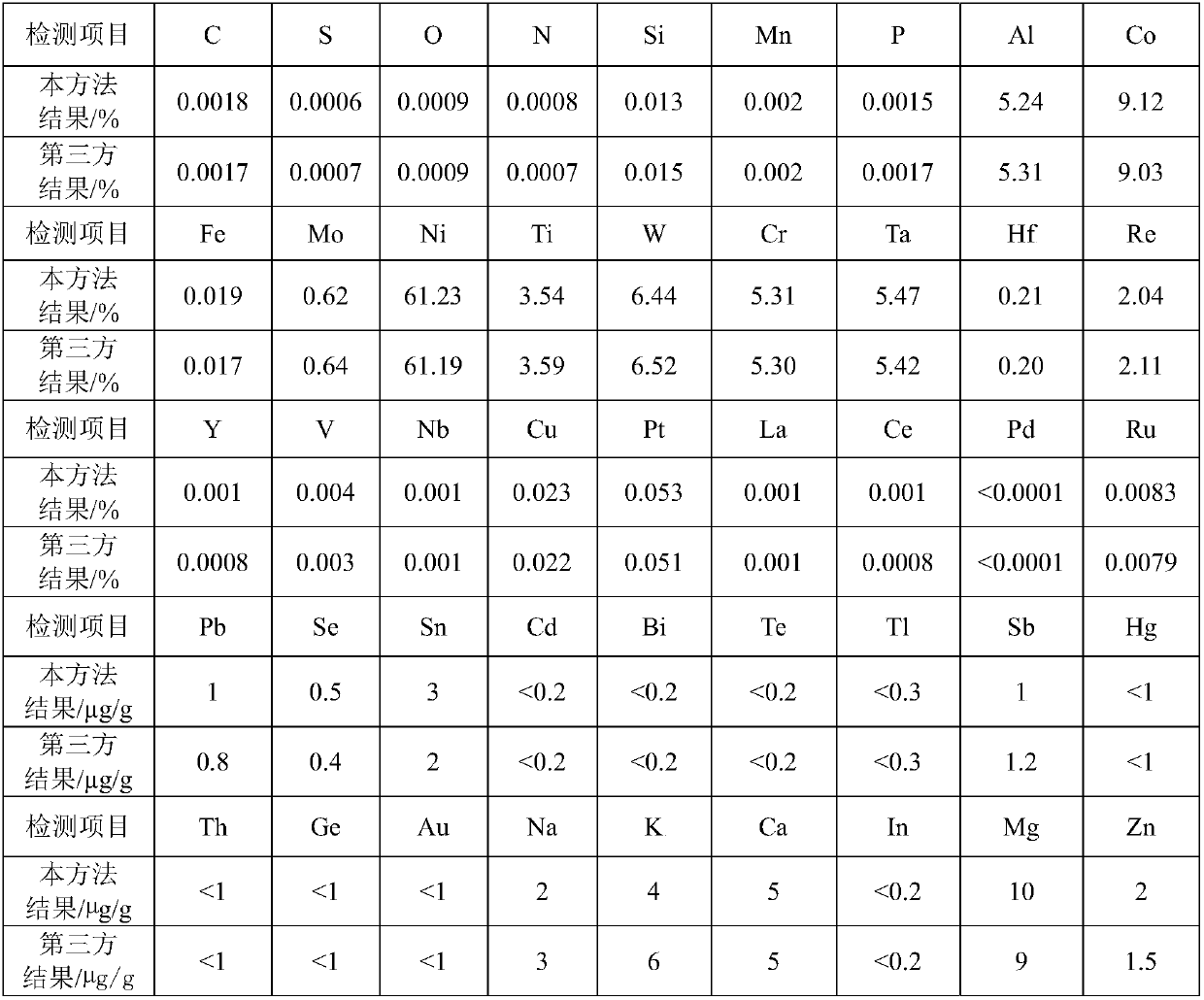
Figure 1 
Figure 2
Abstract
Description
technical field
[0001] The invention relates to a rapid analysis method for main and trace elements in a single crystal high-temperature master alloy before a furnace, and belongs to the technical field of chemical analysis. Background technique
[0002] Single crystal superalloys have excellent comprehensive properties such as creep resistance, fatigue resistance, oxidation resistance and corrosion resistance, and are widely used in aero-engines, rocket engines and industrial gas turbines that are subjected to high stress under high-temperature thermal corrosion conditions and are used for a long time in the hot end blade assembly. The formed single crystal superalloy first needs to add nickel, chromium, molybdenum, tantalum, titanium, aluminum, niobium, hafnium, zirconium, rhenium, carbon, tungsten, cobalt, boron and other major pure elements into the high-frequency vacuum induction furnace The material is melted and smelted and cast into a single crystal high-temperature...
Examples
Embodiment 1
[0025] Take the detection of smelting LD-X-4 single crystal nickel-based high-temperature master alloy as an example:
[0026] (1) Sampling:
[0027] In a 2.5T vacuum induction furnace, a strong magnetic field is used to stir the single crystal nickel-based high-temperature master alloy melt to disperse the scum on the surface of the melt, and use a quartz sampling cup with an inner diameter of 30mm and a length of 50mm that is burned at a high temperature of 1100°C for more than 1h In the vacuum induction furnace, the single-crystal nickel-based high-temperature master alloy melt is taken by the secondary immersion method to ensure that there is no shrinkage cavity, porosity and cracks inside the sample, and the continuous effective length shall not be less than 25mm. After solidification, the flowing water is rapidly cooled. The sample is transported to the sample preparation room;
[0028] (2) Sample preparation:
[0029] Cut the first sample with a thickness of 10mm at t...
Embodiment 2
[0049] Take the detection of smelting Co-Al-W single crystal cobalt-based high-temperature master alloy as an example:
[0050] (1) Sampling:
[0051] Stir the single-crystal cobalt-based high-temperature master alloy melt with a strong magnetic field in a 1T vacuum induction furnace to disperse the scum on the surface of the melt. Use a brown corundum sampling cup with an inner diameter of 40mm and a length of 40mm that has been burned at 1000°C for more than 2 hours. In the vacuum induction furnace, the single crystal cobalt-based high-temperature master alloy melt is taken by the secondary immersion method to ensure that there is no shrinkage cavity, porosity and cracks inside the sample, and the continuous effective length shall not be less than 25mm. After solidification, the flowing water is rapidly cooled. The sample is transported to the sample preparation room;
[0052] (2) Sample preparation:
[0053] Cut the first sample with a thickness of 15mm at the end of the ...