
Preparation method of large-area molybdenum disulfide film
A molybdenum disulfide, large-area technology, applied in chemical instruments and methods, gaseous chemical plating, chemically reactive gases, etc., can solve the problems of difficult to achieve large-area growth, poor uniformity, etc., and achieve low cost and compactness. Excellent and controllable effect
Patent Information
- Authority / Receiving Office
- CN · China
- Patent Type
- Applications(China)
- Current Assignee / Owner
- Publication Date
- 2021-05-28
Smart Images
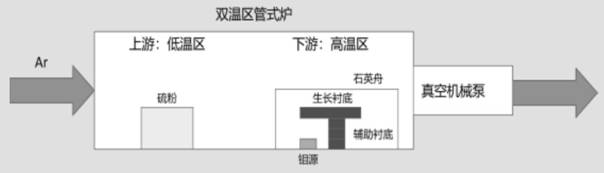
Figure 1
Abstract
Description
technical field
[0001] The invention belongs to the field of material preparation, and in particular relates to a method for preparing a large-area molybdenum disulfide thin film. Background technique
[0002] Two-dimensional materials are a kind of sheet-like materials with single / multi-atom thickness, which have excellent physical, chemical, optical, electronic, mechanical and other properties, and have great application prospects in many fields. Among them, graphene-like molybdenum disulfide has attracted extensive attention of researchers in many fields. MoS 2 The crystal mainly has two crystal systems of hexagonal crystal system and trigonal crystal system. Among them, the hexagonal crystal system is also called the 2H phase, which is also the most stable structure. It consists of two single-layer MoS 2 It is formed by periodic accumulation and belongs to the P63 / mmc space group. The trigonal crystal system has two phases: 1T (space group P3m1) and 3R phase (space gr...
Examples
Embodiment 1
[0028] First, the substrate is ultrasonically cleaned with acetone, isopropanol, and deionized water to remove surface impurities; then, the surface is blown dry with a nitrogen gun. Place the cleaned substrate in the sputtering area of the magnetron sputtering system, and place the high-purity molybdenum target (purity>99.99%) in the sputtering target position in the magnetron sputtering machine, at 1.0×10 -3 Under the vacuum degree of Pa, a constant current source is used for sputtering, and the sputtering rate is 0.18nm / s. The obtained substrate containing the metal molybdenum source was placed in a tube furnace, exposed to air and heated for full oxidation. The oxidation temperature was 250° C., and the treatment time was 120 minutes. Put the molybdenum oxide source substrate face up into the bottom of the quartz boat, stack 4 silicon wafers next to the substrate in the downstream position of the airflow as auxiliary substrates, and place the silicon wafer with a larger ...
Embodiment 2
[0030] First, the substrate is ultrasonically cleaned with acetone, isopropanol, and deionized water to remove surface impurities; then, the surface is blown dry with a nitrogen gun. Place the cleaned substrate in the sputtering area of the magnetron sputtering system, and place the high-purity molybdenum target (purity>99.99%) in the sputtering target position in the magnetron sputtering machine, at 1.0×10 -3 Under the vacuum degree of Pa, a constant current source is used for sputtering, and the sputtering rate is 0.18nm / s. The obtained substrate containing the metal molybdenum source was placed in a tube furnace, exposed to air and heated for full oxidation. The oxidation temperature was 250° C., and the treatment time was 120 minutes. Put the molybdenum oxide source substrate face up into the bottom of the quartz boat, stack 4 silicon wafers next to the substrate in the downstream position of the airflow as auxiliary substrates, and place the silicon wafer with a larger ...