
Methods of Determining pH and Calcium or Chloride Concentration in Samples
a technology of calcium or chloride and ph, which is applied in the field of methods of determining ph and calcium or chloride concentration in biological samples, can solve the problems of not yet identified mediators of lysosomal casup>2+/sup> import, and the difficulty of deconvolving how each of its multiples is handled, so as to achieve efficient and accurate determination of ph
Patent Information
- Authority / Receiving Office
- US · United States
- Patent Type
- Applications(United States)
- Current Assignee / Owner
- Publication Date
- 2022-01-13
Smart Images
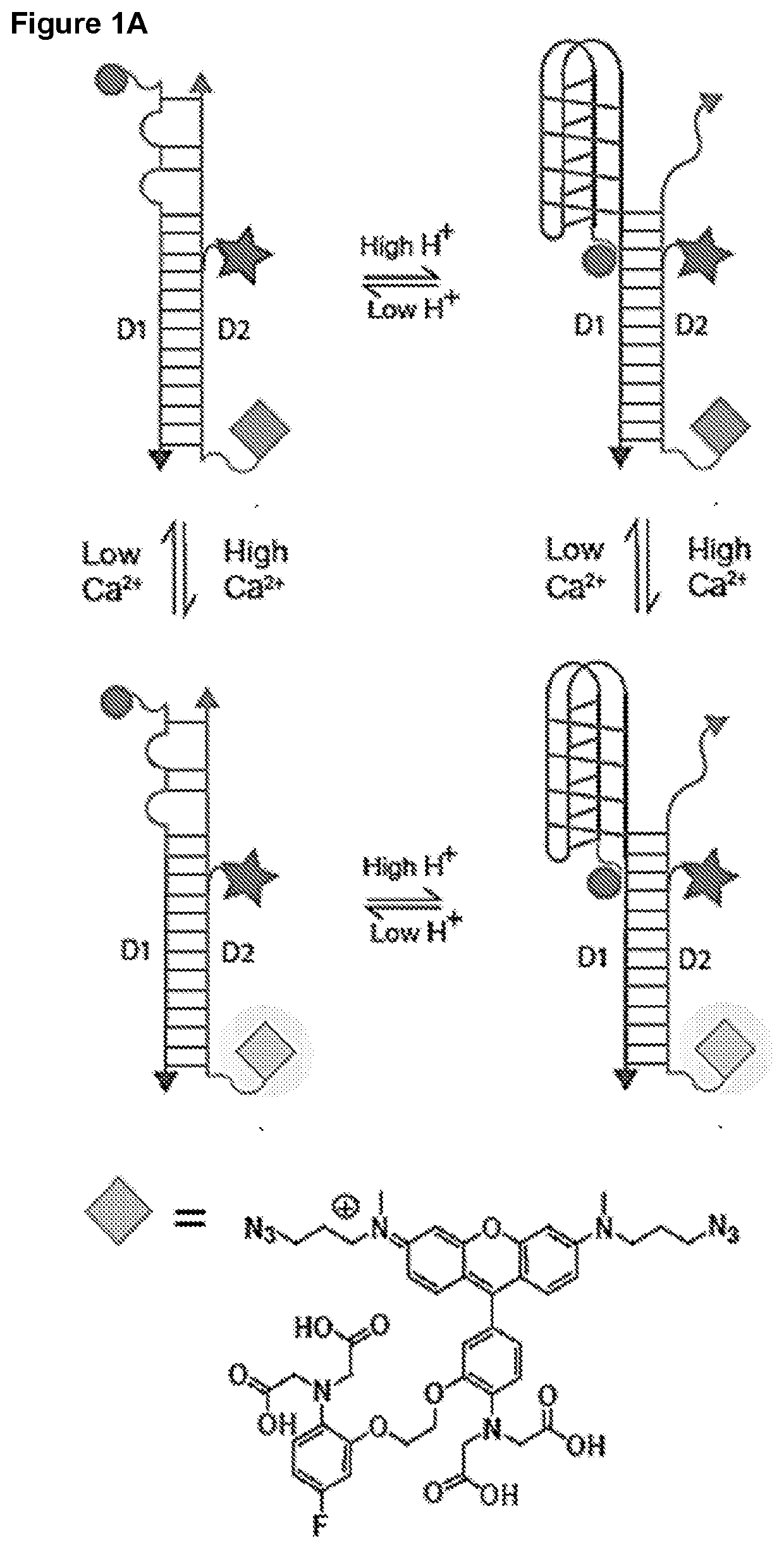
Figure 1 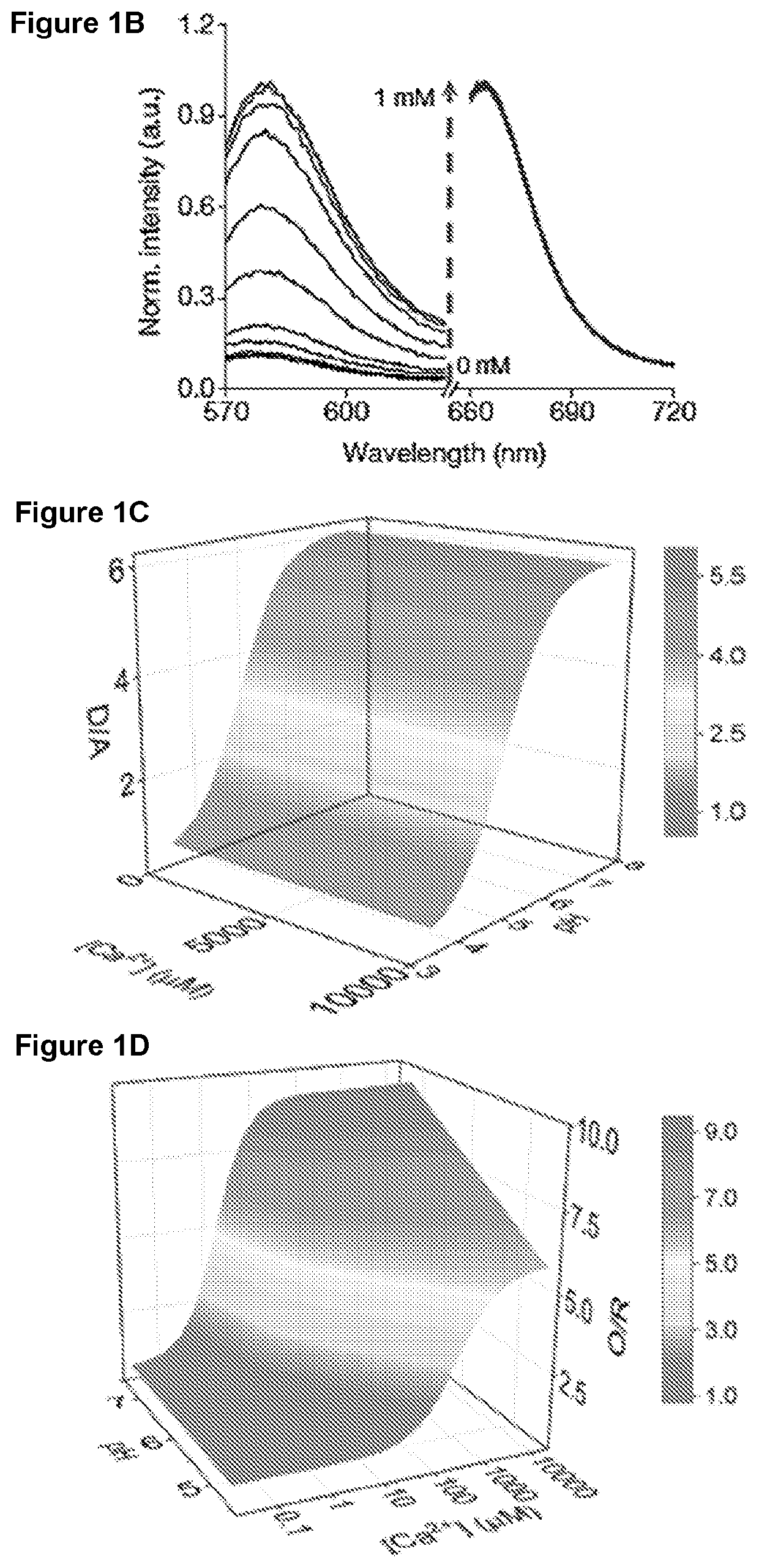
Figure 2 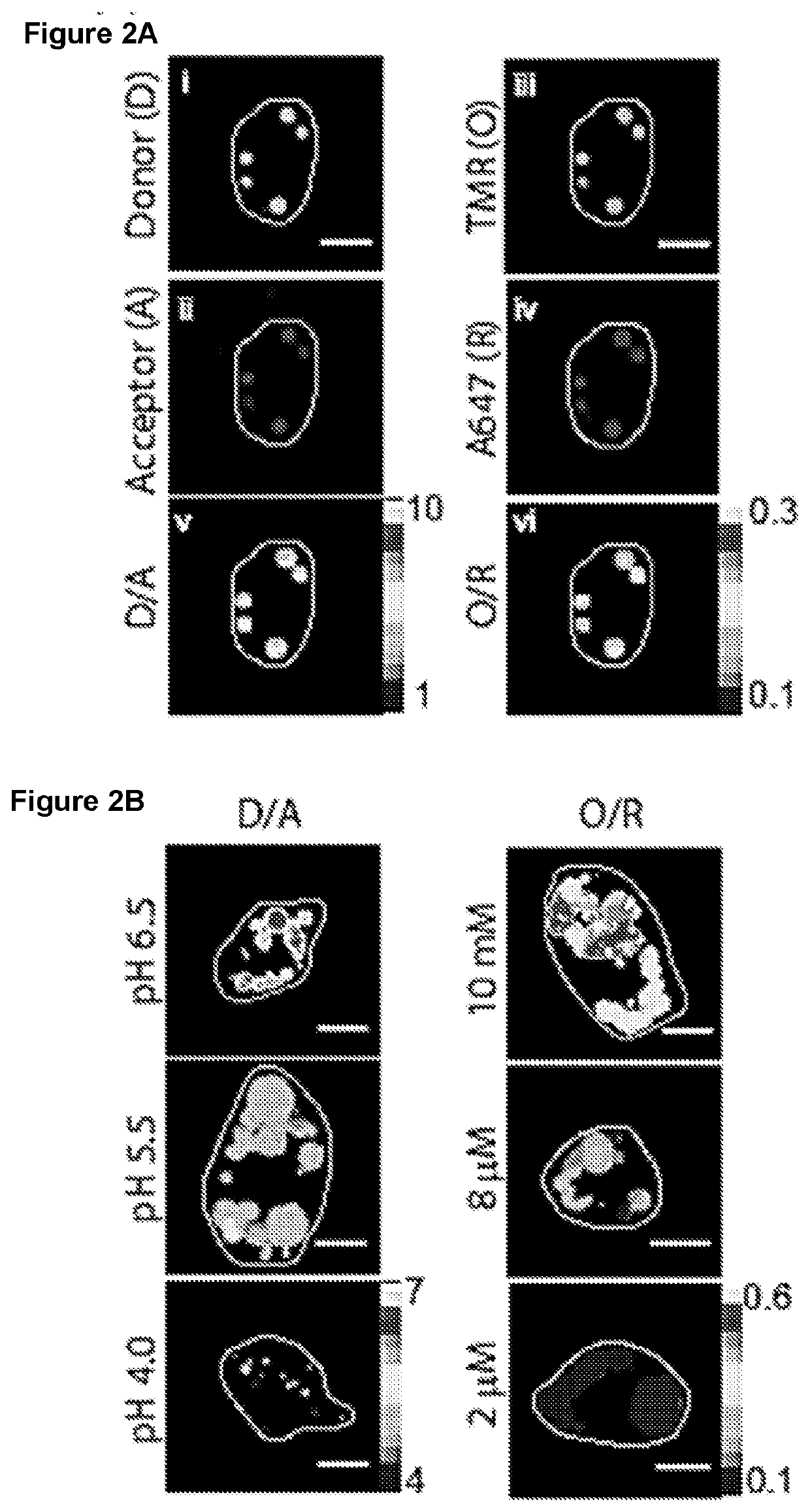
Figure 3
Abstract
Description
CROSS-REFERENCE TO RELATED APPLICATIONS
[0001] This application claims the benefit of priority of U.S. Provisional Patent Application No. 62 / 774,314, filed Dec. 2, 2018, all of which is incorporated by reference in its entirety.STATEMENT REGARDING FEDERALLY SPONSORED RESEARCH OR DEVELOPMENT
[0002] This invention was made with United States government support awarded by National Center for Advancing Translational Sciences (NCATS) of the National Institutes of Health (NIH) Grant No. 1UL1TR002389-01. The United States government has certain rights in this invention.BACKGROUND OF DISCLOSUREField of Disclosure
[0003] This disclosure relates to methods for determining pH and also calcium (Ca2+) concentration or chloride (Cl−) concentration in biological samples. More particularly, this disclosure relates to methods capable of simultaneously determining pH and Ca2+ concentration, or pH and Cl− concentration using nucleic acid complexes.Technical Background
[0004] Lysosomes are highly fusogenic org...
Examples
example 1
Preparation of Ca2+ Fluorophore
[0203]
[0204]BAPTA-5F aldehyde (1) was synthesized according to previous reported procedure (Grynkiewicz et al. (1985) J. Biol. Chem. 260:3440-3450; Collot et al. (2015) eLife 4:e05808). POCl3 (1.12 g, 7.3 mmol) was added to DMF (5 mL) at 0° C. and allowed to stir for 10 minutes. After 10 minutes, BAPTA-5F (1.6 g, 2.9 mmol) in DMF (3 mL) was added to above solution and heated to 65° C. After completion of the reaction, reaction mixture was poured in water and pH adjusted to 6.0 by adding aqueous. NaOH (1M) solution. Product was extracted with ethylacetate (3×50 mL) and solvent was evaporated. Crude product was purified by column chromatography on silica gel using hexane / EtOAc (70 / 30 to 60 / 40) as an eluent to obtain BAPTA-5F aldehyde (1) in 65% yield. 1H-NMR (500 MHz, CDCl3) appin 9.80 (s, 1H), 7.30-7.45 (m, 2H), 6.83 (t, 1H, J=7 Hz), 6.76 (d, 1H, J=8 Hz), 6.59 (t, 2H, J=8 Hz), 4.40 (t, 2H, J=7.0 Hz), 4.35 (t, 2H, J=7.5 Hz), 4.33 (s, 4H), 4.22 (s, 4H), 3...
example 2
Preparation of Crosslinking-Ready Ca2+ Fluorophore
[0206]
[0207]To a solution of 1-bromo-3-chloropropane (1 g, 6.4 mmol) in DMSO (8 mL), sodium azide (0.5 g, 7.7 mmol) was added and allowed to stir at room temperature for 12 hours. After completion of the reaction, the mixture was diluted with water and the product was extracted with hexane to obtain 1-azido-3-chloropropane. Sodium iodide (1.5 g, 10 mmol) was then added to a solution of 1-azido-3-chloropropane (1 g, 8.4 mmol) in acetone (25 mL) and allowed to stir at room temperature for 8 hours. After completion of the reaction, the solvent was evaporated under vacuum. The crude product was diluted with a saturated solution of Na2S2O3 to quench the unreacted iodine followed by extraction of the compound with ethyl acetate (3×50 mL). This was dried over Na2SO4 and the product 1-azido-3-iodopropane was used for further reactions without purification.
[0208]To a solution of 3-aminophenol (1 g, 9.2 mmol) in acetone (30 mL), potassium carb...
example 3
Preparation of Ca2+ Fluorophore Conjugate
[0212]Rhod-5F-N3 (25 μM) was added to 5 μM of dibenzocyclooctyne (DBCO) labelled single-stranded nucleic acid molecule in 100 μL of sodium phosphate (10 mM) buffer containing KCl (100 mM) at pH 7.0 and allowed to stir overnight at room temperature. After completion of the reaction, 10 μL of 3 M sodium acetate (pH 5.5) and 250 μL of ethanol were added to reaction mixture and kept overnight at −20° C. for DNA precipitation. Then, the reaction mixture was centrifuged at 14000 rpm at 4° C. for 20 minutes to remove the unreacted Rhod-5F-N3 and the precipitate was re-suspended in ethanol and centrifuged. This procedure was repeated 3 times for complete removal of unreacted Rhod-5F-N3. Rhod-5F conjugation was confirmed by gel electrophoresis by running a native polyacrylamide gel containing 15% (19:1 acrylamide:bis-acrylaimde) in 1× TBE buffer (Tris HCl (100 mM), boric acid (89 mM), EDTA (2 mM), pH 8.3).