A method for improving radio Ad hoc performance based on layer-spanning collaborative mechanism

A wireless self-organization and cooperation mechanism technology, applied in network topology, wireless communication, data exchange network, etc., can solve the problems of packet loss due to competition, packet loss due to link competition, performance degradation, etc., to improve data transmission efficiency and network throughput The effect of increasing the amount and improving the transmission performance

CN101146033AInactive Publication Date: 2008-03-19CHONGQING UNIV OF POSTS & TELECOMM
0 Cites 17 Cited by

Patent Information

Authority / Receiving Office
CN · China
Patent Type
Applications(China)
Current Assignee / Owner
Publication Date
2008-03-19
Estimated Expiration
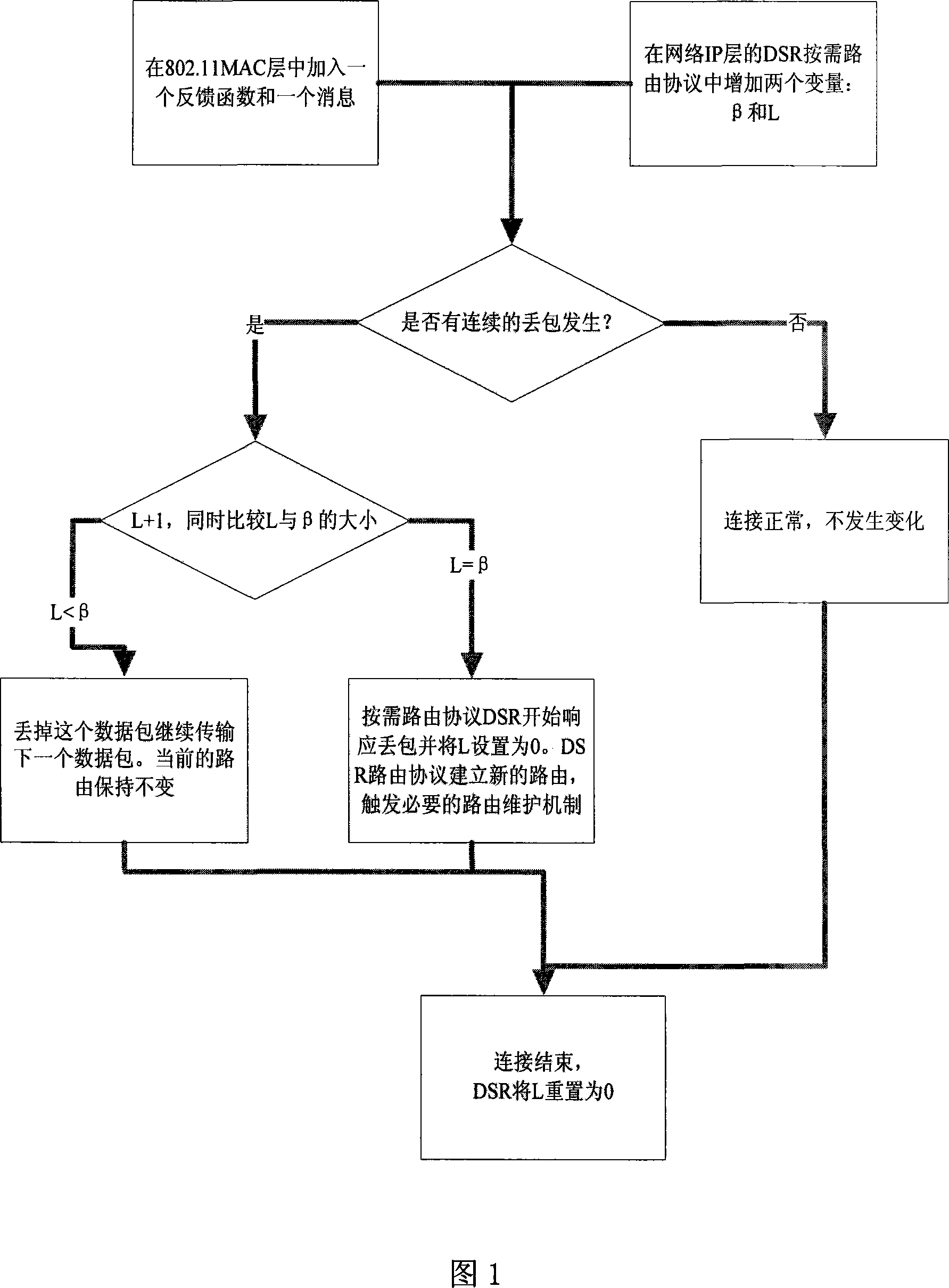
Not applicable · inactive patent

Smart Images

  • Figure 1
    Figure 1
  • Figure 2
    Figure 2
Patent Text Reader

Abstract

A method for improving wireless self-organized network performance is provided by utilizing the VDSR++ cross-layer optimized technology, relating to the wireless communication technology. The method combines with a cross layer optimized protocol VDSR++ optimization strategy of a MAC layer, a network layer and a transmission layer, exerts a cross-layer mechanism DSR++ on a 802.11MAC layer and an IP layer, solves the problem of route discovery and rebuilding caused by network congestion in the wireless self-organized network; the transmission layer adopts a TCP Veno protocol to solve the problem of route discovery and rebuilding caused by high error rate in the wireless self-organized network. The utility model can improve the TCP performance in the wireless self-organized network. The method is applicable to a static wireless self-organized network SANET and a dynamic wireless self-organized network MANET.
Need to check novelty before this filing date? Find Prior Art

Description

technical field

[0001] The invention relates to the technical field of wireless communication, in particular to a technology for improving the performance of a wireless ad hoc network. Background technique

[0002] In wireless ad hoc networks, on-demand routing protocols (such as: DSR and AODV, etc.) are the most widely used and most commonly used routing protocols. The on-demand routing protocol is established in accordance with the requirements of the connection during the establishment of the connection. The on-demand routing protocol judges whether it needs to maintain and rebuild the route by detecting the packet loss at the MAC layer; that is, once the routing protocol discovers the packet loss at the MAC layer, it will trigger the discovery and reconstruction of the route. On-demand routing protocols in wireless ad hoc networks are highly sensitive to packet loss at the 802.11MAC layer. Through a large number of experiments, we found that once the packet loss of the...

Examples

Embodiment Construction

[0012] In the wireless ad hoc network, in the TCP connection using the on-demand routing protocol DSR, once the on-demand routing protocol finds that the packet loss at the MAC layer will immediately trigger the route creation mechanism (that is, too sensitive to packet loss); due to network congestion Packet loss and the high bit error rate of the channel cause unnecessary route reconstruction in the DSR routing protocol, which is too sensitive to packet loss at the MAC layer. This will greatly waste network resources (a large part of network resources are used for unnecessary route maintenance and reconstruction), resulting in a decline in the performance of the TCP network.

[0013] In order to reduce the sensitivity of the DSR routing protocol to packet loss at the MAC layer, thereby reducing the times of route discovery and reconstruction. The present invention utilizes a cross-layer mechanism DSRwithDAMPENpolicy (abbreviated as DSR++) protocol and interlayer cooperation ...