
Mould for cold forging and manufacture method thereof
A mold and cold forging technology, which is applied in the field of cold forging molds and its manufacturing, can solve the problems of wear suppression effect and insufficient, and achieve the effect of good holding force, reduced friction, and not easy to wear
- Summary
- Abstract
- Description
- Claims
- Application Information
AI Technical Summary
Problems solved by technology
Method used
Image

Examples
Embodiment
[0070] Hereinafter, examples and comparative examples of the present invention will be described.
[0071] (Manufacturing of punches and dies)
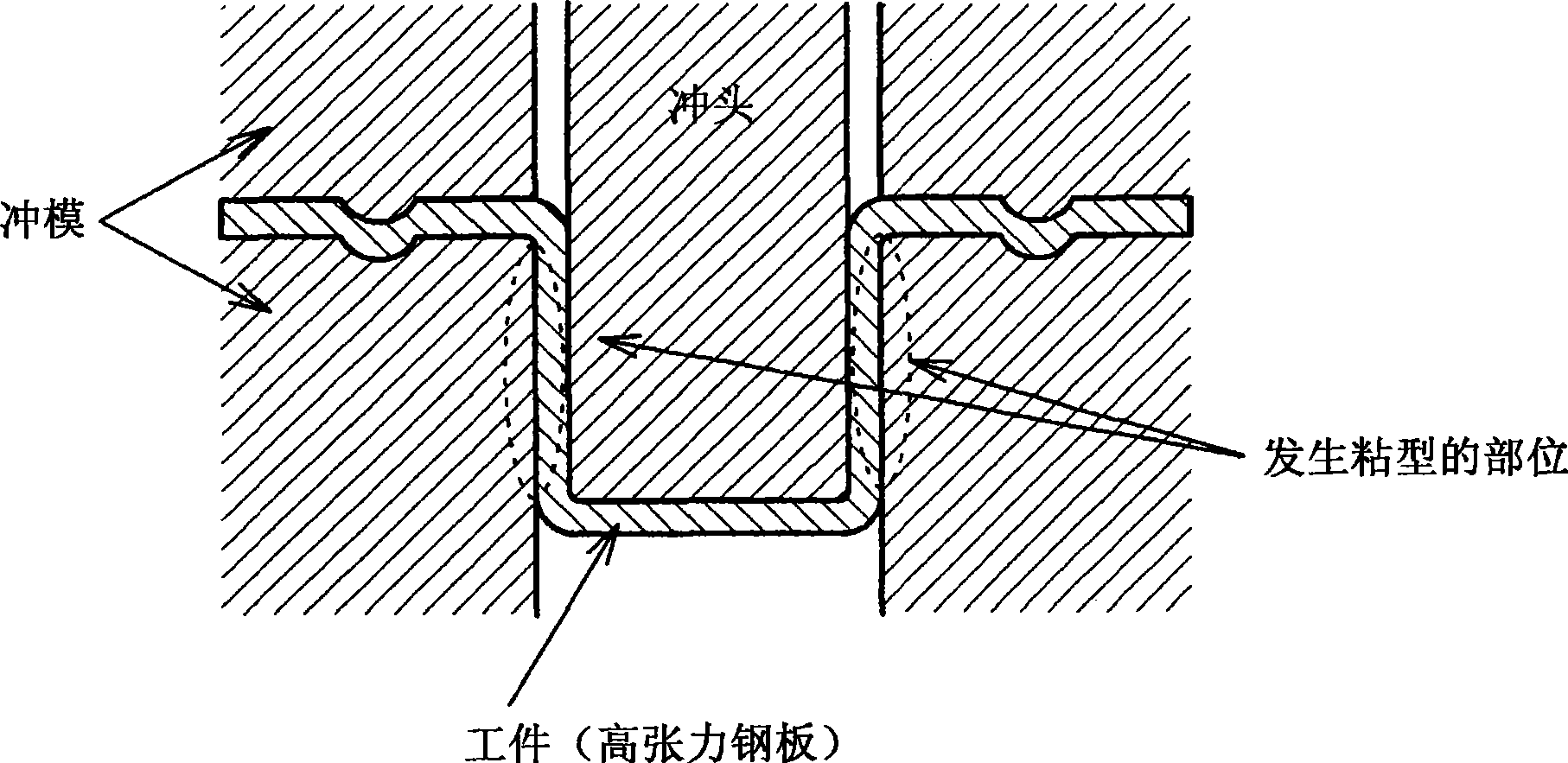
[0072] For Examples 1 to 18 and Comparative Examples 1 to 5, the JISSKD11 of 59HRC is processed and prepared figure 2 The punch and die shown.
[0073] Subsequently, to the base surface of the stamping die of embodiment 1,4,6,9~11,13,16,17,18 and comparative example 2~4 ( figure 2 The part indicated by the dotted line in the middle), respectively, the plasma nitriding treatment with the overall thickness of the hardened layer being 0.05mm.
[0074] Then, to the die surface of embodiment 1~18 and comparative example 2~5 ( figure 2 The part indicated by the dotted line in ) is projected by shot peening to form fine unevenness. At this time, for Examples 1 to 18 and Comparative Examples 3 to 5, shot peening was performed at a projection speed of 100 m / sec using steel shot peening media having a particle size of 100 μm or less. At...
PUM
| Property | Measurement | Unit |
|---|---|---|
| surface roughness | aaaaa | aaaaa |
| thickness | aaaaa | aaaaa |
| surface roughness | aaaaa | aaaaa |
Abstract
Description
Claims
Application Information
 Login to View More