Roller chain tensioning pliers

A roller chain tensioning technology, which is applied in the field of roller chain tensioners, can solve the problems of time-consuming adjustment of tensioning distance, time-consuming, labor-intensive, and time-consuming problems, so as to save the number and workload of maintenance personnel and reduce maintenance time , Improve the effect of equipment start-up rate

CN101920487AInactive Publication Date: 2010-12-22李解放
8 Cites 5 Cited by

Patent Information

Authority / Receiving Office
CN · China
Patent Type
Applications(China)
Current Assignee / Owner
Publication Date
2010-12-22
Estimated Expiration
Not applicable · inactive patent

Smart Images

  • Figure 1
    Figure 1
  • Figure 2
    Figure 2
  • Figure 3
    Figure 3
Patent Text Reader

Abstract

The invention relates to roller chain tensioning pliers, which comprise a fixed left half part, a movable right half part and a double-hole connecting block, wherein the left half part comprises a claw at the front end, a handle at the back end and a convex fork-shaped articulated part in the middle; and the movable right half part comprises a reversed L-shaped movable claw at the front end and a movable handle at the back side. The fixed left half part, the movable right half part and the double-hole connecting block form the tensioning pliers with a four-rod principle, can quickly tension a chain, and is suitable for installation and replacement of a heavy long chain and a flow production line with pressed requirement for maintenance time, thereby effectively reducing the maintenance time, improving the equipment operation rate, improving the comprehensive production efficiency, having the advantages of simple structure, reasonable design and good use effect, and being very favorable for popularization and implementation.
Need to check novelty before this filing date? Find Prior Art

Description

1. Technical field:

[0001] The invention relates to a special tool for tensioning a chain, in particular to a roller chain tightening pliers which can repair or replace the chain conveniently and effectively. 2. Background technology:

[0002] In industrial production lines, chain transmission is a commonly used transmission method, which has its unique transmission function. However, installing a long and heavy chain during use increases a lot of workload, and the chain after long-time use must be replaced due to factors such as wear and tear and pitch elongation. When installing or replacing the chain, it is necessary to pull the two separate ends of the chain together as much as possible, and keep the axle distance between the two joints of the chain just equal to the pitch of the chain, so that the chain clips of the chain can be installed smoothly, making the chain a Closed ring. However, due to the influence of the self-weight of the chain and other fixtures installe...

Examples

Embodiment 1

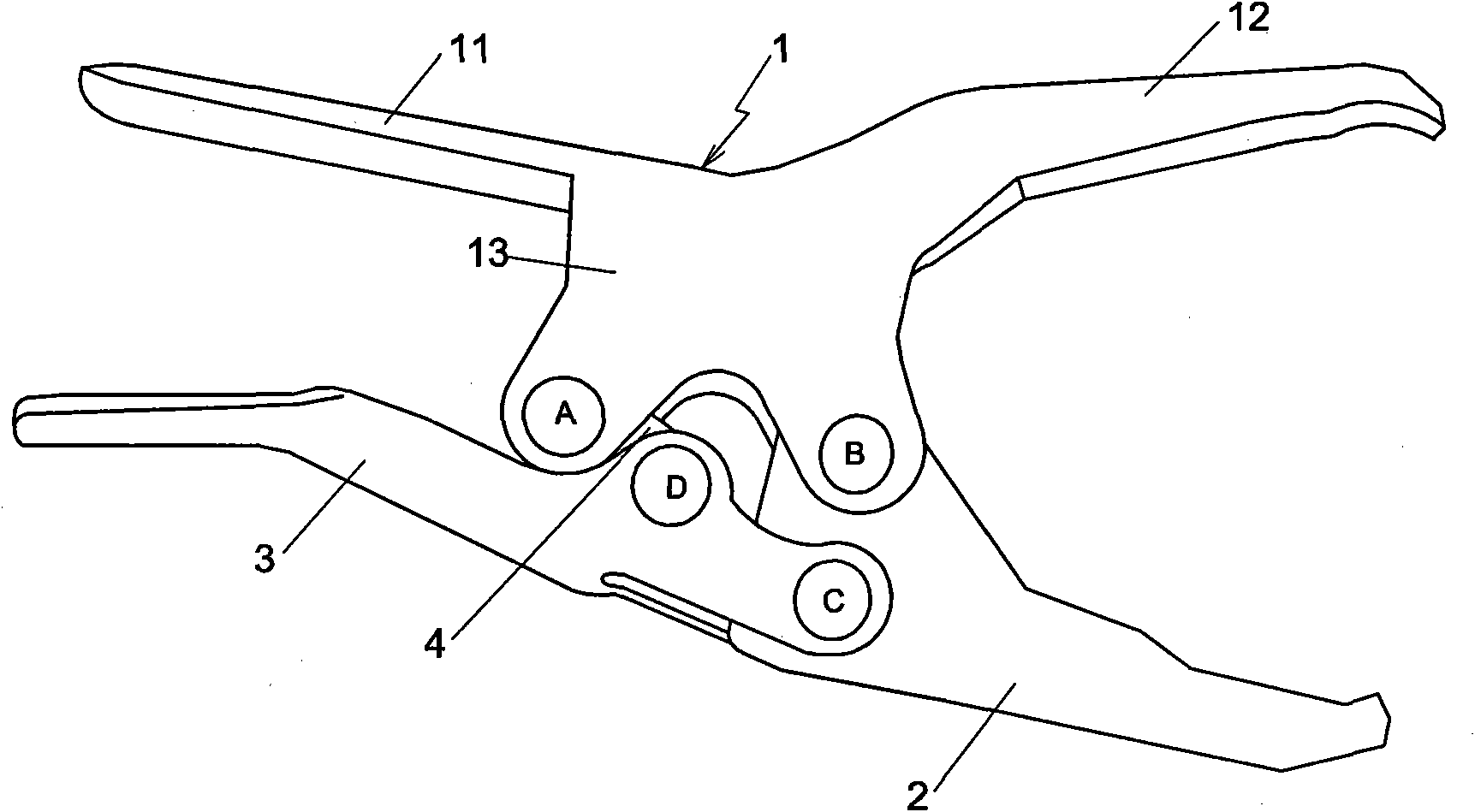
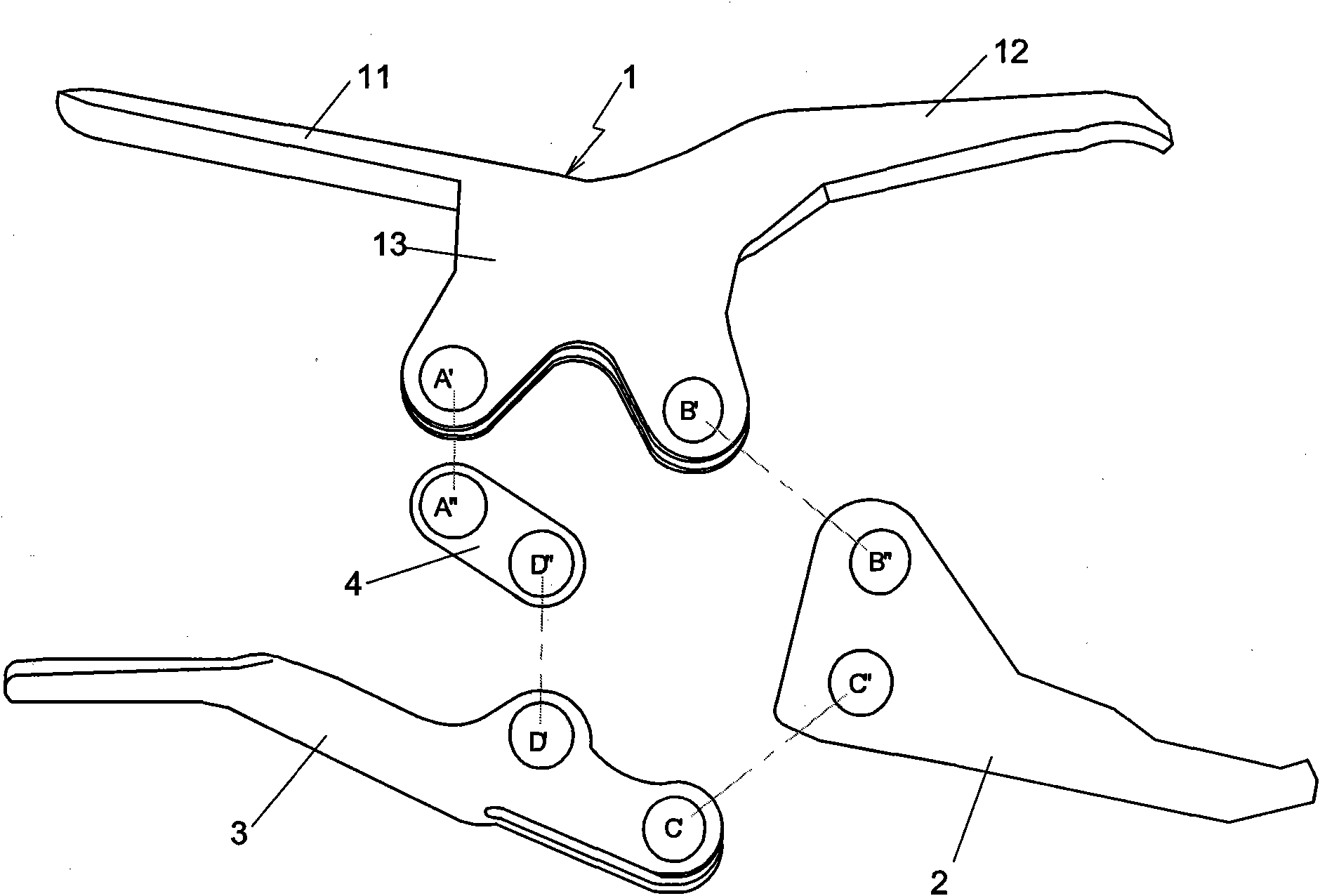
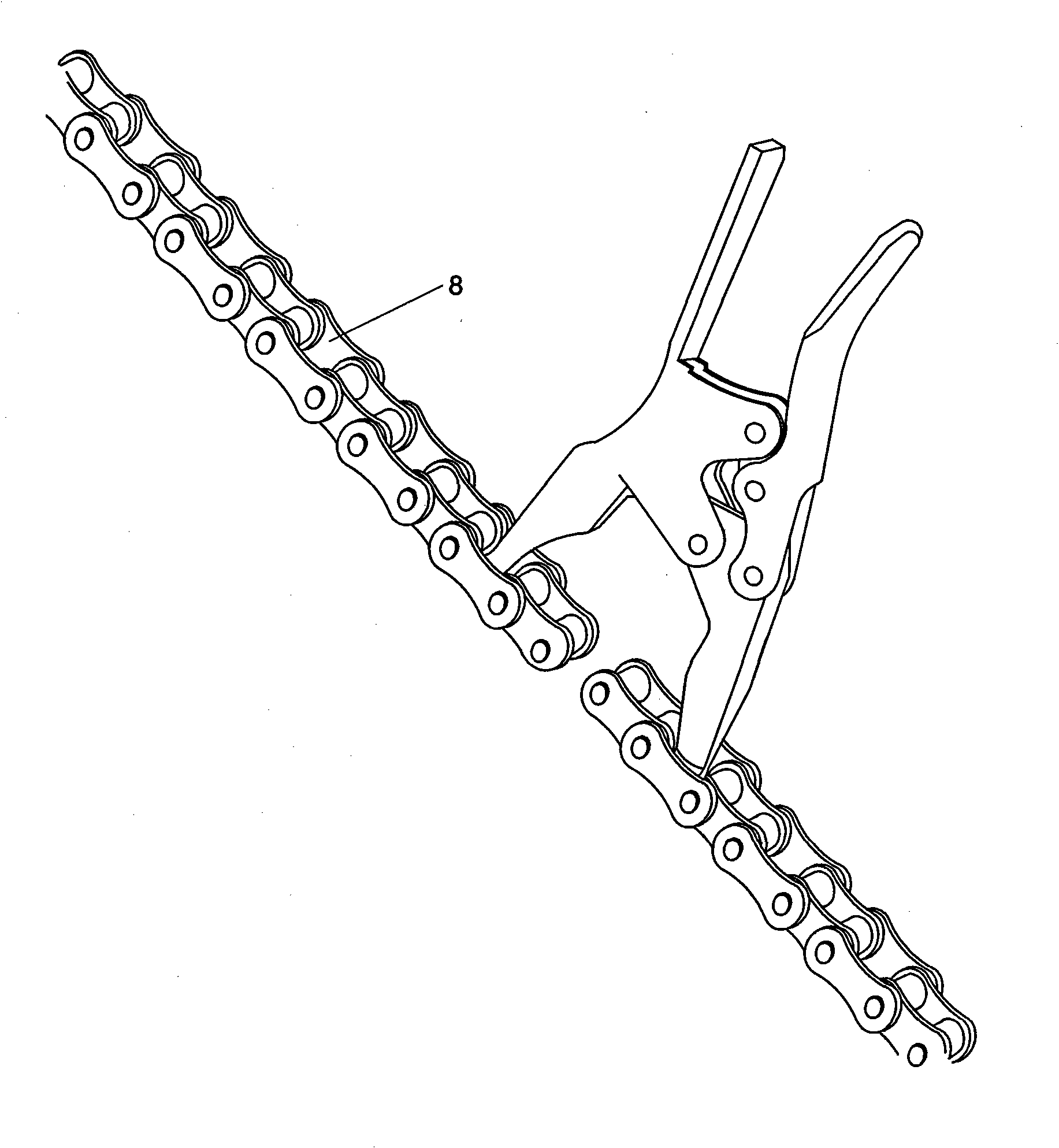
[0021] Embodiment one: see figure 1 , figure 2 , image 3 , Pic 4-1 —— Figure 4-4 , a roller chain tensioner, comprising a fixed left half tongs 1 and a movable right half tongs.

[0022] The fixed left half pliers 1 includes a claw 12 at the front end, a handle 11 at the rear end, and a protruding fork-shaped hinged part 13 in the middle. The front fork of the forked hinged part 13 is provided with a hinge hole B', a rear fork There is a hinge hole A' on it. Wherein the claw 12, the handle 11, and the fork-like hinged part 13 are integrally structured.

[0023] The movable right half pliers includes an anti-"L"-shaped movable claw 2 at the front end and a movable handle 3 at the rear side. A hinge hole B" near the left side and a hinge hole C" near the right side are provided at the rear end of the reverse "L"-shaped movable claw 2 . The front end of the movable handle 3 on the rear side is respectively provided with a hinged hole C' near the front side and a hinged...

Embodiment 2

[0027] Embodiment two: see Figure 5 , the content is basically the same as that of Embodiment 1, and the similarities will not be repeated. The difference is that a positioning claw head 5 is also hinged through a pin shaft 6 at the front end of the movable claw, and a claw is provided on the claw outside the claw head. The adjustable bolt 7 that is used to control the degree of rotation of the clamping head is arranged, so that it can adapt to the repairing use of more types of chains.