Method for predicting down link SINR (Signal-to-Interference and Noise Ratio) in wireless communication system, equipment and base station

A wireless communication system and downlink technology, applied in the field of downlink SINR prediction, equipment and base stations in wireless communication systems, can solve problems such as beamforming weight expiration and ineffectiveness

A wireless communication system and downlink technology, applied in the field of downlink SINR prediction, equipment and base stations in wireless communication systems, can solve problems such as beamforming weight expiration and ineffectiveness

CN102457321AActive Publication Date: 2012-05-16ALCATEL LUCENT SHANGHAI BELL CO LTD

Image

Smart Image Click on the blue labels to locate them in the text.
Viewing Examples
Smart Image
  • Method for predicting down link SINR (Signal-to-Interference and Noise Ratio) in wireless communication system, equipment and base station
  • Method for predicting down link SINR (Signal-to-Interference and Noise Ratio) in wireless communication system, equipment and base station
  • Method for predicting down link SINR (Signal-to-Interference and Noise Ratio) in wireless communication system, equipment and base station

Examples

Experimental program
Comparison scheme
Effect test

Embodiment Construction

[0023] Currently, in order to solve the problem of the accuracy of SRS channel estimation, the following two methods have been proposed:

[0024] Method 1) Layer 1 (physical layer) reports MSE of channel estimation (or SINR of SRS) to layer 2 (MAC layer, ie medium access control layer). Layer 2 compares the value of the reported MSE of the channel estimate with a threshold. If the reported MSE value is higher than the threshold, the transmission strategy of the corresponding UE is switched to TxDiv (Transmit Diversity).

[0025] Method 2) Increase SRS transmission density to reduce TD. For example, if the UE is in the beamforming transmission mode, the SRS transmission period of the UE is configured as 2ms, 5ms or 10ms. Once the SRS resource cannot meet the requirement, the transmission strategy of the corresponding UE is switched to TxDiv.

[0026] For method 1, it is difficult to set an appropriate threshold because the gain of beamforming not only depends on the MSE of c...

the structure of the environmentally friendly knitted fabric provided by the present invention; figure 2 Flow chart of the yarn wrapping machine for environmentally friendly knitted fabrics and storage devices; image 3 Is the parameter map of the yarn covering machine
Login to View More

PUM

No PUM Login to View More

Abstract

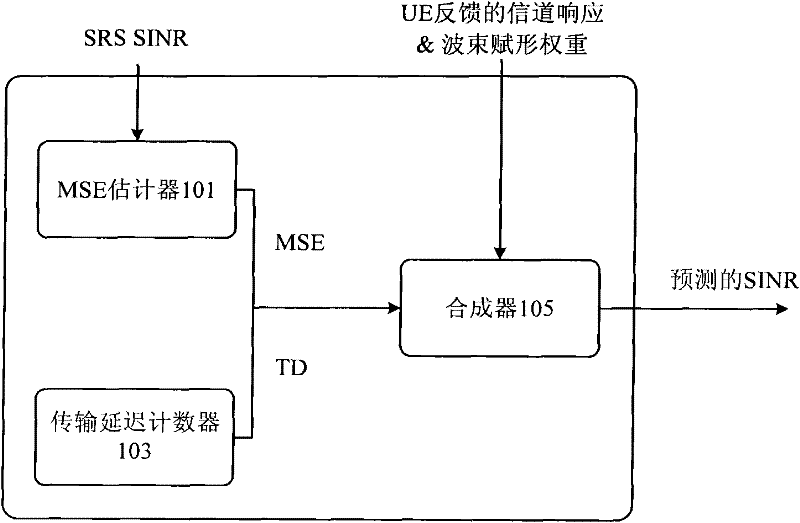
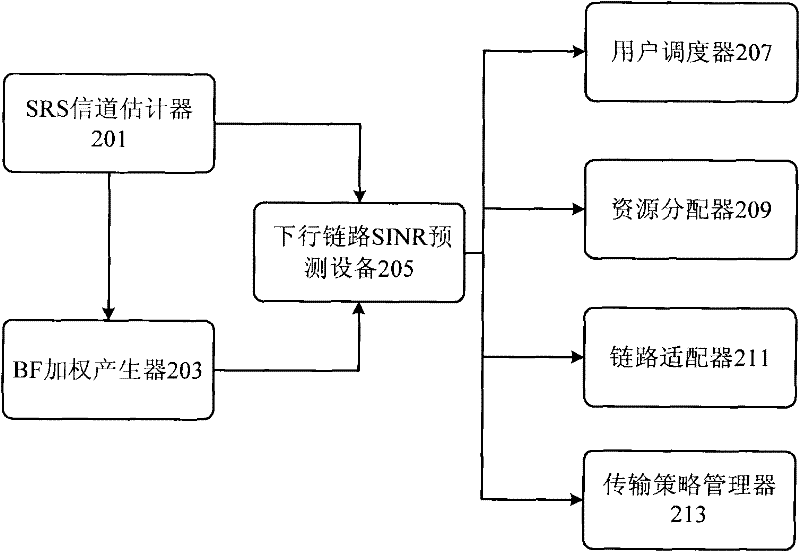
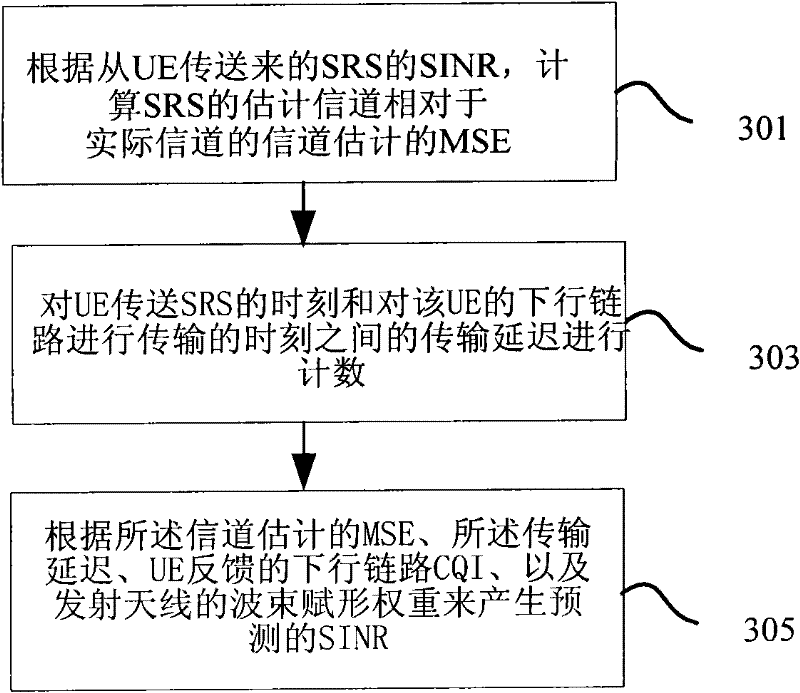
The invention provides a method for predicting down link SINR (Signal-to-Interference and Noise Ratio) in wireless communication system, equipment and base station. The equipment comprises an MSE (Mean-Square Error) estimator for computing an MSE of an estimated channel of an SRS (Sounding Reference Signal) relative to the channel estimation of an actual channel according to the SINR of the SRS transmitted by UE, and outputting the MSE estimated by the channel to a synthesizer, a transmission delay counter for counting transmission delay between the time for the UE to transmit the SRS and the time for transmitting the down link of the UE, and outputting the transmission delay to the synthesizer, and the synthesizer for generating a predicted SINR according to the MSE estimated by the channel and received by the MSE estimator, the transmission delay received by the transmission delay counter, and down link CQI (Channel Quality Indication) feed back by the UE, and wave beam forming weight of an transmission antenna.

Description

technical field [0001] The present invention relates to a downlink signal-to-interference-noise-ratio (SINR) prediction method and device and a base station in a multi-antenna wireless communication system using beamforming, capable of taking mean square error (MSE) and transmission delay (TD) into account ) to better predict the actual SINR for beamforming transmissions and provide higher system performance gains based on the predicted SINR. Background technique [0002] Beamforming is a very important technology in a multi-antenna communication system, such as an LTE TDD (Long Term Evolution-Time Division Duplex) communication system. This technology can improve system throughput and coverage area. The eNB (Base Station) generates beamforming weights based on the SRS (Sounding Reference Signal) transmitted from the UE (User Equipment), and then applies these weights to downlink transmissions when transmissions are scheduled for that UE. [0003] The beamforming weights n...

Claims

the structure of the environmentally friendly knitted fabric provided by the present invention; figure 2 Flow chart of the yarn wrapping machine for environmentally friendly knitted fabrics and storage devices; image 3 Is the parameter map of the yarn covering machine
Login to View More

Application Information

Patent Timeline
16 May 2012
Publication
CN102457321A
IPC
H04B7/06; H04B7/08; H04L25/02
Inventors
吕星哉; 王继康