Supercharge Your Innovation With Domain-Expert AI Agents!

A rapid method for evaluating the selectivity of iron catalysts to light olefins

A low-carbon olefin and iron catalyst technology, which is applied in the direction of chemical analysis using catalysis, can solve the problems of evaluation time not less than 10 hours and catalyst reaction evaluation time being too long, so as to improve evaluation efficiency and save time. Effect

Inactive Publication Date: 2015-12-02
ANHUI POLYTECHNIC UNIV
View PDF4 Cites 0 Cited by
  • Summary
  • Abstract
  • Description
  • Claims
  • Application Information

AI Technical Summary

Problems solved by technology

This method can improve the evaluation efficiency of the catalyst to a certain extent, but because the influence of the induction period must also be avoided, the evaluation time of each batch of samples loaded at the same time still cannot be less than 10 hours
[0004] In order to overcome the problem that the catalyst reaction evaluation time is too long due to the existence of the induction period in the prior art, the present invention provides a method that can quickly evaluate the selectivity of iron catalysts to low-carbon olefins

Method used

the structure of the environmentally friendly knitted fabric provided by the present invention; figure 2 Flow chart of the yarn wrapping machine for environmentally friendly knitted fabrics and storage devices; image 3 Is the parameter map of the yarn covering machine
View more

Image

Smart Image Click on the blue labels to locate them in the text.
Viewing Examples
Smart Image
  • A rapid method for evaluating the selectivity of iron catalysts to light olefins
  • A rapid method for evaluating the selectivity of iron catalysts to light olefins

Examples

Experimental program
Comparison scheme
Effect test

Embodiment 1

[0026] The sample to be evaluated is a commercial ammonia synthesis catalyst HA202Q (Pingxiang Baisheng Chemical Packing Co., Ltd.).

[0027] First, a carburizing performance reference curve Q is formed.

[0028] In the first step, adopt the co-precipitation method of ferric nitrate (Shanghai test, AR), manganese nitrate (Shanghai test, AR) and ammonia water (Shanghai test, GR), according to the molar ratio Mn / Fe=0, 0.001, 0.01, 0.02 and 0.05 Preparation of oxidation state samples of Fe with different contents of additive Mn;

[0029] In the second step, take 0.1 g of the sample in the oxidation state prepared in the first step, put it into the reaction unit in the test platform, and perform the reduction treatment of H2 to form a metal sample in the reduced state; the specific treatment method is that the temperature is 450 After processing for 2 hours under H2 normal pressure at ℃, switch to Ar purge for 20 minutes after cooling down to room temperature in H2 atmosphere;

...

the structure of the environmentally friendly knitted fabric provided by the present invention; figure 2 Flow chart of the yarn wrapping machine for environmentally friendly knitted fabrics and storage devices; image 3 Is the parameter map of the yarn covering machine
Login to View More

PUM

No PUM Login to View More

Abstract

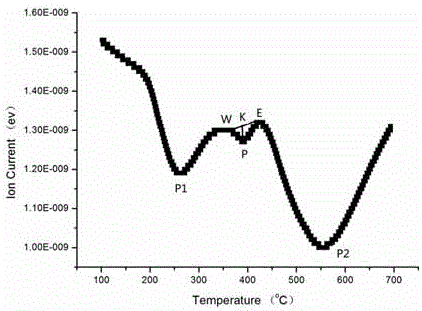
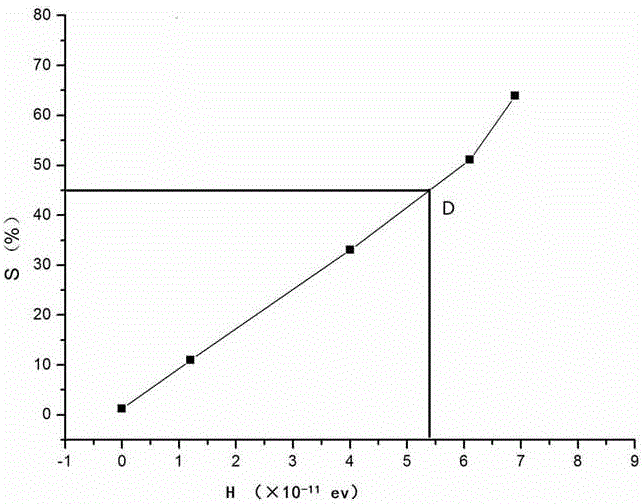
The invention discloses a method for rapidly evaluating the selectivity of an iron catalyst to low-carbon olefin. The aim of replacing a catalyst evaluation method in the prior art is achieved in a way of testing the carburization performance of a sample catalyst. The induction period factor existing during catalyst evaluation is not needed to be considered, so that the catalyst evaluation time is shortened, and the evaluation efficiency is increased. The method is particularly suitable for evaluating the selectivity of an iron catalyst to low-carbon olefin in a Fischer-Tropsch synthesis process.

Description

technical field [0001] The invention relates to a method for evaluating a catalyst, in particular to a method for rapidly evaluating the selectivity of an iron catalyst to C2 to C4 olefins in a Fischer-Tropsch synthesis reaction. Background technique [0002] Fischer-Tropsch synthesis is a reaction in which CO and H2 are used as raw material gases to synthesize products with different carbon chain structures under the action of a catalyst. Different types of catalysts will have obvious performance differences in the Fischer-Tropsch synthesis process. This difference is mainly reflected in the selectivity of the reaction product. For example, pure Fe catalysts, the Fischer-Tropsch synthesis products are mostly saturated hydrocarbons, while After adding K or Mn as an auxiliary agent, the content of unsaturated hydrocarbons in the catalytic reaction product is significantly increased. [0003] The traditional evaluation method of Fischer-Tropsch synthesis catalyst is to put a ...

Claims

the structure of the environmentally friendly knitted fabric provided by the present invention; figure 2 Flow chart of the yarn wrapping machine for environmentally friendly knitted fabrics and storage devices; image 3 Is the parameter map of the yarn covering machine
Login to View More

Application Information

Patent Timeline
no application Login to View More
Patent Type & Authority Patents(China)
IPC IPC(8): G01N31/10
Inventor 王翀唐虹侯春园葛陈兵
Owner ANHUI POLYTECHNIC UNIV
Features
  • R&D
  • Intellectual Property
  • Life Sciences
  • Materials
  • Tech Scout
Why Patsnap Eureka
  • Unparalleled Data Quality
  • Higher Quality Content
  • 60% Fewer Hallucinations
Social media
Patsnap Eureka Blog
Learn More