Check patentability & draft patents in minutes with Patsnap Eureka AI!

A method for rapid detection of pine xylophilus

A pine wood nematode, rapid technology, applied in the field of rapid detection of pine wood nematode, can solve the problems of affecting the survival rate, long parking time, long observation time, etc., achieve accuracy and repeatability, broad application prospects, and easy to popularize and apply Effect

Inactive Publication Date: 2018-10-26
泸县农林局 +1
View PDF7 Cites 0 Cited by
  • Summary
  • Abstract
  • Description
  • Claims
  • Application Information

AI Technical Summary

Problems solved by technology

This is a long time for the goods to be parked, which will affect the circulation and the owner's business. If it is a seedling, it will also affect the survival rate due to long-term water loss.
[0005] There is also the use of biological detection equipment to detect pine wood nematodes, but the cost of such biological detection equipment is high, and the observation time after preparation and detection is long, and the accuracy rate cannot reach 100%.

Method used

the structure of the environmentally friendly knitted fabric provided by the present invention; figure 2 Flow chart of the yarn wrapping machine for environmentally friendly knitted fabrics and storage devices; image 3 Is the parameter map of the yarn covering machine
View more

Image

Smart Image Click on the blue labels to locate them in the text.
Viewing Examples
Smart Image
  • A method for rapid detection of pine xylophilus
  • A method for rapid detection of pine xylophilus

Examples

Experimental program
Comparison scheme
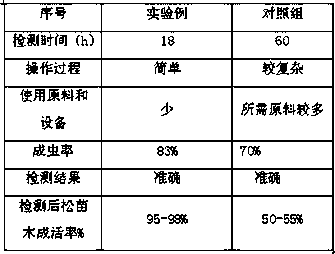
Effect test

example 1

[0025] Wash the pine wood (seedlings) collected from the field with clean water to remove impurities such as sediment or dust; put the sample in a light incubator at 26°C, under the conditions of light 600LX and humidity 60%, after 8 hours, pine wood nematodes will be It will grow from larvae to adults; split the pine wood (seedling) sample into small wooden strips (diameter less than 0.5cm), soak in water in a beaker, and place it in a light incubator at 26°C for 8 hours, light 600LX and humidity 60% Then use the shallow dish method to separate and inspect under the microscope, and the adult worms can be seen under an ordinary microscope.

[0026] The optimum temperature for the growth and reproduction of pine xylophilus is 25°C. It cannot develop when it is lower than 10°C, and its reproduction will be inhibited above 28°C, and it cannot reproduce when it is above 33°C.

example 2

[0028] Wash the pine wood collected from the field with clean water to remove impurities such as sediment or dust; put the sample in a light incubator at 24°C, under the conditions of light 700LX and humidity 90%, after 12 hours, pine xylophilus will grow from larvae Grow into adults; split the pine wood (seedling) sample into small wooden strips (diameter less than 0.5cm), soak them in water in a beaker, and place them in a light incubator at 24°C for 12 hours, under the conditions of 700LX light and 90% humidity; The adult worms can be seen under a common microscope by using the shallow dish method to separate and examine under the microscope.

example 3

[0030] Wash the pine wood collected from the field with clean water to remove impurities such as sediment or dust; put the sample in a light incubator at 27°C, under the conditions of light 1200LX and humidity 70%, after 10 hours, pine wood nematodes will grow from larvae Grow into adults; split pine wood (seedling) samples into small wooden strips (diameter less than 0.5cm), soak them in water in a beaker, and place them in a light incubator at 27°C for 10 hours, under the conditions of 1200LX light and 70% humidity; Adult worms can be seen under a normal microscope.

the structure of the environmentally friendly knitted fabric provided by the present invention; figure 2 Flow chart of the yarn wrapping machine for environmentally friendly knitted fabrics and storage devices; image 3 Is the parameter map of the yarn covering machine
Login to View More

PUM

No PUM Login to View More

Abstract

The present invention belongs to the field of pests and diseases of quarantine, in particular a method for rapidly detecting pine wood nematodes. The method is characterized by comprising the following steps: washing the pine wood samples collected from the field with pure water to remove impurities; placing and culturing the pine wood samples in an incubator under illumination, in certain illumination and hydrothermal conditions at the temperature of 24-27 DEG C for 8-12 hours; splitting the pine wood samples into small battens, immersing the battens with water in a beaker, meanwhile, placing the beaker into the illumination incubator for culture, at the temperature of 24-27 DEG C for 8-12 hours; and using a shallow dish method for separation and microscopic examination, and performing observation under a general microscope. The detection method provided by the present invention is rapid, low in cost and easy to operate, has a wide application range, and is not limited by detection regions or conditions.

Description

technical field [0001] The invention belongs to the field of pest and disease quarantine, and in particular relates to a method for rapidly detecting pine wood nematodes. Background technique [0002] Pine wood nematode (Bursaphelenchus xylophilus) is a pathogenic nematode that causes pine wilt disease, which is a devastating disease of pine trees. The disease has occurred in Japan, South Korea, the United States, Canada, Mexico and other countries, but the degree of harm is different, and Japan suffers the most. The disease was first discovered in Zhongshan Mausoleum in Nanjing in 1982 in China, and then it was discovered in Anhui, Guangdong, Shandong, Zhejiang and other provinces (districts) and became a disaster, resulting in the death of a large number of pine trees. The ecological environment has caused serious damage, and there is a tendency to continue to spread. Listed as internal and external quarantine forestry pests. [0003] The short-distance transmission of ...

Claims

the structure of the environmentally friendly knitted fabric provided by the present invention; figure 2 Flow chart of the yarn wrapping machine for environmentally friendly knitted fabrics and storage devices; image 3 Is the parameter map of the yarn covering machine
Login to View More

Application Information

Patent Timeline
no application Login to View More
Patent Type & Authority Patents(China)
IPC IPC(8): A01K67/033
CPCA01K67/033
Inventor 华启尧杨佐忠曾一洴贾敏魏福春
Owner 泸县农林局
Features
  • R&D
  • Intellectual Property
  • Life Sciences
  • Materials
  • Tech Scout
Why Patsnap Eureka
  • Unparalleled Data Quality
  • Higher Quality Content
  • 60% Fewer Hallucinations
Social media
Patsnap Eureka Blog
Learn More