
SiCN aerogel and preparation method thereof
A technology of airgel and gel, which is applied in the field of airgel to achieve the effects of simple preparation process, lower molding temperature and high purity
- Summary
- Abstract
- Description
- Claims
- Application Information
AI Technical Summary
Problems solved by technology
Method used
Image

Examples
Embodiment 1
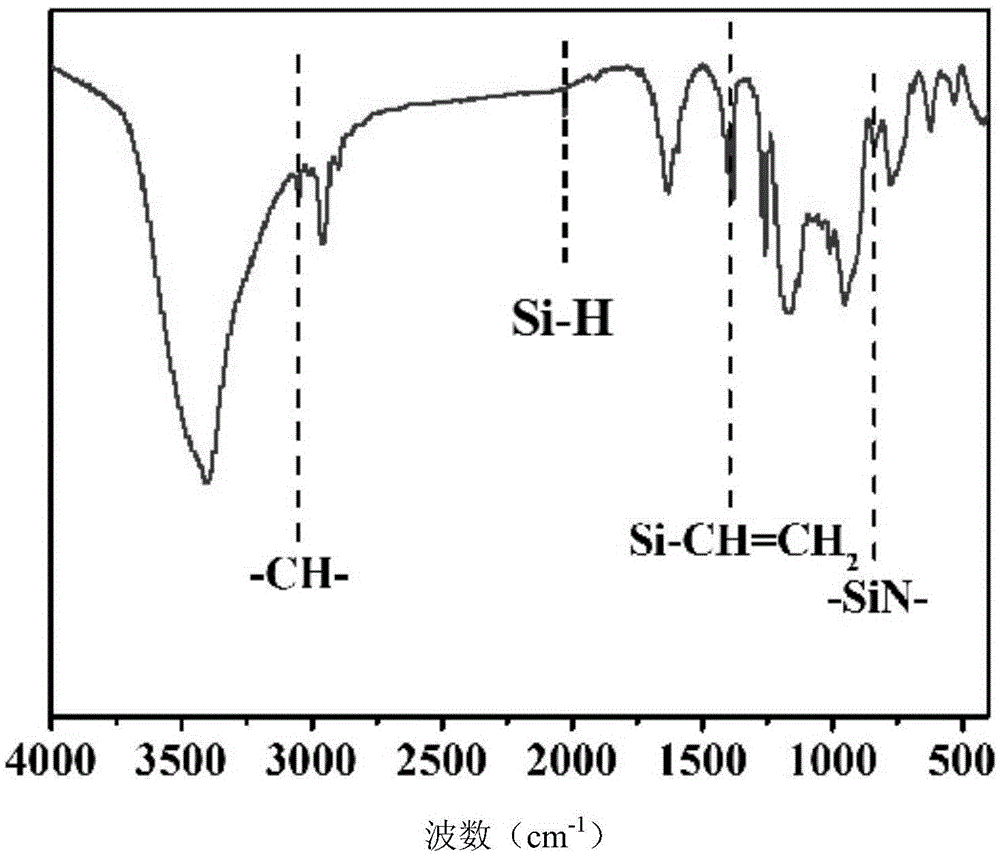
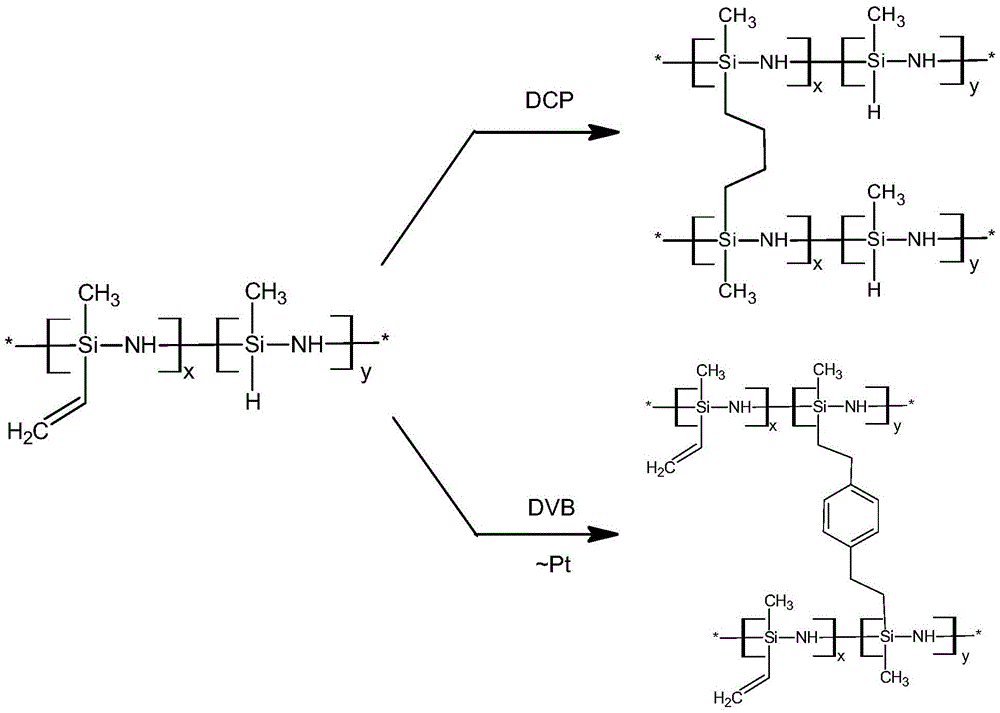
[0033] (1) In parts by weight, 10 parts of PVSZ (its Fourier transform infrared spectrogram as shown in figure 1 shown) and 0.1 part of DCP were dissolved in 90 parts of cyclohexane, stirred evenly to form a homogeneous solution, then transferred to the polytetrafluoroethylene tank in the reactor, and then transferred to the pressure reactor, at 150 ° C Carry out polymerization and cross-linking reaction, the reaction time is 5h, after the reaction is completed, the reaction kettle and materials are cooled to room temperature, and the precursor gel is obtained;
[0034] (2) Transfer the precursor gel to a supercritical drying kettle, first replace it with liquid carbon dioxide for 1-3 days, and then undergo supercritical drying (50°C, 20MPa) to obtain the precursor aerogel;
[0035] (3) Precursor airgel is kept at 180°C (heating rate 5°C / min) for 1 hour in an inert atmosphere, and then heat-treated at 800°C (heating rate 2°C / min) for 1-3 hours to obtain amorphous SiCN gas. Ge...
Embodiment 2
[0037] After the precursor gel obtained in Example 1 was sealed and aged, n-hexane was used as a replacement solvent to replace the cyclohexane in the pores, and the replacement was performed 3 times for 24 hours each time. Then it is placed in a programmed temperature-controlled oven, and the drying program is as follows: heat up to 50°C (3°C / min) for 2 hours; heat up to 80°C (heating rate 2°C / min) for 4 hours; heat up to 110°C (5°C / min) for 6 hours; the precursor airgel was obtained after natural cooling, and the subsequent treatment method was the same as in Example 1, and SiCN airgel materials could also be obtained. SiCN airgel porosity ~ 80%, specific surface area ~ 110m 2 / g, density ~ 150Kg / m 3 .
Embodiment 3
[0039] (1) In parts by weight, dissolve 5 parts of PVSZ and 5 parts of DVB in 90 parts of cyclohexane, add 0.02 parts of ~Pt, stir evenly to form a homogeneous solution, and then transfer to the polytetrafluoroethylene tank in the reaction kettle , and then transferred to a pressure reactor, and carried out polymerization and crosslinking reaction at 150 ° C for 4 hours. After the reaction was completed, the reactor and materials were cooled to room temperature to obtain a precursor gel;
[0040] (2) Transfer the precursor gel to a supercritical drying kettle, first replace it with liquid carbon dioxide for 1-3 days, and then undergo supercritical drying (50°C, 20MPa) to obtain the precursor aerogel;
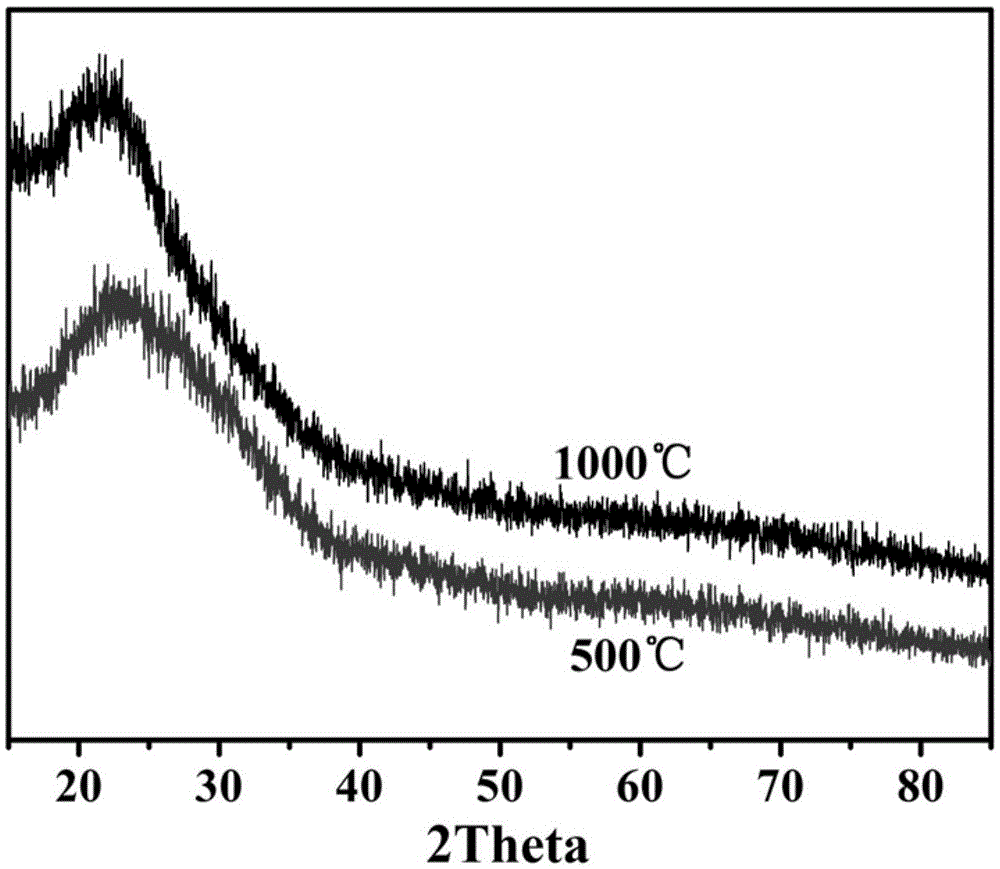
[0041] (3) Precursor airgel is kept at 180°C (heating rate 5°C / min) for 1 hour under an inert atmosphere, and then heat-treated at 1000°C (heating rate 2°C / min) for 4 hours to obtain amorphous SiCN airgel (Such as figure 2 shown), SiCN airgel porosity ~ 90%, specific surface a...
PUM
| Property | Measurement | Unit |
|---|---|---|
| specific surface area | aaaaa | aaaaa |
| specific surface area | aaaaa | aaaaa |
| specific surface area | aaaaa | aaaaa |
Abstract
Description
Claims
Application Information
 Login to View More