Disubstituted Bicyclic Derivatives and Their Application as Efflux Pump Inhibitors in Antibacterial
What is AI technical title?
AI technical title is built by Patsnap AI team. It summarizes the technical point description of the patent document.
A technology of substituents and compounds, applied in the field of disubstituted bicyclic derivatives and their preparation
Inactive Publication Date: 2019-02-22
SHANDONG UNIV +1
View PDF2 Cites 0 Cited by
Summary
Abstract
Description
Claims
Application Information
AI Technical Summary
This helps you quickly interpret patents by identifying the three key elements:
Problems solved by technology
Method used
Benefits of technology
Problems solved by technology
At present, research on efflux pump inhibitors for bacterial AcrB efflux pumps is a hot spot, focus and difficulty in research at home and abroad. In recent years, the discovery of new AcrB efflux pump inhibitors has rarely been reported.
Method used
the structure of the environmentally friendly knitted fabric provided by the present invention; figure 2 Flow chart of the yarn wrapping machine for environmentally friendly knitted fabrics and storage devices; image 3 Is the parameter map of the yarn covering machine
View more
Image
Smart Image Click on the blue labels to locate them in the text.
Viewing Examples
Smart Image
Click on the blue label to locate the original text in one second.
Reading with bidirectional positioning of images and text.
Smart Image
Examples
Experimental program
Comparison scheme
Effect test
Embodiment 1
[0095] Preparation of benzylidene succinic acid (compound of formula 2)
[0096] Benzaldehyde (15.0g, 141mmol) and dimethyl succinate (25.8g, 17.6mmol) were dissolved in ethanol (100mL), and the above mixture was slowly added dropwise to ethanol ( 150mL) solution, reflux for 4h. After the reaction was completed, evaporated to dryness under reduced pressure, the resulting solid was dissolved in 15% NaOH aqueous solution (100 mL), heated to reflux for 3 h, the reaction solution was cooled to room temperature, extracted once with ethyl acetate (60 mL), and the aqueous phase was retained. Use concentrated HCl to adjust the pH to <2, and a white solid precipitates out, which is filtered with suction, and the filter cake is washed twice with water. The filter cake was dried to obtain 21.75 g of white solid, with a yield of 75%.
Embodiment 2
[0098] Preparation of 4-hydroxyl-2-naphthoic acid (compound of formula 3)
[0099] Benzylidene succinic acid (20.6g, 100mmol) was slowly added to stirred concentrated sulfuric acid (147g, 1500mmol) at low temperature, protected by nitrogen, and then transferred to room temperature for 48h. The reaction solution was slowly added dropwise into stirred ice water (300 mL), and a yellow solid was precipitated. Suction filtration with a Buchner funnel, washing with ice water three times to obtain a crude brown-yellow solid. Finally, it was recrystallized with ethanol / water to obtain 12.2 g of a yellow solid with a yield of 65%.
Embodiment 3
[0101] Preparation of 4-acetoxy-2-naphthoic acid (compound of formula 4)
[0102] 4-Hydroxy-2-naphthoic acid (12.2g, 65mmol) was dissolved in pyridine (80mL), and acetic anhydride (26.5g, 260mmol) was slowly added dropwise at room temperature, and reacted at room temperature for 3h. After the reaction was completed, evaporate to dryness under reduced pressure, add water (120 mL) to the obtained residue, adjust the pH=3 with 1N HCl, extract three times with ethyl acetate (3×80 mL), combine the organic phases, wash the organic phases with saturated brine, Anhydrous Na 2 SO 4 After drying, filtering, and evaporating to dryness under reduced pressure, 13.3 g of brown-yellow solid was obtained, with a yield of 89%.
the structure of the environmentally friendly knitted fabric provided by the present invention; figure 2 Flow chart of the yarn wrapping machine for environmentally friendly knitted fabrics and storage devices; image 3 Is the parameter map of the yarn covering machine
Login to View More
PUM
Login to View More
Abstract
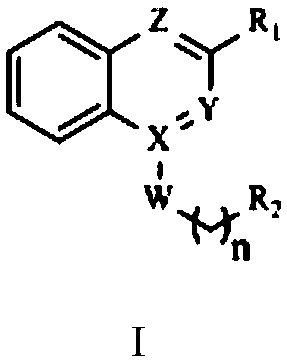
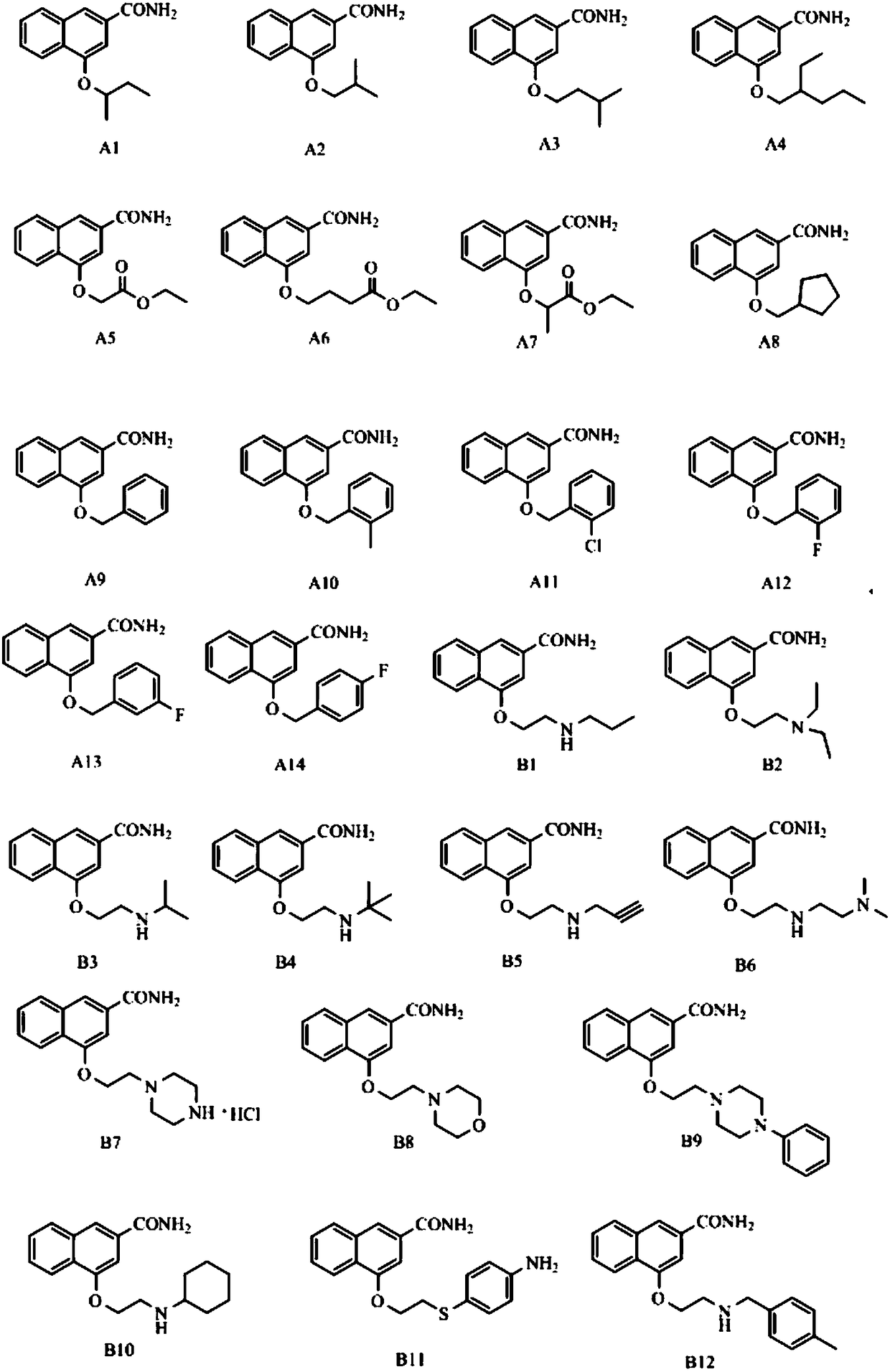
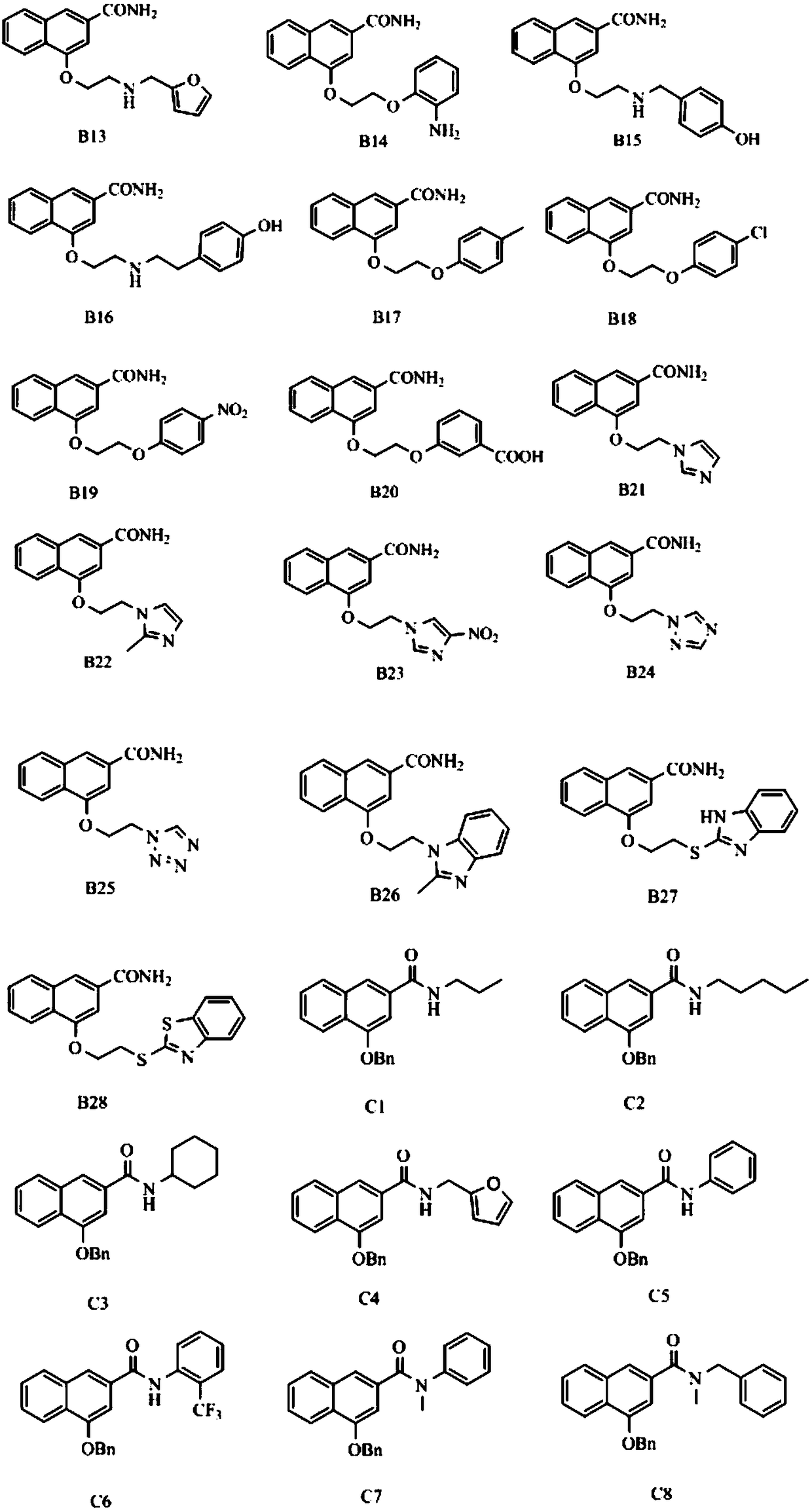
The invention discloses a disubstituted bicyclic derivative and application thereof as an efflux pump inhibitor to anti-microbial. It is proved by experiments that the disubstituted bicyclic derivative has a good inhibition function on multidrug-resistant bacteria carrying an AcrB efflux pump and can effectively recover or enhance antibacterial efficiency of existing antibiotics. The chemical structural formula of the disubstituted bicyclic derivative is as shown in a formula (I) (the formula can be seen in specification), and R1, R2, X, Y, Z and W are as defined in the specification.
Description
technical field [0001] The invention relates to a class of disubstituted bicyclic derivatives, a preparation method thereof, and an antibacterial application as an antibacterial synergist. Background technique [0002] Due to the widespread use and even abuse of antibiotics, the problem of bacterial resistance is becoming more and more serious, and it has become one of the important factors that seriously threaten human health. In recent years, the multi-drug resistance of Gram-negative bacteria to antimicrobial agents has been increasing day by day, and multi-drug-resistant Gram-negative bacteria infection has become the main cause of death in clinical patients. The most common clinical multidrug-resistant Gram-negative bacteria include Escherichia coli, Pseudomonas aeruginosa, Enterobacter aerogenes, Acinetobacter baumannii, etc. The isolation rate of Escherichia coli in ICU wards is as high as 34%. The drug rate is as high as 44%, often causing serious infections in vari...
Claims
the structure of the environmentally friendly knitted fabric provided by the present invention; figure 2 Flow chart of the yarn wrapping machine for environmentally friendly knitted fabrics and storage devices; image 3 Is the parameter map of the yarn covering machine
Login to View More
Application Information
Patent Timeline
Application Date:The date an application was filed.
Publication Date:The date a patent or application was officially published.
First Publication Date:The earliest publication date of a patent with the same application number.
Issue Date:Publication date of the patent grant document.
PCT Entry Date:The Entry date of PCT National Phase.
Estimated Expiry Date:The statutory expiry date of a patent right according to the Patent Law, and it is the longest term of protection that the patent right can achieve without the termination of the patent right due to other reasons(Term extension factor has been taken into account ).
Invalid Date:Actual expiry date is based on effective date or publication date of legal transaction data of invalid patent.


 Login to View More
  Login to View More