12-point SCMA codebook design method based on hexagonal planisphere and SCMA system

A regular hexagon and design method technology, applied in the transmission system, multi-carrier system, digital transmission system, etc., can solve the problems of high codebook complexity and bit error rate performance degradation, and achieve excellent system bit error rate performance, The effect of reduced complexity and high realizability

CN107222291AActive Publication Date: 2017-09-29SOUTHEAST UNIV
4 Cites 9 Cited by

Patent Information

Authority / Receiving Office
CN · China
Patent Type
Applications(China)
Current Assignee / Owner
Publication Date
2017-09-29

Smart Images

  • Figure 1
    Figure 1
  • Figure 2
    Figure 2
  • Figure 3
    Figure 3
Patent Text Reader

Abstract

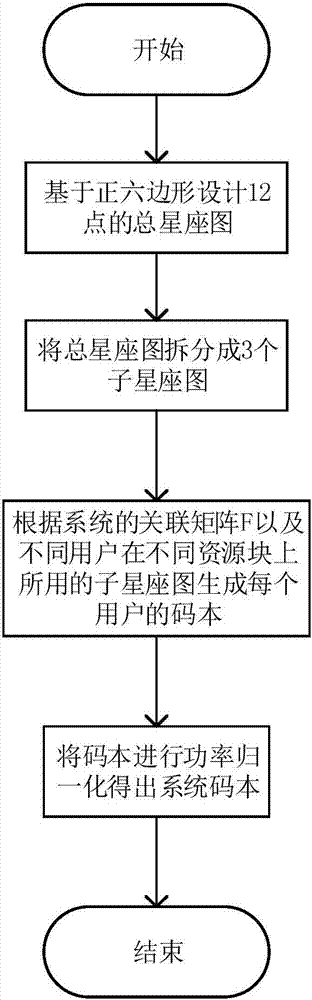
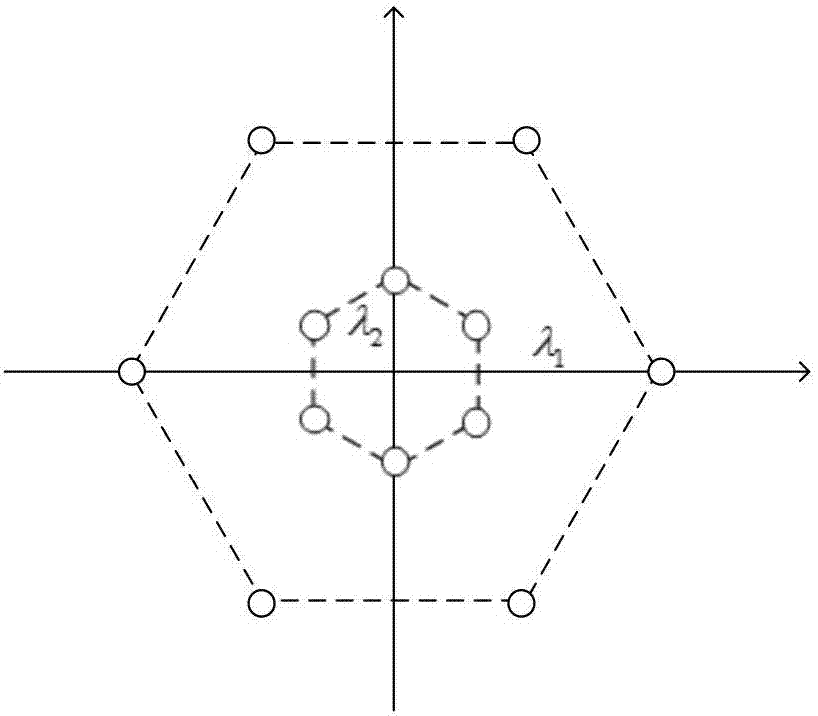
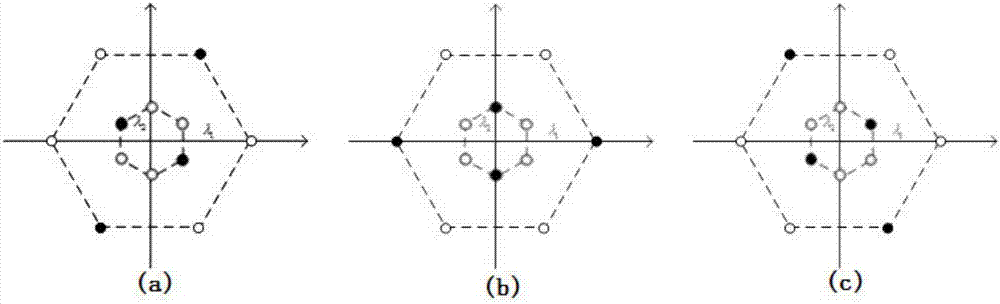
The invention discloses a 12-point SCMA codebook design method based on a hexagonal planisphere and a SCMA system using the method. The codebook design method comprises the following steps: 1, allocating 12 constellation points on the end points of two embedded hexagons to form a total planisphere on a resource block; 2, splitting the total planisphere into 3 sub planispheres according to the principle that the minimum Euclidean distance on the same planisphere is the maximum, and separately expressing the 3 sub planispheres as S1, S2 and S3, wherein the size of each sub planisphere is 4; 3, generating a codebook of each user according to an incidence matrix F of the SCMA system and the sub planispheres used by different users on different resource blocks; and 4, performing power normalization on the codebook of each user so as to generate a system codebook. The codebook designed by the method has the advantages of low complexity, low error rate under high signal to noise ratio and convenient hardware implementation.
Need to check novelty before this filing date? Find Prior Art

Description

technical field

[0001] The invention belongs to the field of codebook design in mobile communication systems, in particular to a 12-point SCMA codebook design method. Background technique

[0002] Sparse Code Multiple Access (SCMA, Sparse Code Multiple Access) is a codebook-based multi-dimensional non-orthogonal multiple access technology proposed by Huawei Technologies Co., Ltd. In the SCMA system, each transmission layer (user) has a specific codebook sequence, and the overlapping transmission layers (users) are non-orthogonally superimposed, which allows the system to directly map the input data stream into a codebook sequence from a predefined The codeword (Codeword) selected in the codebook.

[0003] The SCMA codebook design enables the SCMA system to fully obtain the shaping gain and coding gain brought by the multi-dimensional constellation diagram. But at the same time, the design of the SCMA codebook is more difficult and demanding, and the optimal codebook design...

Examples

Embodiment Construction

[0047] The present invention will be further explained below in conjunction with the accompanying drawings and specific embodiments.

[0048] In the SCMA system, assuming that the total number of users is J, K represents the length of each codeword in the codebook, that is, the number of resource blocks for transmitting data, that is, the number of carriers in the system. Each codeword contains N non-zero elements, and the remaining K-N elements are 0. Define the overload rate of the system Then the number of users d on each resource block can be calculated further f=λ·N. In the SCMA system, different users correspond to different codebooks, and the codebook of each user is a K×2 M The complex matrix of , where M represents the number of bits transmitted by the user each time, that is, the modulation order of the user, and the codebooks of all users constitute the codebook of the system.

[0049] This embodiment takes the 6-user 4-carrier system as an example to illustrat...