Homographic invariant image simulation model and method based on mapping adaptive convolution
An image simulation and convolution technology, applied in the field of image simulation, can solve problems such as inability to construct image simulation methods, standard convolution does not obey the law of mapping distribution, etc.
- Summary
- Abstract
- Description
- Claims
- Application Information
AI Technical Summary
Problems solved by technology
Method used
Image

Examples
Embodiment
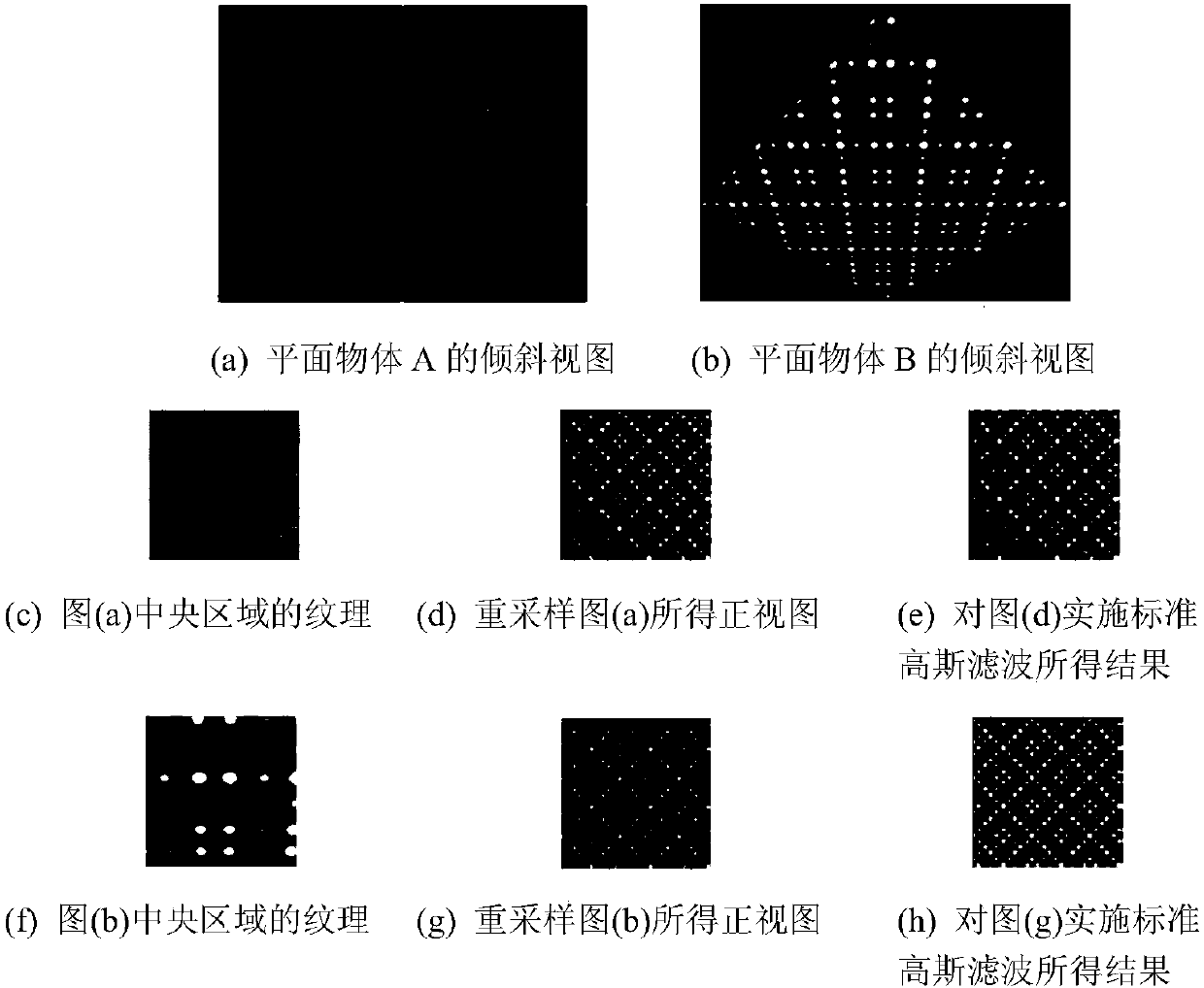
[0113] as attached Figure 9 As shown, we systematically compare the accuracy of the two simulation methods for standard convolution-based image simulation and map-adapted convolution-based image simulation. Figure 10 We demonstrate the application advantages of map-adapted convolution in perspective-invariant matching methods.
[0114] Figure 9 In, (a) the left image is the front view image of the object surface (64*64). (a) The image on the right is the blurred image after applying standard Gaussian convolution to the image on the left. This image is used as a reference image, and all simulated frontal images are compared with this image to evaluate the simulation accuracy.
[0115] Figure 9 In order to compare the image simulation based on standard convolution (Equation (1.7)) and the image simulation based on mapping adaptive convolution (Equation (2.8)), consider that the optical center of the camera is located on the surface of a hemisphere, and the center of the h...
PUM
 Login to View More
 Abstract
Description
Claims
Application Information
 Login to View More
 - R&D
- Intellectual Property
- Life Sciences
- Materials
- Tech Scout
- Unparalleled Data Quality
- Higher Quality Content
- 60% Fewer Hallucinations
Browse by: Latest US Patents, China's latest patents, Technical Efficacy Thesaurus, Application Domain, Technology Topic, Popular Technical Reports.
© 2025 PatSnap. All rights reserved.Legal|Privacy policy|Modern Slavery Act Transparency Statement|Sitemap|About US| Contact US: help@patsnap.com