
Air temperature type LNG gasifier
A vaporizer and air temperature technology, which is applied to pressure vessels, indirect heat exchangers, heat exchanger types, etc., can solve the problem that the volume of equipment is difficult to reduce
- Summary
- Abstract
- Description
- Claims
- Application Information
AI Technical Summary
Problems solved by technology
Method used
Image


Examples
Embodiment Construction
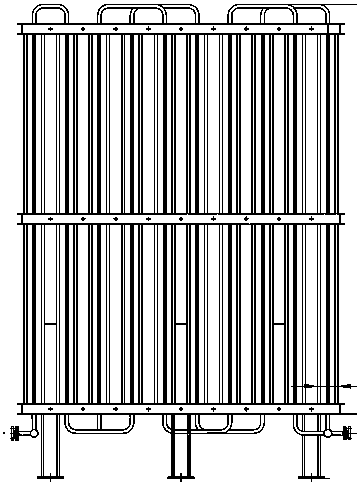
[0012] The air-temperature type LNG vaporizer involved in the present invention, such as figure 1 and figure 2 As shown, it includes a frame and finned tubes, the finned tubes are arranged in parallel to form an array, and the finned tubes are divided into two arrays, namely 8-finned tubes and 12-finned tubes, the finned tubes are The tube has a built-in spiral guide.
[0013] Further, the finned tube adopts a built-in liquid-absorbing core, and the built-in liquid-absorbing core is a stainless steel belt. At this time, due to the capillary phenomenon of the surface tension of the liquid, the liquid in the liquid film is adsorbed in the narrow gap between the liquid-absorbing core and the inner wall of the finned tube, and the liquid in the liquid film absorbs heat and gasifies to form tiny bubbles. When the tiny bubbles flow upward and When the larger bubbles are formed, they escape from the small holes on the upper surface of the liquid-absorbing core, and finally detach ...
PUM
 Login to View More
 Abstract
Description
Claims
Application Information
 Login to View More