
Method for detecting Apis dorsata MRJP1 through liquid chromatography-tandem mass spectrometry and application of method in identifying authenticity of Apis dorsata honey
A technology of tandem mass spectrometry and bee honey, which is applied in the direction of measuring devices, instruments, scientific instruments, etc., and can solve the problems of undeveloped identification methods of big bee honey
- Summary
- Abstract
- Description
- Claims
- Application Information
AI Technical Summary
Problems solved by technology
Method used
Image

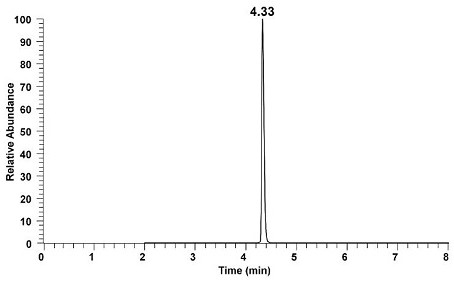
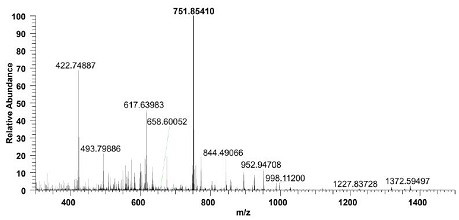
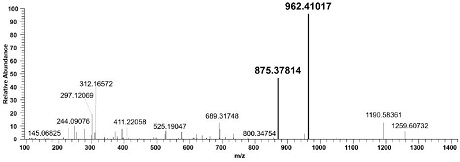
Examples
Embodiment 1
[0037] Example 1 Excavation of MRJP1 characteristic peptides in the honey of Apis mellifera
[0038] Solution preparation:
[0039] 1. Solution preparation
[0040] 40 mM NH 4 HCO 3 Solution: weigh 0.316 g NH 4 HCO 3 , dilute to 100 mL with ultrapure water, and store in a 4°C refrigerator until use.
[0041] 100 mM DTT solution: weigh 0.308 g of DTT, add 40 mM NH 4 HCO 3 The solution was dissolved, mixed evenly and adjusted to 20mL, and stored in a -20°C refrigerator until use.
[0042] 100 mM IAA solution: Weigh 0.39 g of IAA, add 40 mM NH 4 HCO 3 The solution was fixed to 20 mL, and stored in a -20°C refrigerator until use.
[0043] 2. Weigh the honey and PBS solution according to the ratio of 1:1, vortex fully, centrifuge at 4°C for 20 min, and collect the supernatant;
[0044] 3. Take 100 μL supernatant and add 400 μL 40 mM NH 4 HCO 3 The solution was vortexed and mixed with it, and 50 μL of 100 mM DTT solution was added. After fully vortexed and mixed, it was...
Embodiment 2
[0055] Example 2 The establishment and detection method of the characteristic peptide segment of MRJP1 in bee honey
[0056] 1. All the characteristic peptides screened out in Example 1 are verified on the NCBI and Uniprot websites, and the characteristic peptides that only exist in the large bee MRJP1 are screened, and the mass spectrometry data generated in Example 1 is checked, and the response is selected The characteristic peptide with high concentration and no influence of other substances is the final characteristic peptide, ie ENAILSGEYDYTK.
[0057] 2. Synthesize the characteristic peptide segment ENAILSGEYDYTK and the stable isotope internal standard (IS) peptide segment ENAILSGEYDYTK*, K* means that all Cs in arginine are replaced by 13 C, all N replacements are 15 N, with a purity of over 98%, was stored at -20°C for future use.
[0058] 3. Drawing of Standard Curve
[0059] A series of characteristic peptide standards (1 ng / mL, 3 ng / mL, 5 ng / mL, 10 ng / mL , 20 ...
Embodiment 3
[0070]Example 3 Practical Application of MRJP1 Characteristic Peptides in Big Bee Honey
[0071] 1. Purchase samples of honey made by Italian bees (acacia honey, linden honey and wattle honey), soil honey (honey made by Apis mellifera), big bees and small bees from the regular market for actual sample testing.
[0072] 2. Detection of 6 kinds of honey samples
[0073] (1) Weigh the same amount of different honeys into centrifuge tubes, add PBS solution at a ratio of 1:1, vortex fully, centrifuge at 4°C for 20 min, and collect the supernatant;
[0074] (2) Take 100 μL supernatant and add 400 μL 40 mM NH 4 HCO 3 The solution was vortexed and mixed with it, and 50 μL of 100 mM DTT solution was added. After fully vortexed and mixed, it was reacted at room temperature for 60 minutes, and then 250 μL of 100 mM IAA solution was added to react in the dark at room temperature for 60 minutes;
[0075] (3) Add 2 μg excess trypsin to the 6 final solutions obtained in (2), and digest ov...
PUM
 Login to View More
 Abstract
Description
Claims
Application Information
 Login to View More