
Process for preparing 3,4-dihydroxy benzonitrile
A technology of hydroxybenzonitrile and methylenedioxybenzonitrile, which is applied in 3 fields of preparation, can solve the problems of complex post-processing, harsh reaction conditions, and unfavorable industrial applications.
- Summary
- Abstract
- Description
- Claims
- Application Information
AI Technical Summary
Problems solved by technology
Method used
Image

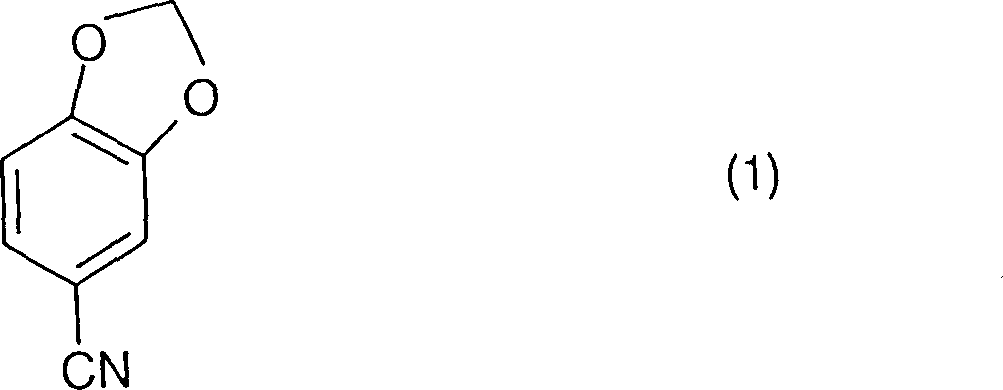
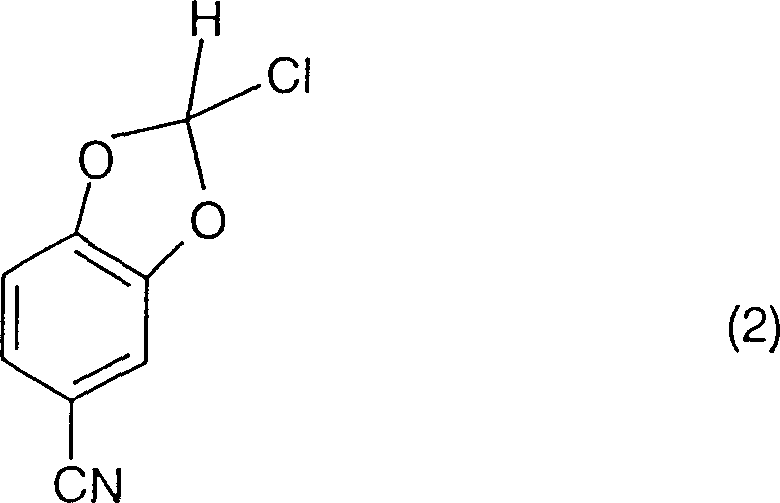
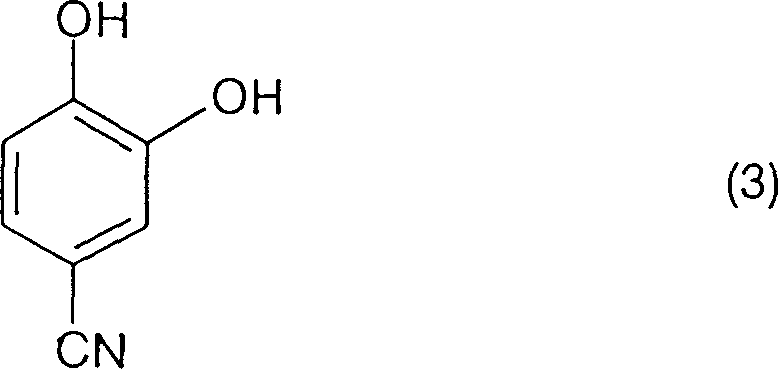
Examples
Embodiment 1
[0055] 10.00 g (67.97 mmol) of 3,4-methylenedioxybenzonitrile and 50 ml of toluene were added to a 200 ml internal capacity flask equipped with a stirrer, thermometer, dropping funnel and airway under nitrogen atmosphere. Then, 0.96 g (6.99 mmol) of phosphorus trichloride was added to the mixture through a dropping funnel while stirring the resulting mixture in the flask. The resulting mixture was heated to 50°C, and then chlorine gas was continuously introduced into the mixture at this temperature for 3.5 hours through a gas duct.
[0056] After the chlorination reaction, the resulting reaction mixture was cooled to room temperature and then concentrated under reduced pressure to remove toluene.
[0057] The concentrated reaction mixture was then mixed with 50 ml of water, the resulting reaction was heated to 50°C and stirred at this temperature for 30 minutes. After completion of the hydrolysis reaction, the reaction system was cooled to 50°C and stirred at this temperature...
Embodiment 2~5
[0059] In each case in Examples 2 to 5, except that the toluene used as the reaction medium was replaced by the compounds shown in Table 1, and the time of the chlorination reaction was changed as shown in Table 1, 3,4-dihydroxybenzonitrile The preparation methods are all the same as in Example 1.
[0060] The conversion rate of 3,4-methylenedioxybenzonitrile (MDBN) and the selectivity of generating 3,4-dihydroxybenzonitrile (DHBN) are analyzed by the high performance liquid chromatography (absolute calibration curve method) result of gained product Sure. The results are shown in Table 1.
[0061] implement
Example number
reaction medium
when reacting
time (hour)
Transformation of MDBN
Rate (mol%)
Choice of DHBN
Sex (mol%)
2
1
99
96
3
tert-butylbenzene
1
99
88
4
4
91
81
5
2
100
...
Embodiment 6
[0066] Under a nitrogen atmosphere, add 1.00 g (6.8 mmol) of 3,4-methylenedioxybenzonitrile and 5 ml of toluene to a glass flask with an internal capacity of 25 ml equipped with a stirrer, a thermometer and a dropping funnel, and stir The mixture was heated to 50° C., and then 3.67 g (27.2 mmol) of sulfuryl chloride were gradually mixed into the heated mixture. The resulting reaction mixture was stirred at 50°C for 8 hours to chlorinate 3,4-methylenedioxybenzonitrile.
[0067] After completion of the chlorination reaction, the reaction mixture containing the chlorination product was mixed with 15 g of ice water and heated to 50° C., at which temperature the hydrolysis reaction of the chlorination product was carried out for one hour.
[0068] After the hydrolysis reaction was completed, the resulting reaction mixture was mixed with 250 ml of acetonitrile to obtain a homogeneous solution. Analyze this solution with high-performance liquid chromatography (absolute calibration c...
PUM
 Login to View More
 Abstract
Description
Claims
Application Information
 Login to View More