

Glenoid bone graft retention plate
a bone graft and glenoid bone technology, applied in the field of surgical instruments, can solve the problems of screw breakage, human shoulder instability, and possible complication of recurrent instability, and achieve satisfactory compression of bone grafts and limit friction
- Summary
- Abstract
- Description
- Claims
- Application Information
AI Technical Summary
Benefits of technology
Problems solved by technology
Method used
Image

Examples
Embodiment Construction
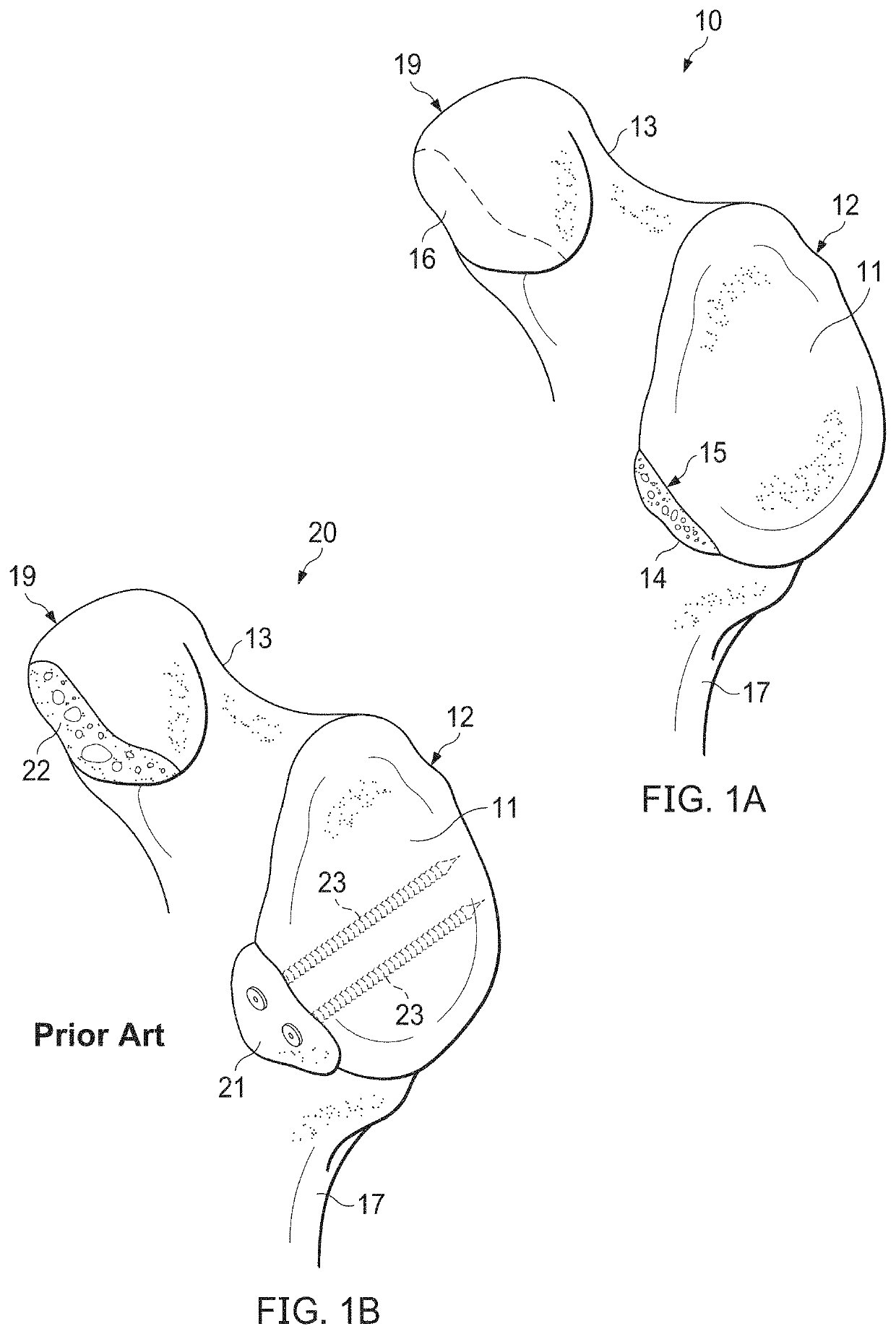
[0033]Referring to the drawings for a better understanding of the function and structure of the invention, FIG. 1A shows the glenoid area 10 of the body with the surrounding muscle and tendons omitted, and the humerus bone also omitted. The glenoid cavity 11 is circumscribed by a closed, curved periphery of scapula bone 12 onto which a margin of glenoid labrum is attached (not shown). The glenoid cavity 11 is joined to the coracoid 19 via a concave portion of scapula bone 13 and from which an example donor site of bone 16 is potentially extracted, the location of which may vary from patient to patient. The collected bone from site 16 is typically transplanted in a single medical procedure onto a worn or damaged glenoid cavity periphery 14 to form a graft 15 that buttresses the glenoid. A lower portion of the scapula 17 supports both the glenoid cavity 11, the coracoid 19, and the newly transplanted graft.
[0034]FIG. 1B shows a traditional fixation method for the glenoid area 10 in wh...
PUM
 Login to View More
 Abstract
Description
Claims
Application Information
 Login to View More