
Pharmaceutical composition for use in the prophylactic and/or therapeutic treatment of L-DOPA-induced dyskinesia
a technology of l-dopa and composition, applied in the field of pharmaceuticals, can solve the problems of limiting patients' daily activity, giving rise to complications and side effects, and limiting patients' daily activities, so as to treat and/or prevent dyskinesia
- Summary
- Abstract
- Description
- Claims
- Application Information
AI Technical Summary
Benefits of technology
Problems solved by technology
Method used
Image

Examples
example 1
Investigation of the Dyskinetic Model
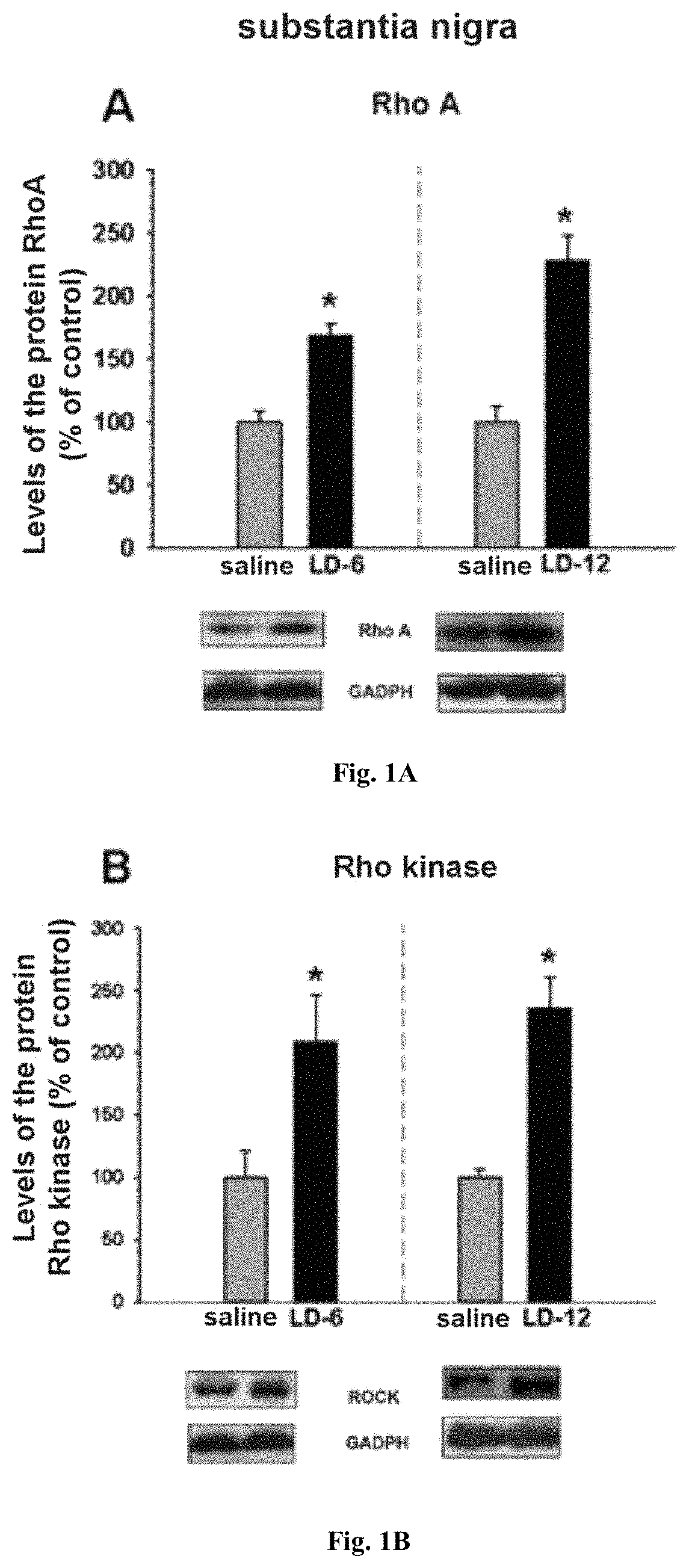
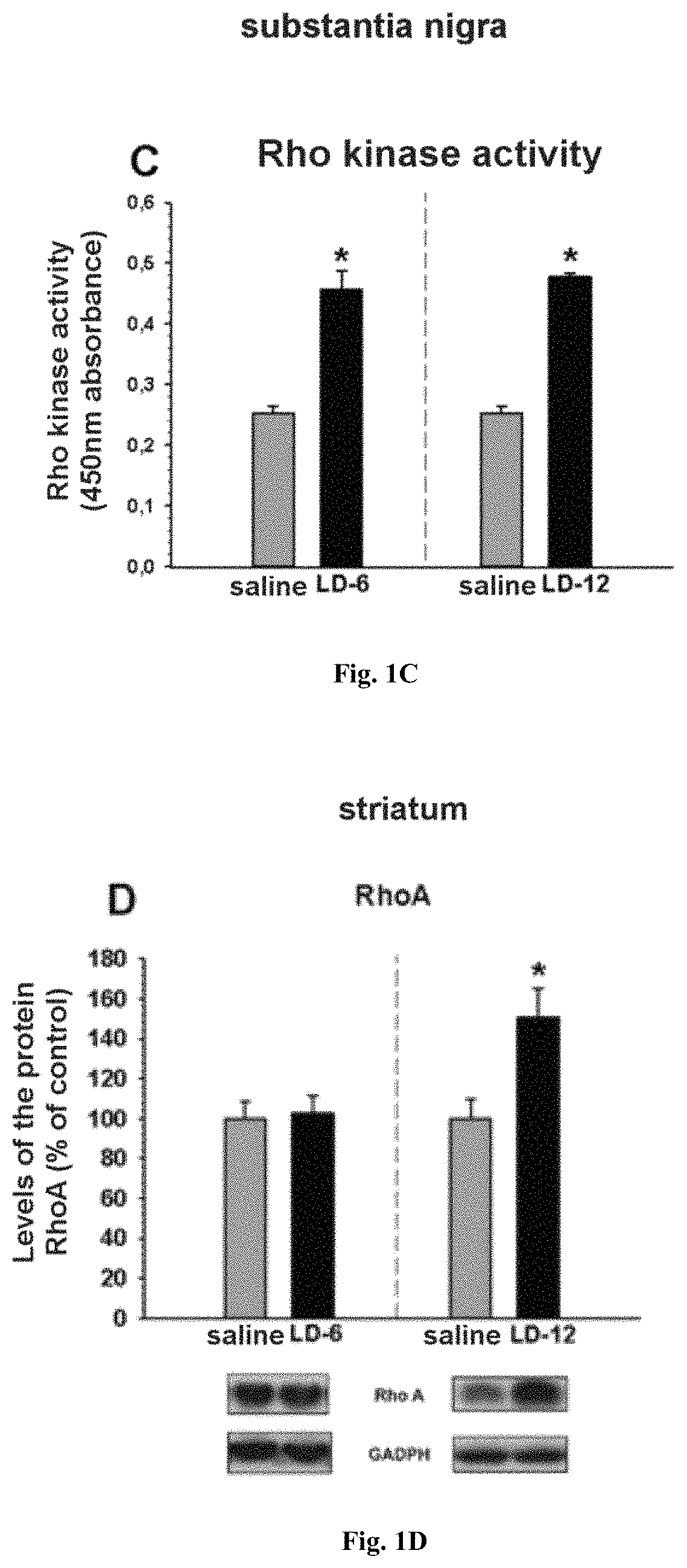
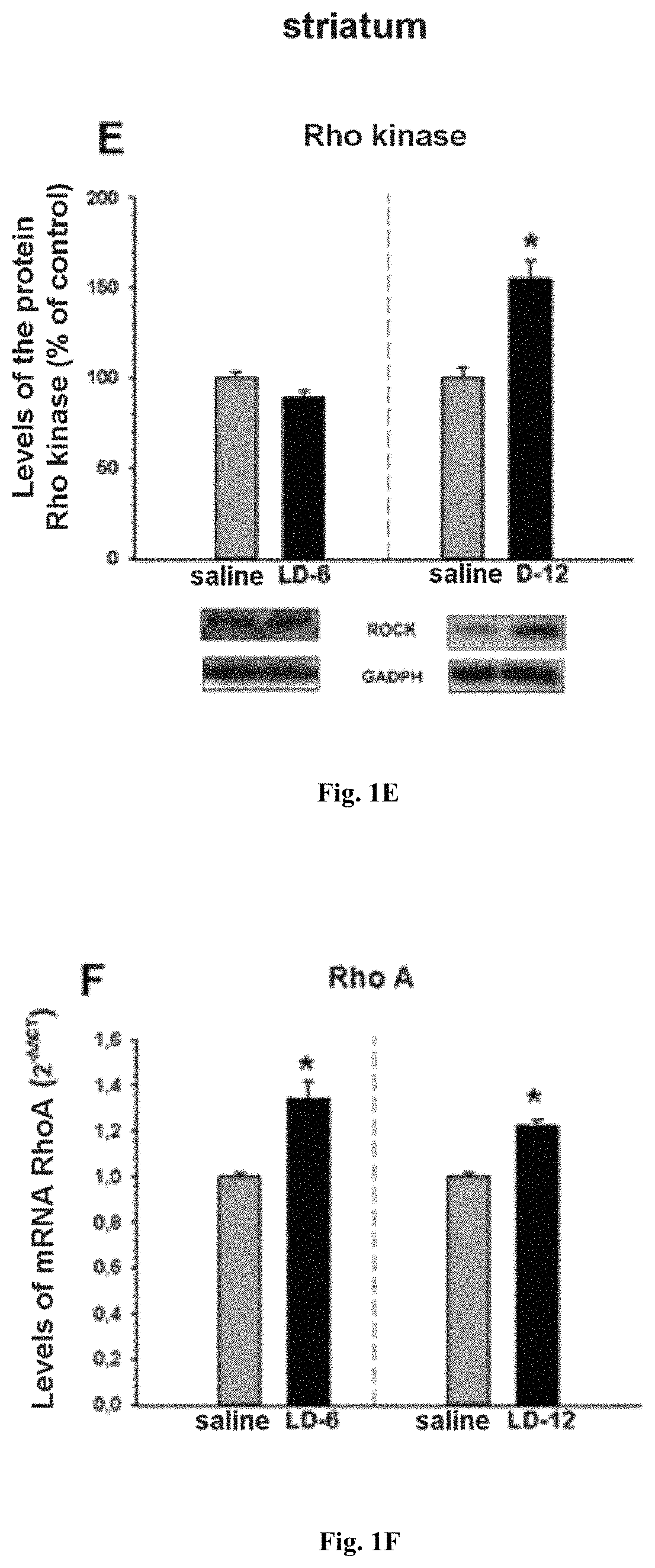
[0038]A group of animal models of PD was injected daily with different doses of L-DOPA (6 mg / kg and 12 mg / kg), until the levels of dyskinesia were stable (3-4 weeks). At autopsy, the striatum and the substantia nigra were dissected and the expression levels of RhoA and ROCK were analyzed by Western blot and real-time PCR.
[0039]It was observed that in the dyskinetic animals there was a significant increase in the levels of the RhoA protein and of the ROCK protein. It was also observed that in the animals treated with the higher dose of L-DOPA, and which showed earlier and more severe dyskinesias, the increase in the levels of said proteins was greater (see FIG. 1).
[0040]This experiment demonstrates that the ROCK pathway is activated in dyskinetic animals.
example 2
Treatment with Fasudil During Chronic Treatment with L-DOPA
[0041]A group of rats treated with L-DOPA as described above was used as the control in this study. In addition to L-DOPA, an inhibitor of the ROCK pathway, fasudil, was administered to one group at a dose of 10 mg / kg / day, by the intraperitoneal route (although it could be administered by the oral route after suitably adjusting the dose), beginning 5 days before starting the treatment with L-DOPA, and 30 minutes before each administration of L-DOPA. In addition to L-DOPA, another group was administered fasudil at a dose of 30 and 40 mg / kg / day, intraperitoneally with the same frequency as the preceding group. In all cases, the treatment was carried out chronically for 3 weeks, and the abnormal involuntary movements were evaluated during this period.
[0042]In the animals treated with a low dose of fasudil (10 mg / kg) and L-DOPA, a statistically significant reduction was observed in the development of dyskinesias relative to the ...
example 3
Study of the Interaction Between Inhibition of the ROCK Pathway and the Therapeutic Effect of L-DOPA
[0046]To investigate whether fasudil could interfere with the therapeutic effect of L-DOPA, the cylinder test was carried out, which is based on analysis of the motor asymmetry affecting the animals after unilateral lesion with 6-OHDA (Schallert T, Kozlowski D A, Humm J L, Cocke R R. (1997) 73:229-38). In this experiment the animals treated with fasudil at all the doses studied (10, 30 and 40 mg / kg) recovered the motor asymmetry caused by the lesion 1 h after injection of L-DOPA, no differences being observed relative to the animals injected only with L-DOPA, indicating that this compound does not alter the therapeutic effect of L-DOPA (see FIG. 3A-B). Moreover, in experiments in which the rotational behavior was evaluated, no differences were observed in the rotations induced by L-DOPA in the animals treated with the different doses of fasudil, demonstrating that the reduction in dys...
PUM
| Property | Measurement | Unit |
|---|---|---|
| frequency | aaaaa | aaaaa |
| frequency | aaaaa | aaaaa |
Abstract
Description
Claims
Application Information
 Login to View More