
Apparatus for enhancing hobby servo performance
a technology for enhancing the performance of hobby servos, applied in the direction of motor/generator/converter stoppers, application, dynamo-electric converter control, etc., can solve the problems of mechanical alteration, limited rotation of hobby servo shafts, and the ability to produce a relatively limited amount of torque power, so as to enhance the operational performance of a servo motor
- Summary
- Abstract
- Description
- Claims
- Application Information
AI Technical Summary
Benefits of technology
Problems solved by technology
Method used
Image

Examples
Embodiment Construction
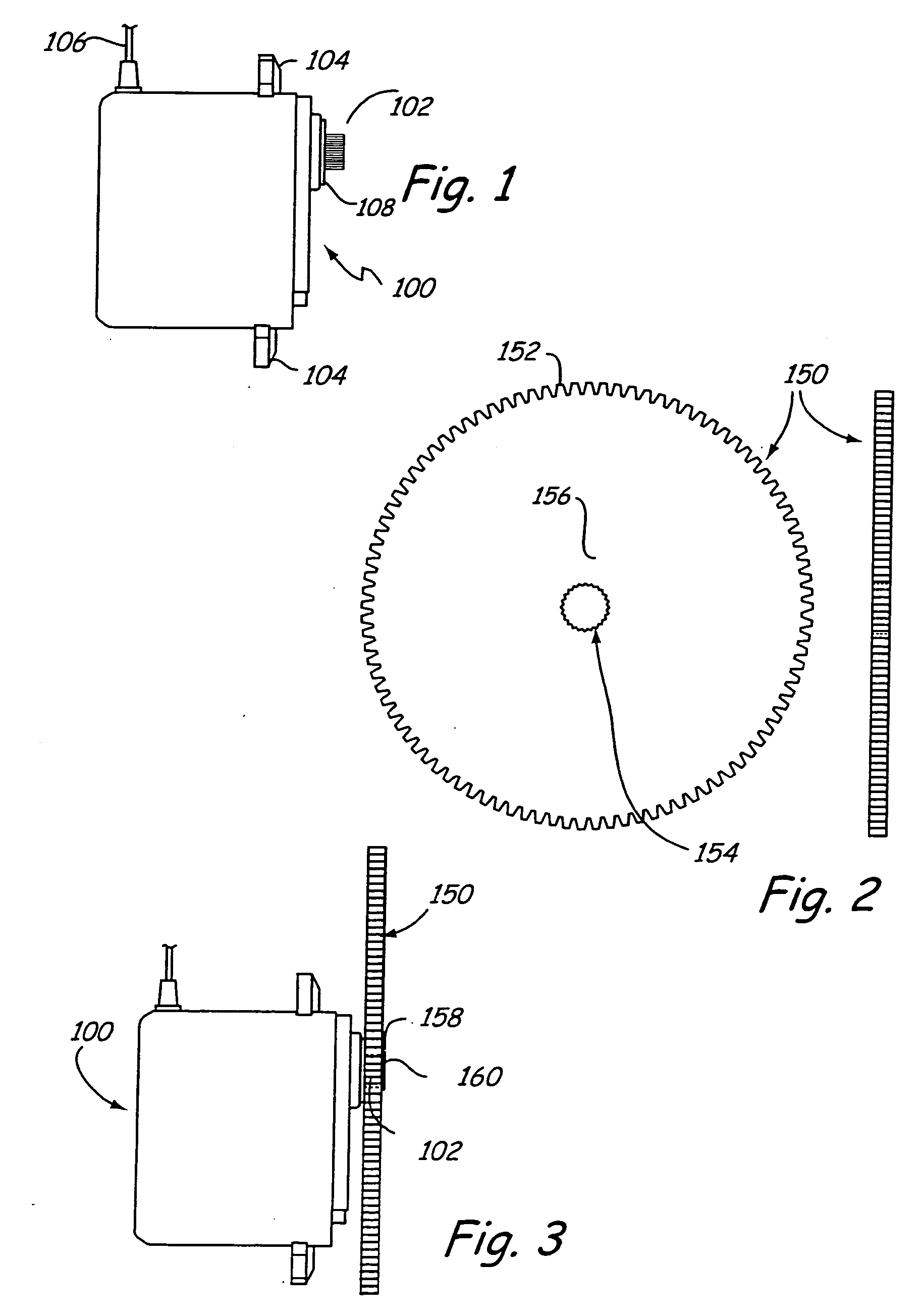
[0020]FIG. 1 is a side view of a hobby servo 100. Servo 100 includes attachment flanges 104. Flanges 104 typically include apertures formed therein for receiving an attachment mechanism (e.g., a screw, bolt, etc). The attachment mechanism is utilized to secure servo 100 within an operative environment. Servo 100 also includes an electrical connection 106 that enables the servo to receive electrical power and / or control signals.
[0021] Servo 100 includes a rotatable output shaft 102 also known as a servo spline. The servo output shaft 102 can be positioned to specific angular positions in accordance with a coded signal received by the servo. It is common that a particular angular position will be maintained as long as a corresponding coded signal exists on an input line. If the coded signal changes, the angular position of the servo output shaft 102 will change accordingly. Control circuits and a potentiometer are typically included within the illustrated outer housing of servo motor...
PUM
| Property | Measurement | Unit |
|---|---|---|
| Rotation | aaaaa | aaaaa |
| angles | aaaaa | aaaaa |
| diameter | aaaaa | aaaaa |
Abstract
Description
Claims
Application Information
 Login to View More