
Autoclaveable small-volume dropper bottle
a dropper bottle and autoclave technology, applied in the field of dropper bottles, can solve the problems of difficult to squeeze the dropper bottle, no small-volume container closure is suitable, and the drying heat sterilization requires much higher temperatures and is not as effectiv
- Summary
- Abstract
- Description
- Claims
- Application Information
AI Technical Summary
Benefits of technology
Problems solved by technology
Method used
Image

Examples
Embodiment Construction
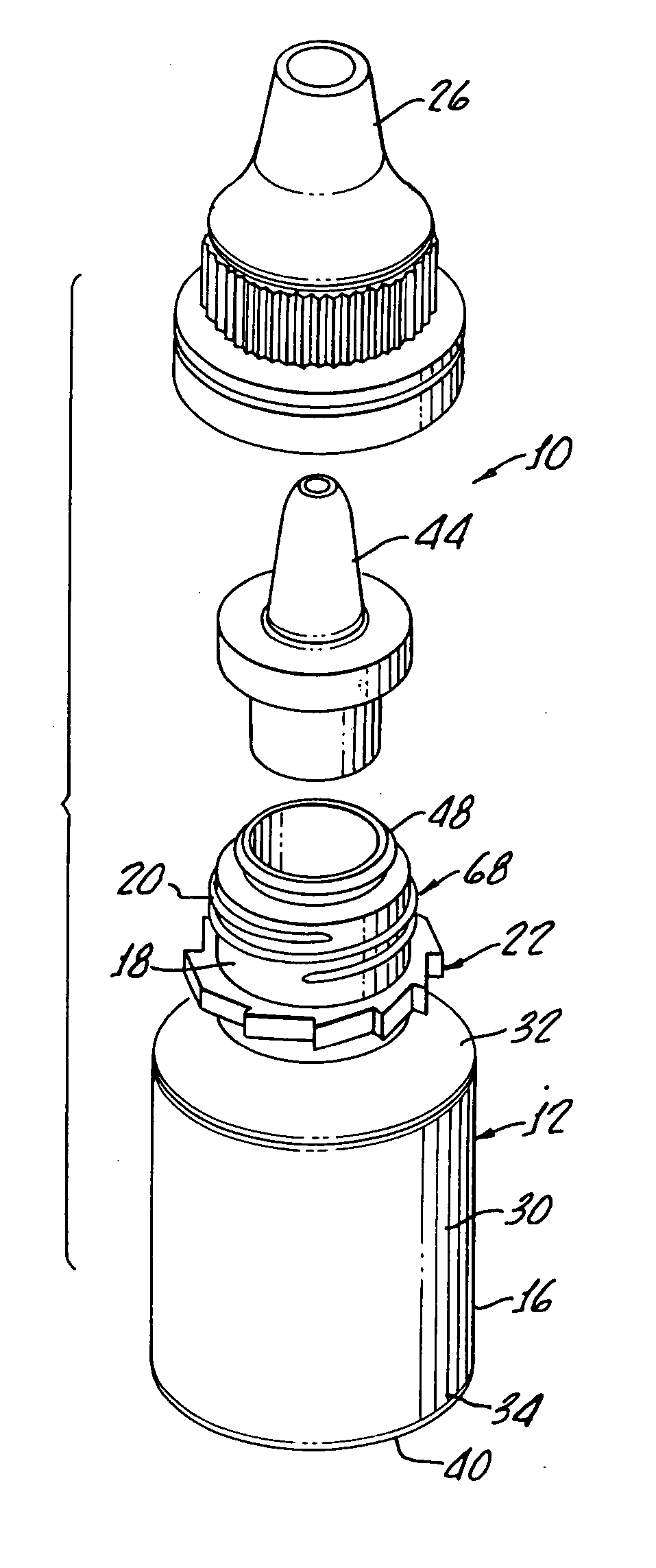
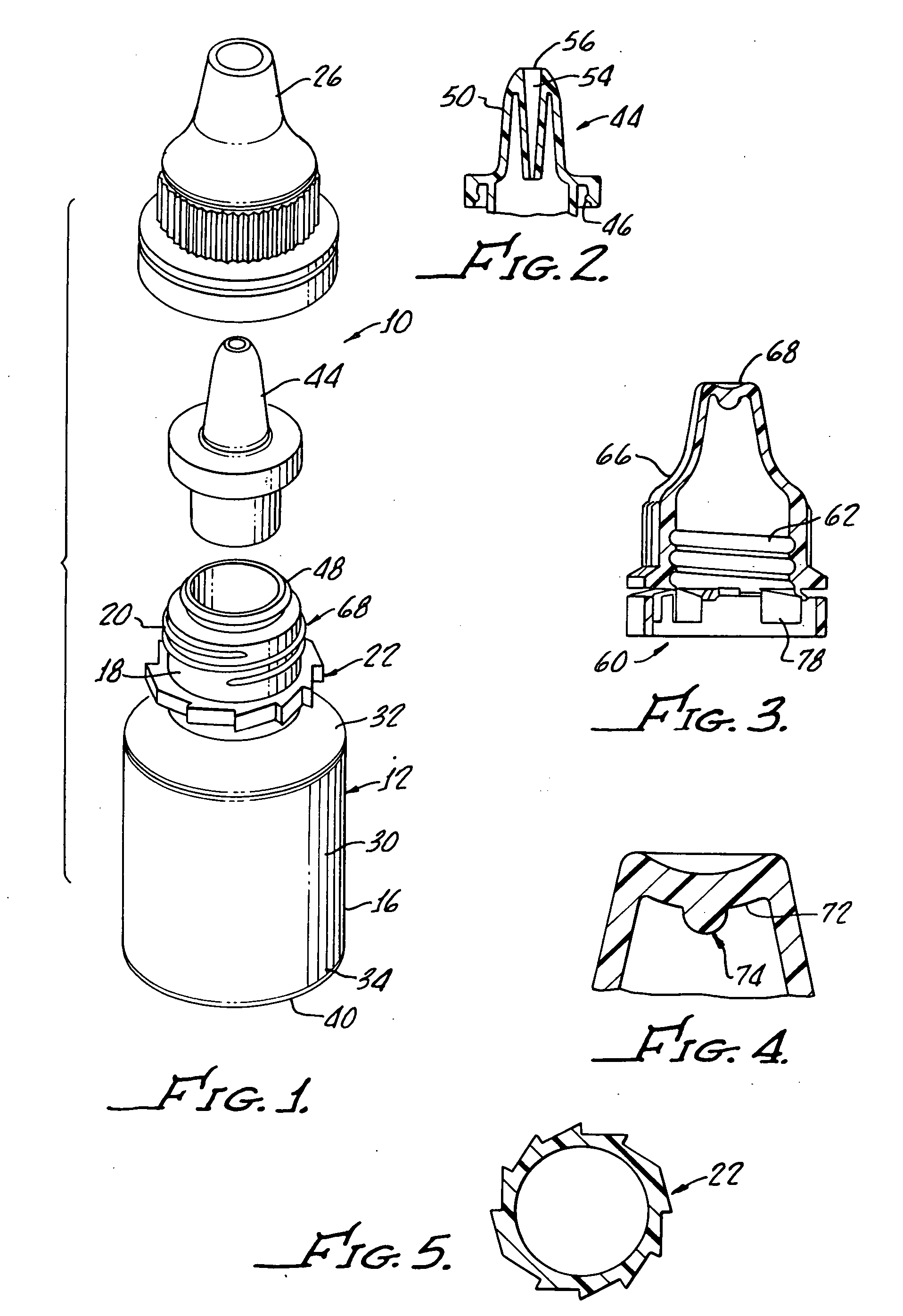
[0028] With reference to FIG. 1, there is shown a terminally sterilizable container 10 including a polypropylene bottle 12 having a manually squeezable sidewall 16 which is formed with a thickness, as hereinafter described, which both enables manual squeezing of the bottle 12 while at the same time preventing more than about 5% water loss over a period of about 24 months.
[0029] As shown, the bottle includes a neck 18 with threads 20 molded therein along with a ratchet 22 for providing secure closure with a cap 26 in a tamper proof manner, as will be hereinafter described in greater detail.
[0030] The bottle includes a body 30 having a top rounded shoulder 32 below the neck 18 and a bottom rounded shoulder 34 subtending a concave bottle bottom 40 and the sidewall 16.
[0031] Preferably, the bottle is formed from a polypropylene provided by Phillips Marlex HLM-020 and for a 5 mL bottle has a wall thickness of between about 0.022 inches and about 0.24 inches to provide both flexibility...
PUM
 Login to View More
 Abstract
Description
Claims
Application Information
 Login to View More