
Authenticating an application
a technology for authenticating applications and applications, applied in the field of authentication, can solve the problems of affecting the usability of service usage, adding significantly to the cost of service providers, and requiring all service providers to trust the source of configuration data, etc., and achieves the effect of convenient movemen
- Summary
- Abstract
- Description
- Claims
- Application Information
AI Technical Summary
Benefits of technology
Problems solved by technology
Method used
Image

Examples
Embodiment Construction
[0036]Reference will now be made in detail to the embodiments of the present invention, examples of which are illustrated in the accompanying drawings.
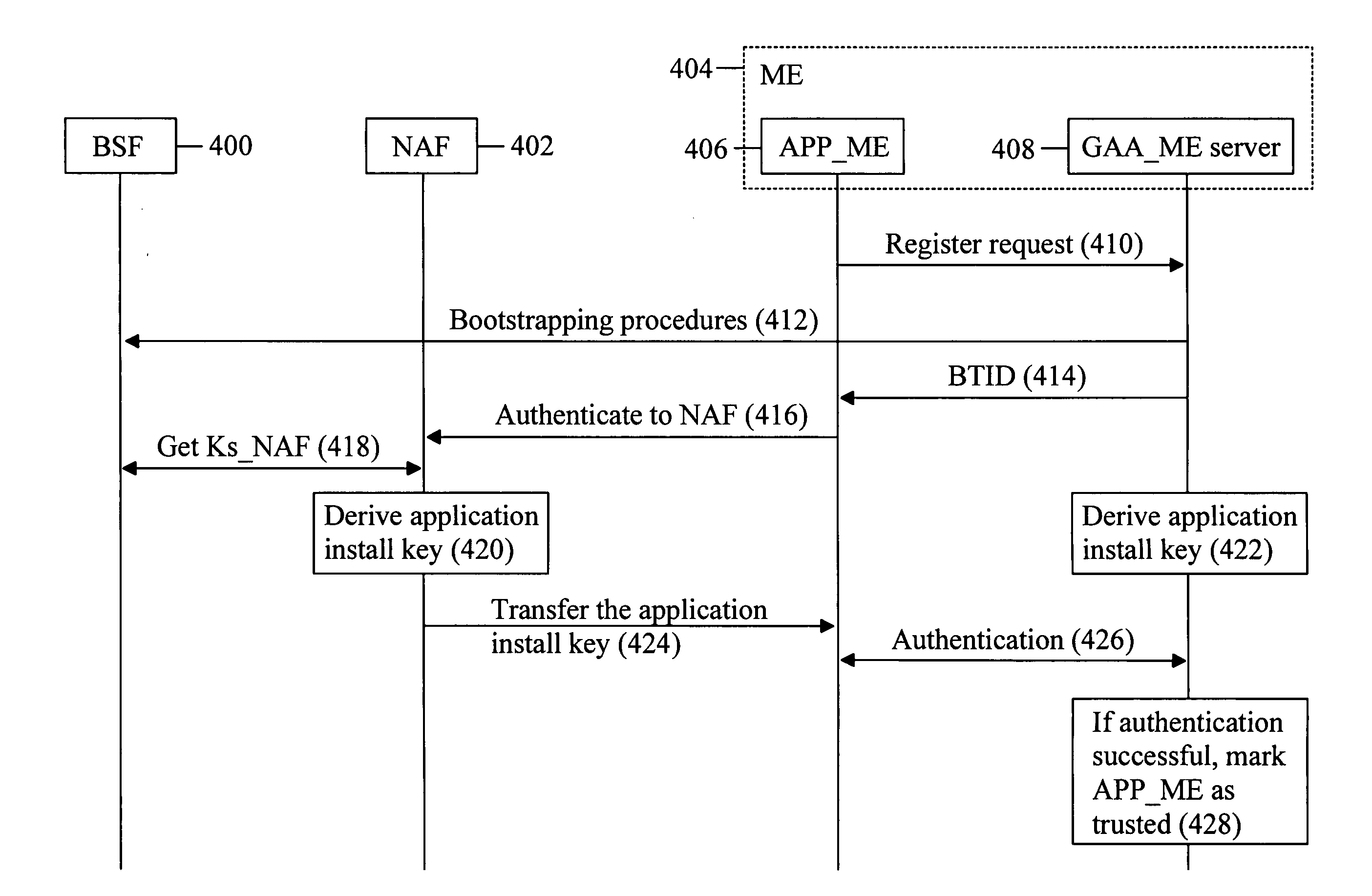
[0037]FIG. 3 discloses a block diagram that illustrates various elements that may take part in the solution disclosed in the invention at hand. FIG. 3 discloses five different entities: Mobile Equipment (ME) 300, a Bootstrapping Server Function (BSF) 302, a Network Application Function (NAF) 306, a Home Subscriber System (HSS) 304 and a computer 308. The block diagram of FIG. 3 takes into also account a split-terminal situation. In a split-terminal situation a local application 320 resides e.g. in the computer 308. The local application is connected to a GAA_ME server of mobile equipment 314 via a GAA module 318 and a proximity module 312. The actual connection between mobile equipment 314 and the computer 308 is accomplished e.g. via a proximity link, e.g. Bluetooth. APP_ME 310 is a (client) application that is installed in mobile eq...
PUM
 Login to View More
 Abstract
Description
Claims
Application Information
 Login to View More