Conformable wide wall angle

US20090139158A1Inactive Publication Date: 2009-06-04USG INTERIORS LLC
33 Cites 2 Cited by

Patent Information

Authority / Receiving Office
US · United States
Current Assignee / Owner
Publication Date
2009-06-04
Estimated Expiration
Not applicable · inactive patent

Smart Images

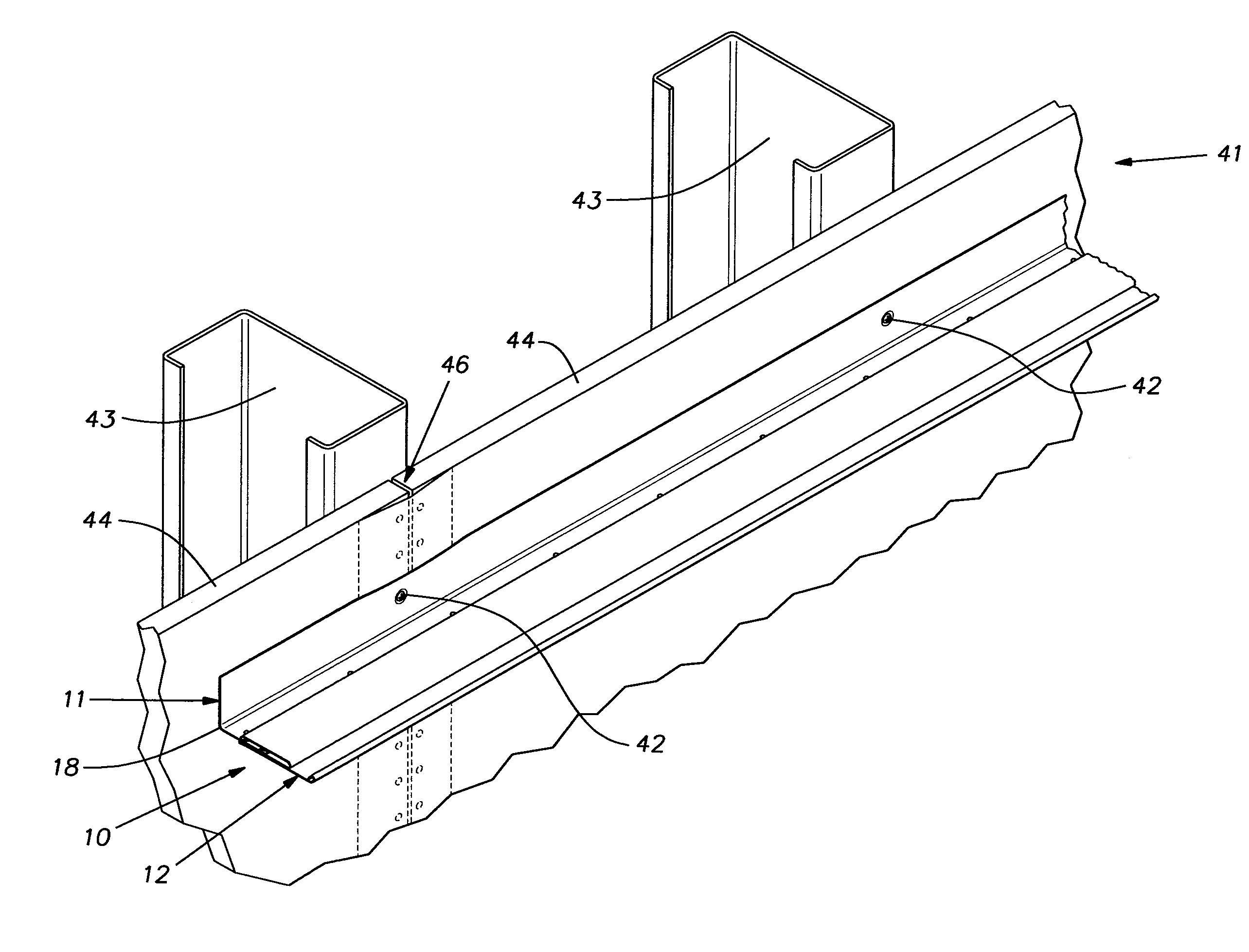
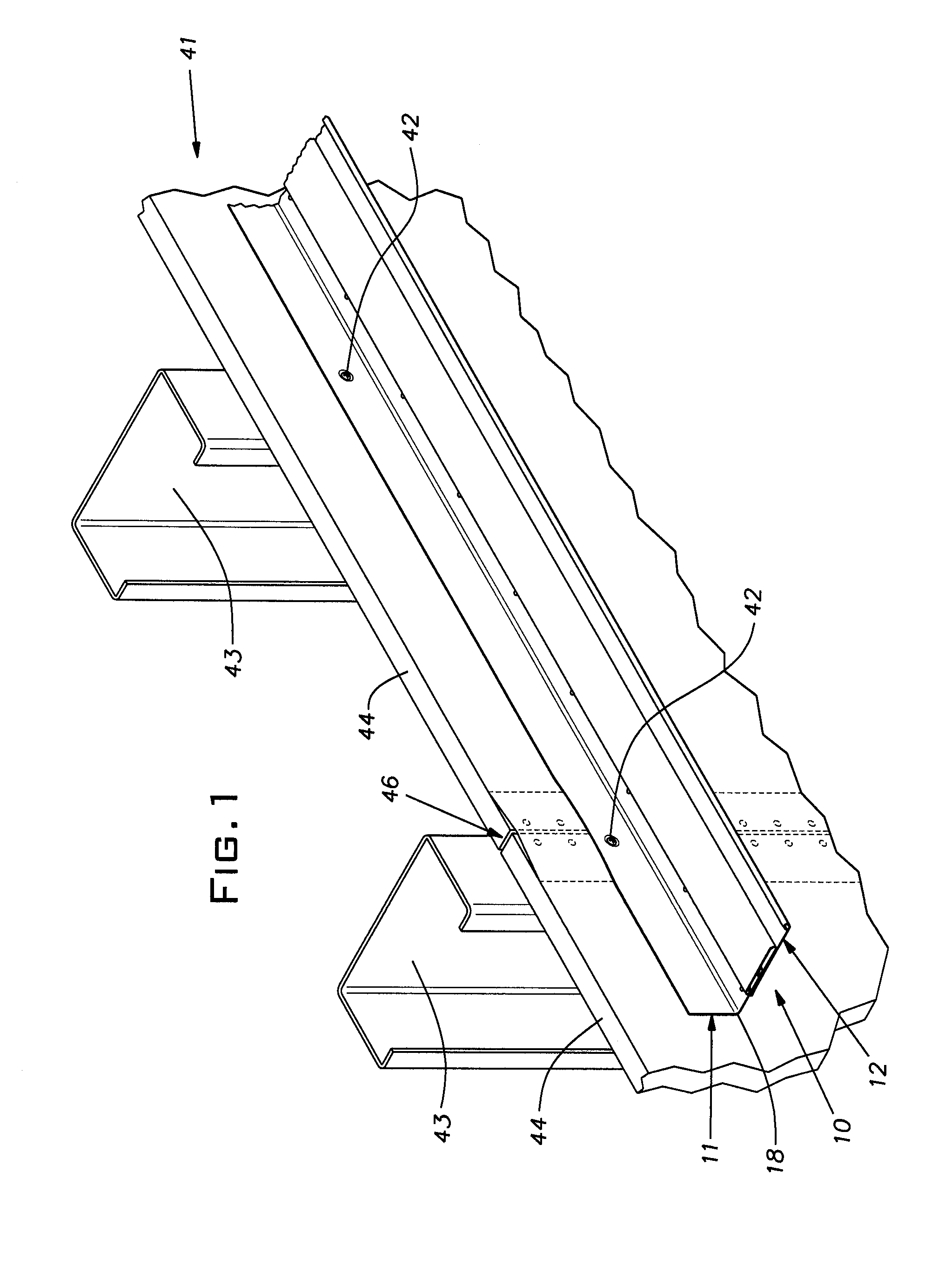
  • Figure 1
    Figure 1
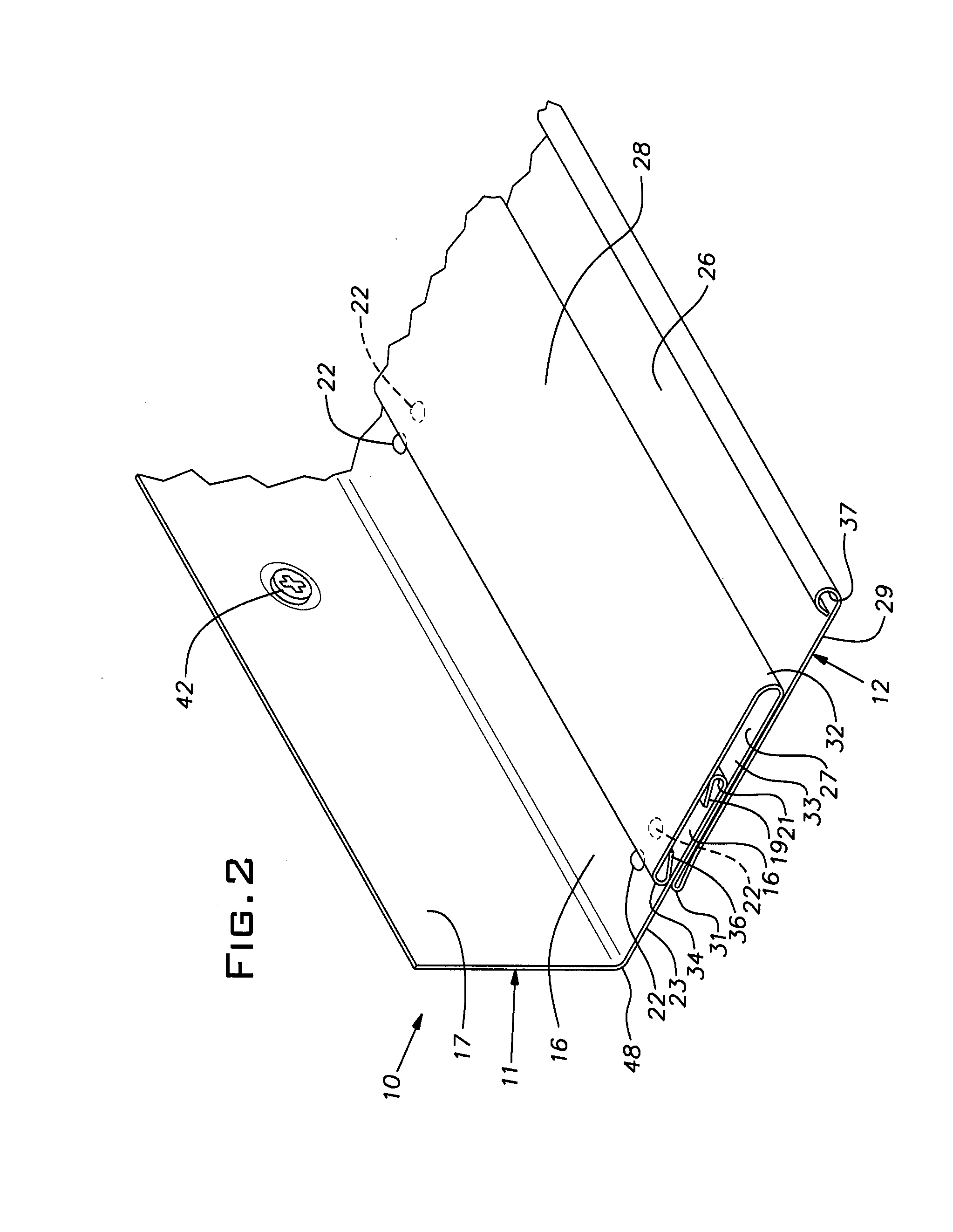
  • Figure 2
    Figure 2
  • Figure 3
    Figure 3
Patent Text Reader

Abstract

A wide wall angle useful in locations of seismic activity to support ceiling tile and grid tees of a suspended ceiling comprising an assembly of an elongated base angle and an elongated extension strip, the base angle having generally perpendicular legs integral with one another and intersecting at a longitudinally extending corner, one leg being adapted to be fixed against a wall with the corner down, and the other adapted to project horizontally from the wall, the extension strip having a face with greater than the width of the horizontal leg, the extension strip having a multiple layer construction, two layers of the extension strip being held together in close parallel relation by an intermediate web integral with the layers, at least portions of the two layers being arranged to frictionally engage at least a part of the horizontal leg of the base angle spaced from the corner such that the strip can be assembled on and frictionally retained on the horizontal leg of the base angle, the horizontal leg of the base angle being disposed between the two layers of the extension strip.
Need to check novelty before this filing date? Find Prior Art

Description

BACKGROUND OF THE INVENTION

[0001] The invention relates to accessories for suspended ceilings and, in particular, to a novel wall angle especially suited for use in locations of potential seismic activity.PRIOR ART

[0002] In conventional suspended ceiling installations, wall angle is typically used along the walls to support the edges of ceiling tiles and ends of cross tees. In cases of expected seismic activity, the wall angle can be specified to be significantly wider than the normal width so that the risk of the ceiling tiles or grid elements slipping off during an earthquake of limited magnitude is reduced. Conventional wide faced wall angle frequently presents a problem because walls are seldom flat. Walls regularly deviate from an ideal flat plane for various reasons. A common reason for a wall to depart from a flat plane is the presence of taped joints in drywall type construction particularly where the joints are between non-tapered panel edges. Such joints can be almost imperc...

Examples

Embodiment Construction

[0007]A wall angle 10 constructed in accordance with the invention is a two-part assembly comprising a base angle 11 and an extension strip 12. The wall angle 10 is especially suited for seismic applications by virtue of having a relatively wide horizontal side indicated generally at 13. Both the base angle and extension strip components 11, 12 are unitary or one-piece elements preferably made of roll-formed sheet metal, typically steel or, less commonly, aluminum. The metal strips forming these components 11, 12 can be coated, plated or otherwise treated to impart corrosion resistance and whether or not so treated, are usually finish painted for improved appearance. Such treatments and painting are ordinarily done before roll forming of the components 11, 12.

[0008]The base angle 11 and extension strip 12 are provided in standard lengths of, for example, 10 foot or 12 foot or metric equivalent. The base angle 11 and extension strip 12 have their profiles drawn to scale in the figure...