Unlock instant, AI-driven research and patent intelligence for your innovation.

System for distributing an alarm indication to a dynamically configured set of alarm systems

a dynamic configuration and alarm system technology, applied in the direction of alarms, instruments, etc., can solve the problems of inability to benefit from the alarm indications produced by the system, the existing 911 and reverse 911 systems are not integrally coordinated, and the inability of existing 911 and reverse 911 systems to properly warn individuals located in the affected area

Inactive Publication Date: 2009-12-31
EMERGENCY ALERTS INNOVATIONS LLC
View PDF11 Cites 11 Cited by
  • Summary
  • Abstract
  • Description
  • Claims
  • Application Information

AI Technical Summary

Benefits of technology

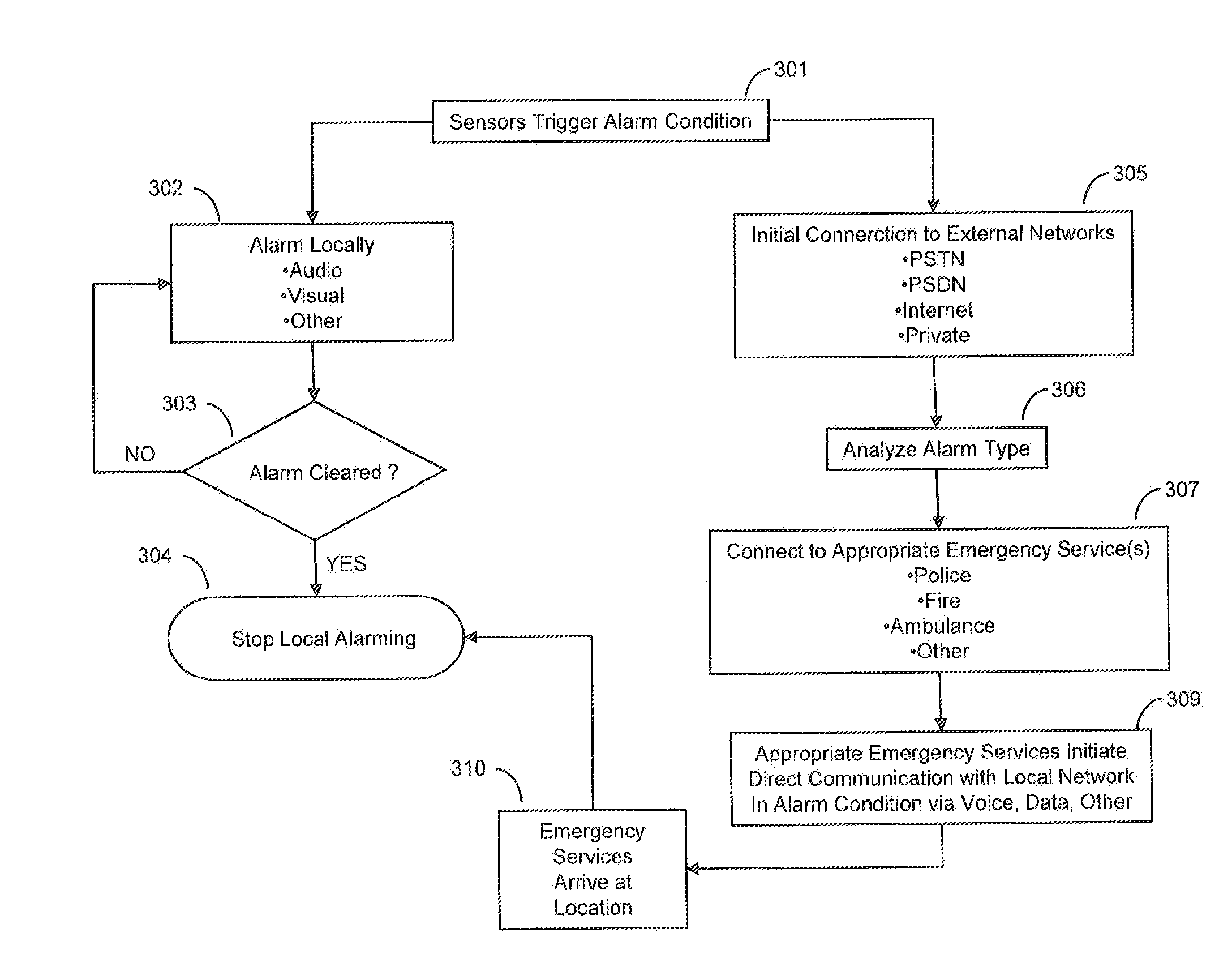
[0008]The present System For Distributing An Alarm Indication To A Dynamically Configured Set Of Alarm Systems (termed “Reverse 911 Alarm System” herein) solves the above-described problems by implementing a central alarm distribution site that is capable of generating an alarm indication to warn individuals of a hazard and propagating the alarm indication to selected ones of a plurality of alarm systems that are located in the service area of the central alarm distribution site to warn individuals of a hazard. The central alarm distribution site dynamically selects the alarm systems to encompass the present extent of the hazard and can provide advanced warning to individuals located in an area that extends beyond the present hazard extent area. The present Reverse 911 Alarm System thereby integrates the operation of alarm systems with the 911 and Reverse 911 services to provide efficient and comprehensive distribution of alarm indications to the individuals who are impacted by an emergency situation.
[0010]By making use of existing installed alarm systems, the Reverse 911 Alarm System can propagate alarm indications to targeted areas using different alarm delivery modes. The coverage area of the alarm distribution can be dynamically altered in response to the changing area impacted by the hazard, and different alarm indications can be provided to different coverage areas or classes of individuals to customize the warning and provide accurate updated information to individuals located in the area.

Problems solved by technology

It is a problem in the field of alarm systems that there are numerous hazards that can be threatening to the occupants of a dwelling or a predetermined locale; and where such a hazard encompasses a widespread area, existing alarm systems are inadequate to properly warn individuals located in the impacted area.
Furthermore, existing 911 and Reverse 911 systems are not integrally coordinated with the operation of alarm systems and thereby fail to benefit from the alarm indications produced by these systems.
However, the audible alarm only alerts individuals who are presently located proximate to the active autonomous alarm device.
However, the integrated home protection systems are unable to respond to communications that are received from a Public Safety Answering Point (PSAP).
Therefore, existing alarm systems fail to propagate an alarm indication beyond the bounds of their installation, except for an automatic notification transmitted to the police / fire department that serves the locale in which the alarm system is installed.
These alarm systems also fail to provide the ability to receive communications from external sources in response to an alarm event, or provide output devices that are networked to cover a spatial area that may not be coextensive with the spatial area covered by the alarm devices.
This process is time consuming, since the number of calls can be significant, and also fails to include cellular telephones in the reverse 911 call list.
In addition, in a very large metropolitan area, the sheer volume of one-to-one connections, data or voice, can overload the telecommunications infrastructure.
Therefore, existing Reverse 911 systems are slow, prone to miss numbers due to a failure to answer, and do not cover all parties in the impacted area.

Method used

the structure of the environmentally friendly knitted fabric provided by the present invention; figure 2 Flow chart of the yarn wrapping machine for environmentally friendly knitted fabrics and storage devices; image 3 Is the parameter map of the yarn covering machine
View more

Image

Smart Image Click on the blue labels to locate them in the text.
Viewing Examples
Smart Image
  • System for distributing an alarm indication to a dynamically configured set of alarm systems
  • System for distributing an alarm indication to a dynamically configured set of alarm systems
  • System for distributing an alarm indication to a dynamically configured set of alarm systems

Examples

Experimental program
Comparison scheme
Effect test

Embodiment Construction

[0017]There are numerous hazards that can be threatening to the occupants of a dwelling (to include, but not limited to, a factory, office, commercial establishment, public building, or school campus) or those present in a predetermined locale. Autonomous alarm devices are available to detect the presence of a predetermined level, concentration, or intensity of the hazard and automatically generate an alarm indication, such as a loud sound, to alert the individuals in the vicinity of the alarm device of the presence of the hazard.

[0018]Alarm systems, such as those described in the above-noted U.S. Pat. No. 7,301,455 and the above-noted U.S. application titled “Self-Configuring Emergency Event Alarm System With Autonomous Output Devices” typically include multiple alarm devices and the associated output devices, each of which generates human sensible alarm indications in response to the receipt of an alarm indication. The output devices can be integrated into the alarm devices or can...

the structure of the environmentally friendly knitted fabric provided by the present invention; figure 2 Flow chart of the yarn wrapping machine for environmentally friendly knitted fabrics and storage devices; image 3 Is the parameter map of the yarn covering machine
Login to View More

PUM

No PUM Login to View More

Abstract

The present Reverse 911 Alarm System implements a central alarm distribution site that is capable of generating an alarm indication to warn individuals of a hazard and propagating the alarm indication to selected ones of a plurality of alarm systems that are located in the service area of the central alarm distribution site to warn individuals of a hazard. The central alarm distribution site creates an integrated Reverse 911 system which dynamically selects the alarm systems to encompass the present extent of the hazard and can provide advanced warning to individuals located in an area that extends beyond the present hazard extent area.

Description

CROSS-REFERENCE TO RELATED APPLICATIONS[0001]This application is related to a U.S. application titled “System For Controlling The Operation Of A Wireless Multicasting System To Distribute An Alarm Indication To A Dynamically Configured Coverage Area”, and a U.S. application titled “System For Controlling The Operation Of Both Wireless Multicasting Systems And Alarm Systems To Distribute An Alarm Indication To A Dynamically Configured Coverage Area”, both filed on the same date as the present application and incorporating the disclosures of each herein.FIELD OF THE INVENTION[0002]This invention relates to a Reverse 911 alarm system that propagates an alarm indication throughout an impacted area by transmitting the alarm indication to output devices which are sited in fixed locations as part of one or more alarm networks which are operable in the impacted area.BACKGROUND OF THE INVENTION[0003]It is a problem in the field of alarm systems that there are numerous hazards that can be thr...

Claims

the structure of the environmentally friendly knitted fabric provided by the present invention; figure 2 Flow chart of the yarn wrapping machine for environmentally friendly knitted fabrics and storage devices; image 3 Is the parameter map of the yarn covering machine
Login to View More

Application Information

Patent Timeline
no application Login to View More
Patent Type & Authority Applications(United States)
IPC IPC(8): G08B21/00
CPCG08B25/006G08B27/006G08B27/001
Inventor MCKENNA, DANIEL B.GRAZIANO, JAMES M.
Owner EMERGENCY ALERTS INNOVATIONS LLC
Features
  • R&D
  • Intellectual Property
  • Life Sciences
  • Materials
  • Tech Scout
Why Patsnap Eureka
  • Unparalleled Data Quality
  • Higher Quality Content
  • 60% Fewer Hallucinations
Social media
Patsnap Eureka Blog
Learn More