[0007]The present invention addresses the above
disadvantage. Thus, it is an objective of the present invention to provide a
motion control system of a vehicle, which can effectively limit the pitching during the braking period of the vehicle and can maintain the good ride feeling of the occupant(s) during the non-braking period of the vehicle without providing a dedicated mechanism in suspensions of the vehicle.
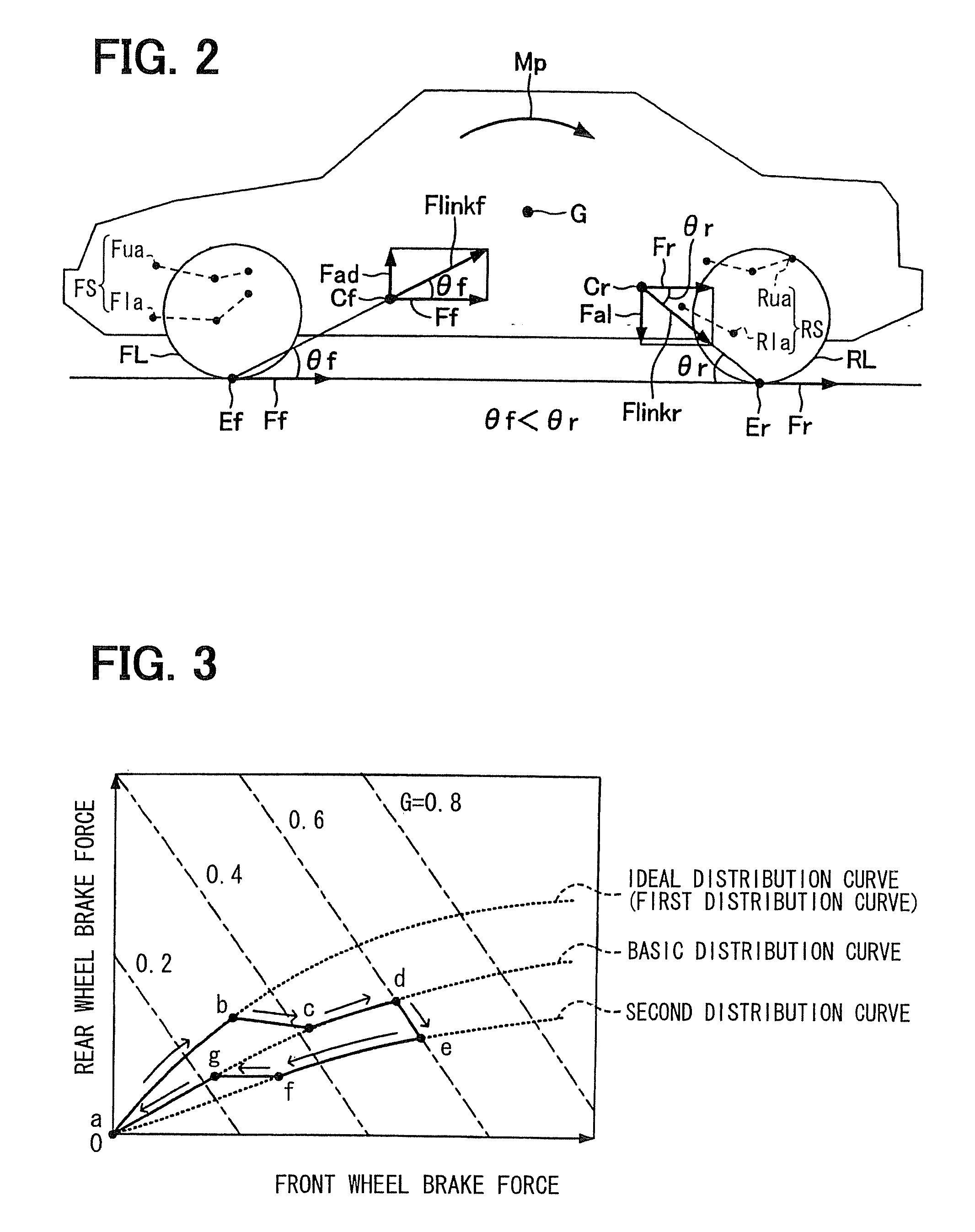
[0012]Therefore, the amount of increase in the degree of the anti-lift effect caused by the increase in the
brake force respectively applied to the plurality of rear wheels upon changing of the basic distribution to the first distribution becomes larger than the amount of decrease in the degree of the anti-dive effect caused by the decrease in the
brake force respectively applied to the plurality of front wheels upon changing of the basic distribution to the first distribution. That is, when the entire vehicle is viewed, in the state of the first distribution, the anti-pitching effect is increased in comparison to that of the basic distribution. Specifically, the increasing of the
pitch angle becomes difficult.
[0013]With the above construction, in the state where the
pitch angle may possibly show the large disorder upon starting of the abrupt application of the brakes, the
brake force distribution between the plurality of front wheels and the plurality of rear wheels is changed from the basic distribution to the first distribution. In this way, the anti-pitching effect can be increased to limit the increase in the
pitch angle without a need for providing the dedicated mechanism to the suspensions. As a result, the pitching (the disorder in the
pitch angle) during the braking period is effectively limited while maintaining the good ride feeling of the occupant(s) during the non-braking period by adapting the suspensions, which have the anti-pitching geometry that does not show the large anti-pitching effect.
[0014]In addition, with the above construction, the time period for adjusting the brake force distribution between the plurality of front wheels and the plurality of rear wheels to the first distribution is limited to the time period between the time of starting the abrupt application of the brakes and the time of changing of the
angular acceleration of the
pitch angle from the positive range to the negative range (i.e., the time of changing from the increasing state of the angular speed of the
pitch angle to the decreasing state of the angular speed of the pitch angle). Here, as will be described below, when the time period for adjusting the brake distribution between the plurality of front wheels and the plurality of rear wheels is limited in the above described manner, it is possible to accelerate convergence of the pitching motion (see FIGS. 5A to 5C). In this way, the brake distribution between the plurality of front wheels and the plurality of rear wheels can be returned to the basic distribution in the early stage while accelerating the convergence of the pitching motion.
[0017]Therefore, the amount of decrease in the degree of the anti-lift effect caused by the decrease in the brake force respectively applied to the plurality of rear wheels upon changing of the basic distribution to the second distribution becomes larger than the amount of increase in the degree of the anti-dive effect caused by the increase in the brake force respectively applied to the plurality of front wheels upon changing of the basic distribution to the second distribution. That is, when the entire vehicle is viewed, in the state of the second distribution, the anti-pitching effect is decreased in comparison to that of the basic distribution. Specifically, the decreasing of the pitch angle becomes difficult.
[0018]With the above construction, in the state where the pitch angle may possibly show the large disorder upon starting of the abrupt release of the brakes, the brake force distribution between the plurality of front wheels and the plurality of rear wheels is changed from the basic distribution to the second distribution. In this way, the anti-pitching effect can be decreased to limit the decrease in the pitch angle without a need for providing the dedicated mechanism to the suspensions. As a result, the pitching (the disorder in the pitch angle) during the braking period is effectively limited.


 Login to View More
  Login to View More