
Compositions incorporating sesamin-class compounds and vitamin b1 class compounds
- Summary
- Abstract
- Description
- Claims
- Application Information
AI Technical Summary
Benefits of technology
Problems solved by technology
Method used
Image

Examples
example 1
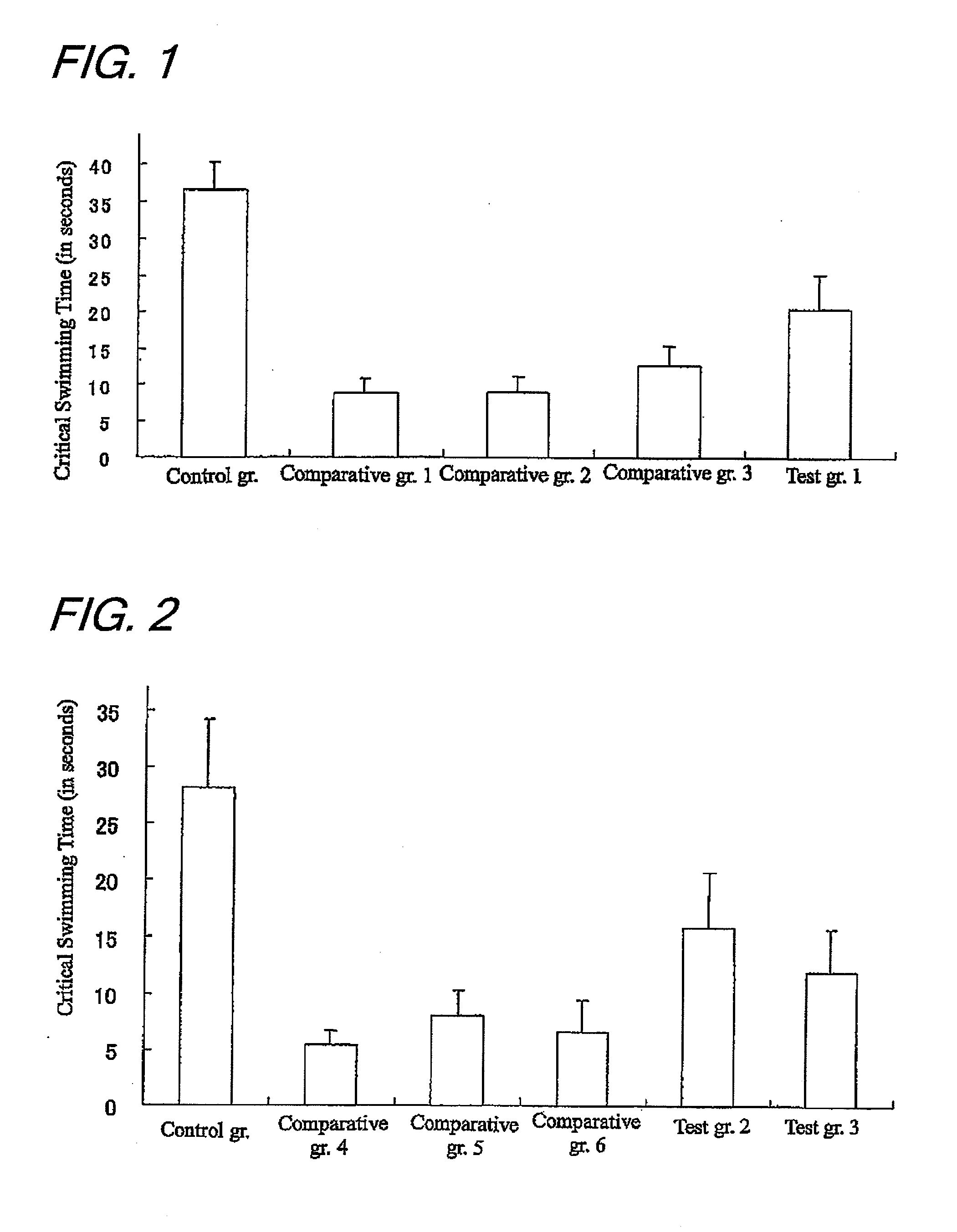
[0072]Anti-Fatigue Action (1) from Vitamin B1 Class Compound and Sesamin-Class Compounds
[0073]A sesamin / episesamin mixture (sesamin:episesamin=5:5 in weight ratio) was used as sesamin-class compounds under test and thiamine hydrochloride (from NACALAI TESQUE) was used as a vitamin B1 class compound.
[0074]The anti-fatigue effect was evaluated by the following partial modification of the method of Tanaka et al. (Neuroscience, Let. 352, 159-162, 2003): Balb / c male mice (8-week old) were purchased from Japan SLC, Inc. and conditioned in a test environment for a week, and the animals that had grown normally were subjected to the test. They were divided into five groups, as identified in Table 1, such that each group consisted of 10 animals and had the same average body weight. The values indicated in Table 1 for the amount of vitamin B1 class compound administered are based on the amount of thiamine hydrochloride as calculated for thiamin. Four of those five groups were water immersion g...
example 2
[0077]Anti-Fatigue Action (2) from Vitamin B1 Class Compound and Sesamin-Class Compounds
[0078]The anti-fatigue action from vitamin B1 class compound and sesamin-class compounds was evaluated as in Example 1, except that the mice were divided into six groups as identified in Table 2 and that the time it took for each mouse to have its nose finally submerged in water (and incapable of rising up to its surface again) was measured as the critical swimming time. The values indicated in Table 2 for the amount of vitamin B1 class compound administered are based on the amount of thiamine hydrochloride as calculated for thiamin.
TABLE 2Test SamplesAmount of sesamin-classAmount of Vitamin B1 classGroupMethod of breedingcompounds administered(mg / kg*)compound administered(mg / kg*)Control groupNormal0 (olive oil administered)0 (distilled water administered)Comparative group 4Immersion in water0 (olive oil administered)0 (distilled water administered)Comparative group 5Immersion in water0 (olive oi...
example 3
Reference Example
[0080]Anti-Fatigue Action from Independent Administration of Vitamin B1 Class Compound
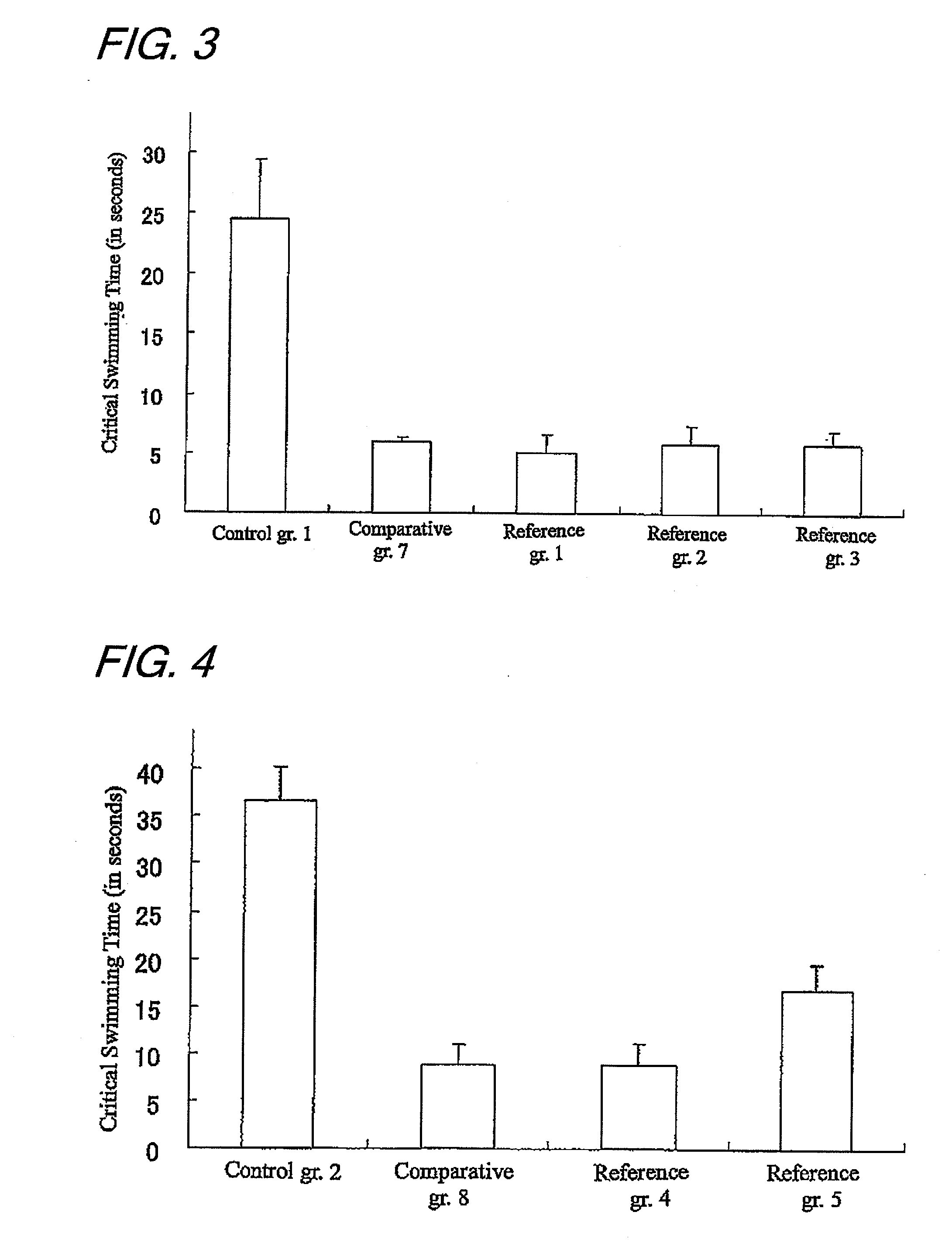
[0081]The anti-fatigue action from independent administration of vitamin B1 class compound was evaluated as in Example 1, except that the mice were divided into nine groups as identified in Tables 3 and 4. The values indicated in Tables 3 and 4 for the amount of vitamin B1 class compound administered are based on the amount of thiamine hydrochloride as calculated for thiamin.
TABLE 3Test SamplesAmount of sesamin-classAmount of Vitamin B1 classGroupMethod of breedingcompounds administered(mg / kg*)compound administered(mg / kg*)Control group 1Normal0 (olive oil administered)0 (distilled water administered)Comparative group 7Immersion in water0 (olive oil administered)0 (distilled water administered)Reference group 1Immersion in water0 (olive oil administered) 5Reference group 2Immersion in water0 (olive oil administered)10Reference group 3Immersion in water0 (olive oil administered)25*th...
PUM
| Property | Measurement | Unit |
|---|---|---|
| Fraction | aaaaa | aaaaa |
| Weight | aaaaa | aaaaa |
Abstract
Description
Claims
Application Information
 Login to View More