
Radio transmitting apparatus and radio transmitting method
a technology of radio transmission and apparatus, applied in the direction of multiplex communication, orthogonal multiplex, assess restriction, etc., can solve the problems of increasing processing delay of association request processing to bs, processing delay by acquiring uplink transmission timing synchronization including ra bursts, etc., to achieve faster initial access processing and improve throughput
- Summary
- Abstract
- Description
- Claims
- Application Information
AI Technical Summary
Benefits of technology
Problems solved by technology
Method used
Image

Examples
embodiment 1
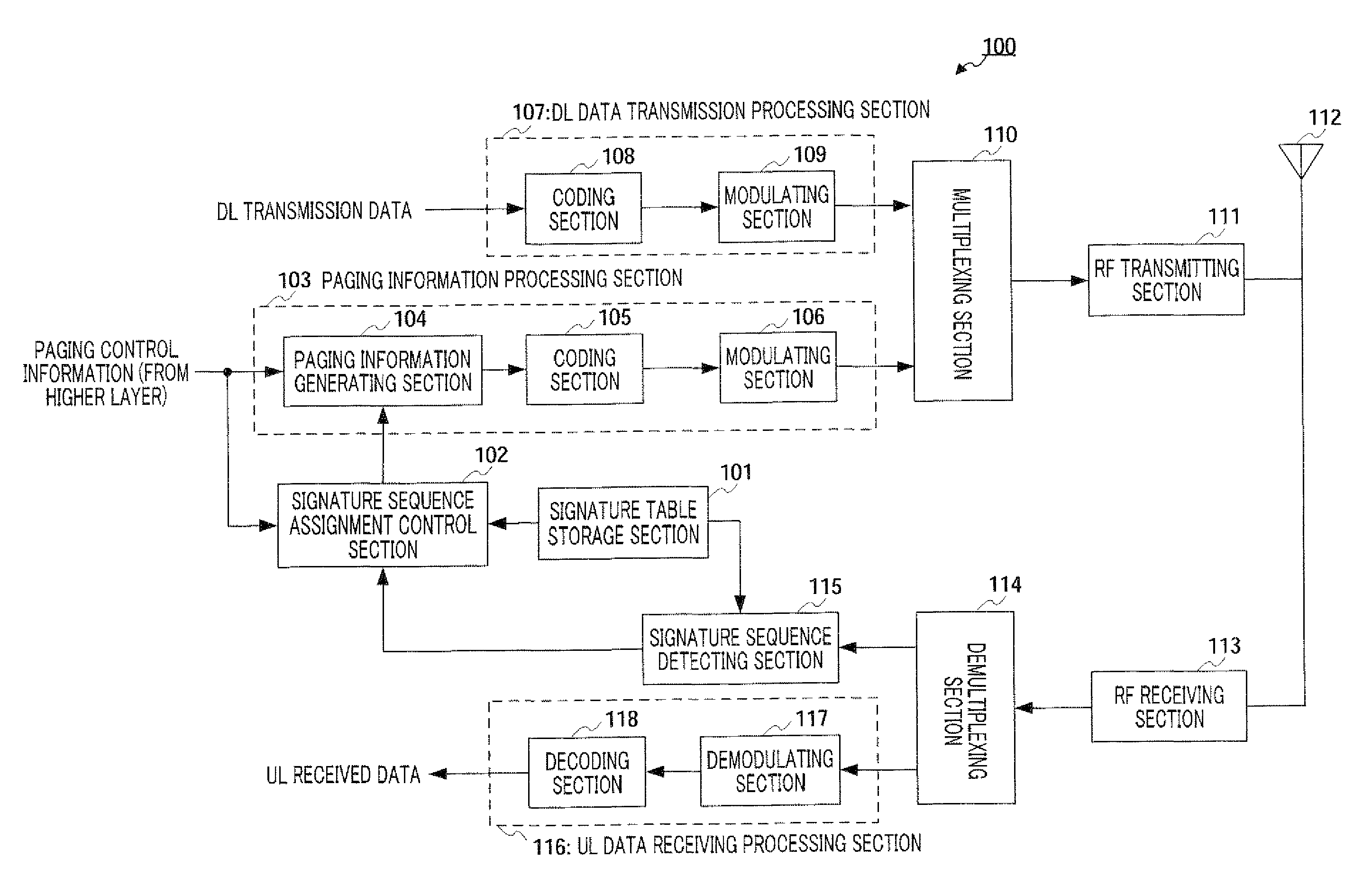
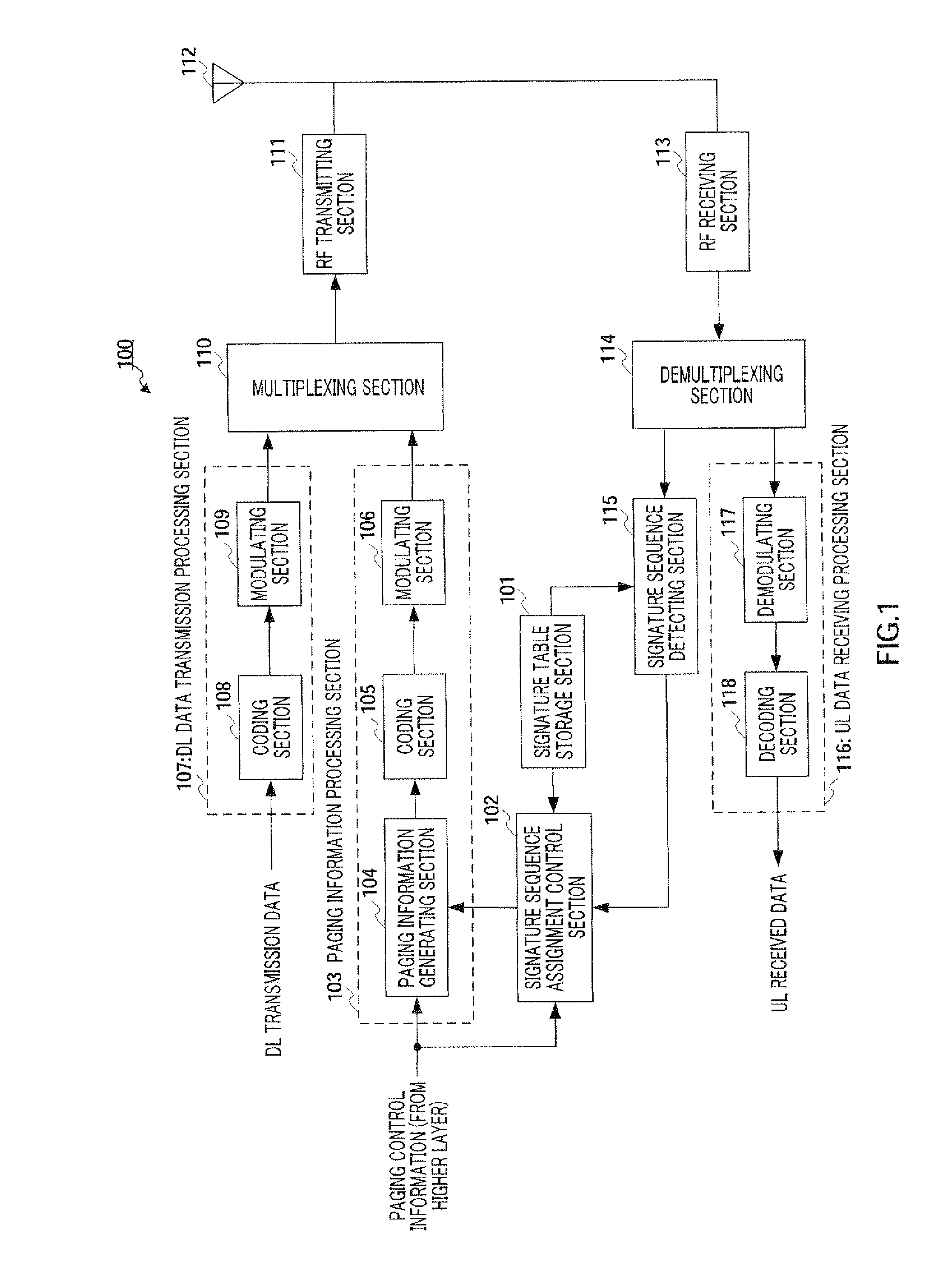
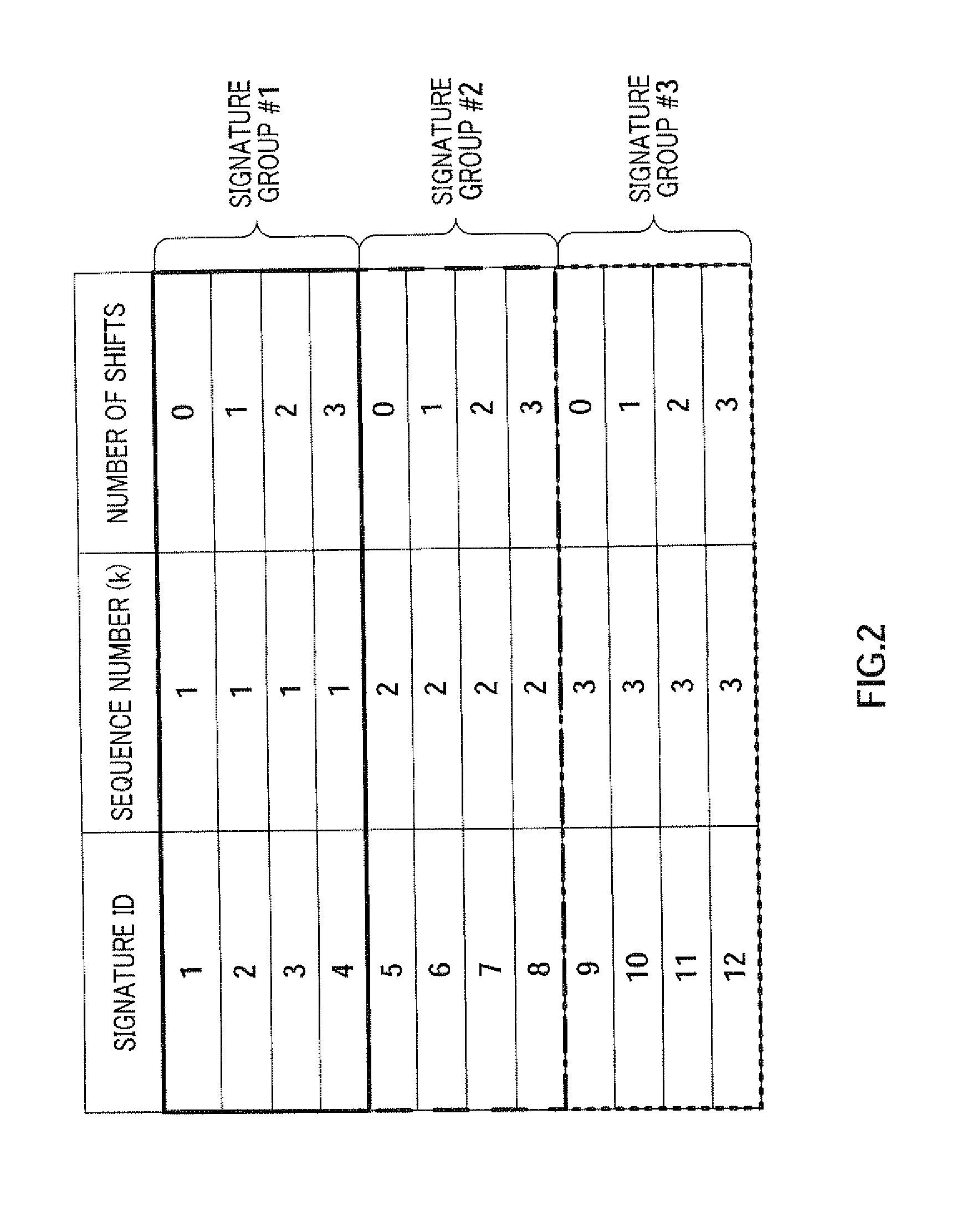
[0028]FIG. 1 is a block diagram showing the configuration of base station apparatus 100 according to Embodiment 1 of the present invention. In this figure, a plurality of signatures generated from a single Zadoff-Chu sequence form a single group (hereinafter “signature group”), and signature table storage section 101 stores a plurality of signature groups generated from a plurality of different Zadoff-Chu sequences. Further, the signature table will be described later in detail.
[0029]Signature sequence assignment control section 102 acquires the identity of the UE targeted for paging from the higher layer (not shown), while reading out a signature sequence from signature table storage section 101 and assigning the read signature sequence to the UE of the paging target. Further, according to a detection result outputted from signature sequence detecting section 115, which will be described later, signature sequence assignment control section 102 decides whether or not to retransmit R...
embodiment 2
[0083]The configurations of the BS and UE according to Embodiment 2 of the present invention are the same as the configurations shown in FIG. 1 and FIG. 3 of Embodiment 1, and will be explained using FIG. 1 and FIG. 3.
[0084]First, in the Zadoff-Chu sequences shown in Embodiment 1, the cross-correlation characteristics between two different sequence numbers k=k1 and k=k2 will be explained. The cross-correlation characteristics have the following relationships. When the greatest common divisor between |k1−k2| and N is one, the peak value of cross-correlation is √N. Further, when the greatest common divisor between |k1−k2| and N is not one, the peak value of the cross-correlation is greater than √N. Further, the peak value of cross-correlation increases in proportion to the scale of the greatest common divisor.
[0085]Although the greatest common divisor between |k1−k2| and N is one with respect to all k's when the sequence length N is a prime number, the sequence length N needs to hold ...
PUM
 Login to View More
 Abstract
Description
Claims
Application Information
 Login to View More