
Container, in Paticular a Self-Supporting Container, and a Method for Producing the Same
a self-supporting, container technology, applied in the field of containers, can solve the problems of complex method, low fiber-volume content, environmental pollution resulting from volatile substances, etc., and achieve the effect of improving material properties and quality
- Summary
- Abstract
- Description
- Claims
- Application Information
AI Technical Summary
Benefits of technology
Problems solved by technology
Method used
Image

Examples
first embodiment
[0062]It is particularly environmentally sound when, as a method of producing an inventive container, a so-called injection method is used, as shown for example in a first embodiment in DE 100 13 409 C1, whose disclosure is fully included in the current notification.
[0063]With the inventive method of the first embodiment (VAP method), in order to produce the container, a dry pre-form, or as the case may be a dry fiber-composite semi-finished material is made, into which dry fabric layers, including, in particular, carbon fiber (CFK), fiberglass (GFK), aramide fiber (AFK), boron fiber (BFK) or hybrid materials are placed in a negative mold. To this, to begin with, an UV-radiation and abrasion-resistant gelcoat is applied to the inside of a negative mold and allowed to dry inside the negative mold. According to the invention, combi-mats are placed in the mold and can be fixated with a spray adhesive. Alternatively, single fiberglass fabrics can also be placed in the negative mold and ...
second embodiment
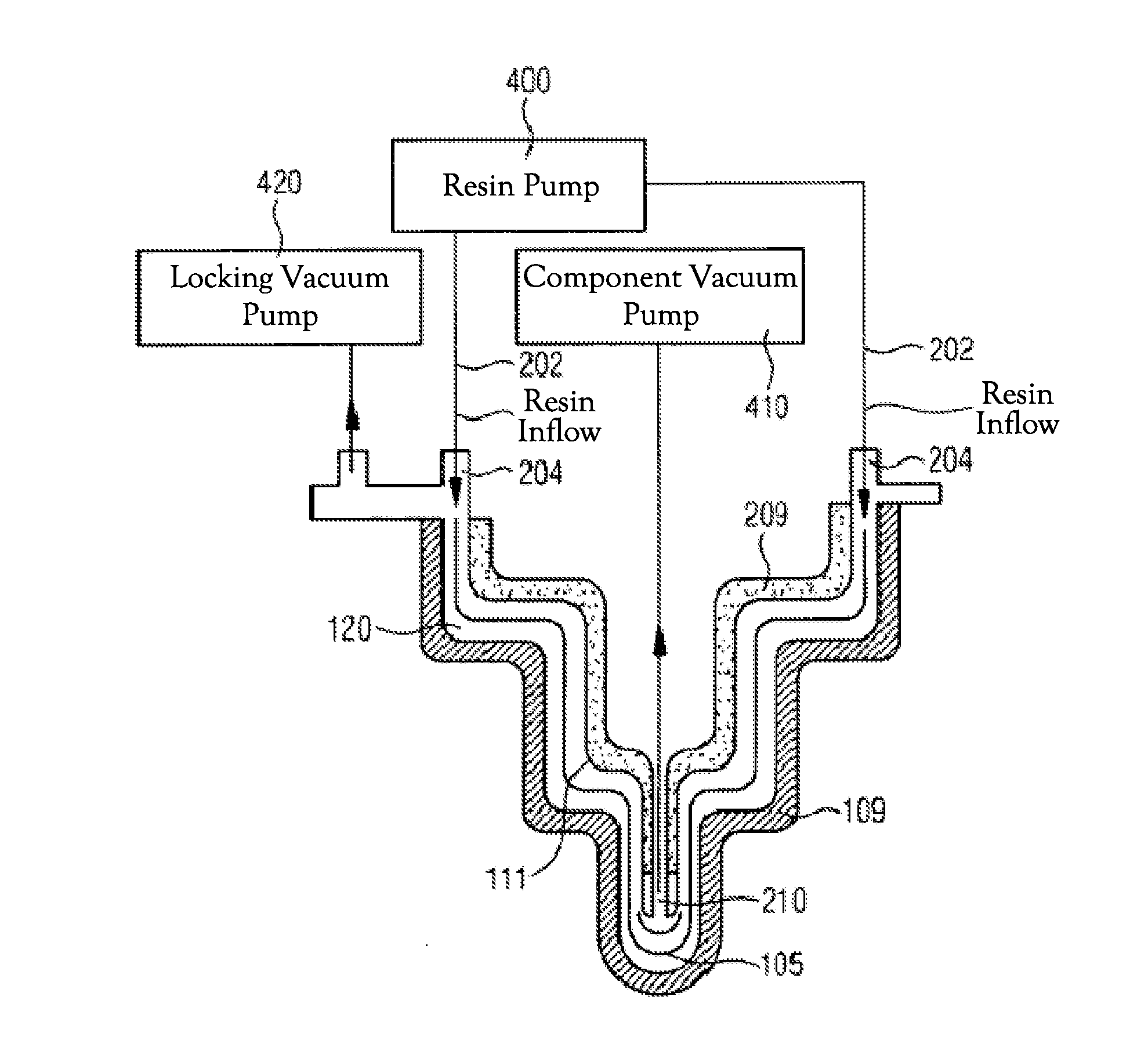
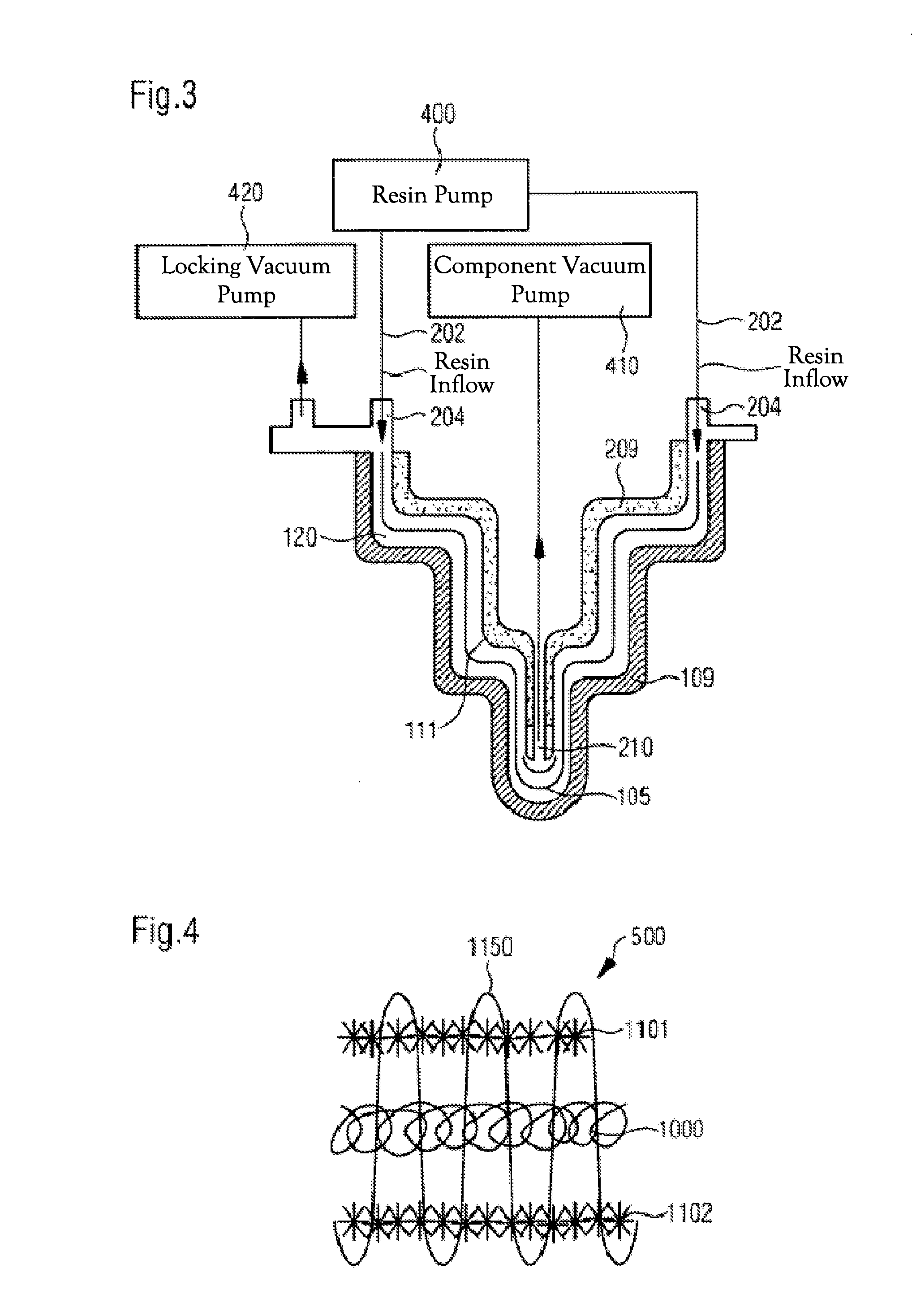
[0092]FIG. 3 shows a device for producing a lower shell 3 according to the inventive method (RTM method). Components identical to those in FIG. 2 are designated by figures raised by 100.
[0093]Easily recognizable are fiberglass mats 111 configured as combination mats, which folded one over the other produce a plurality of fabric layers. A combi-mat, or as the case may be a combination mat according to the invention is, for example, the combi-mat Coroplex® from P-D Glasseiden GmbH Oschatz, Wellerswalder Weg 17, D-04758 Oschatz. The combi-mat Coroplex® is a sandwich construction in which the one, two, or a plurality of E or ECR glass reinforcement materials (for example, shortcut-fiber mat, roving fabric, multi-axial fabric, nonwoven fabric) are mechanically combined with a PP-nonwoven or PP-knit fabric. Here a virtually unlimited number of combinations is possible. The schematic construction of a combination mat of this type is shown in detail in FIG. 4. Instead of multiple layers, si...
PUM
| Property | Measurement | Unit |
|---|---|---|
| porosity | aaaaa | aaaaa |
| volume | aaaaa | aaaaa |
| volume | aaaaa | aaaaa |
Abstract
Description
Claims
Application Information
 Login to View More