
Pyrotechnic yellow smoke compositions based on solvent yellow 33
a technology of solvent yellow 33 and pyrotechnic yellow smoke, which is applied in the direction of smoke/mist generation, alkali metal salt explosive compositions, explosives, etc., can solve the problems of liver and nervous system damage, known to be highly toxic to aquatic life, etc., and achieve the effect of facilitating the flowability of inventive formulations
- Summary
- Abstract
- Description
- Claims
- Application Information
AI Technical Summary
Benefits of technology
Problems solved by technology
Method used
Image

Examples
Embodiment Construction
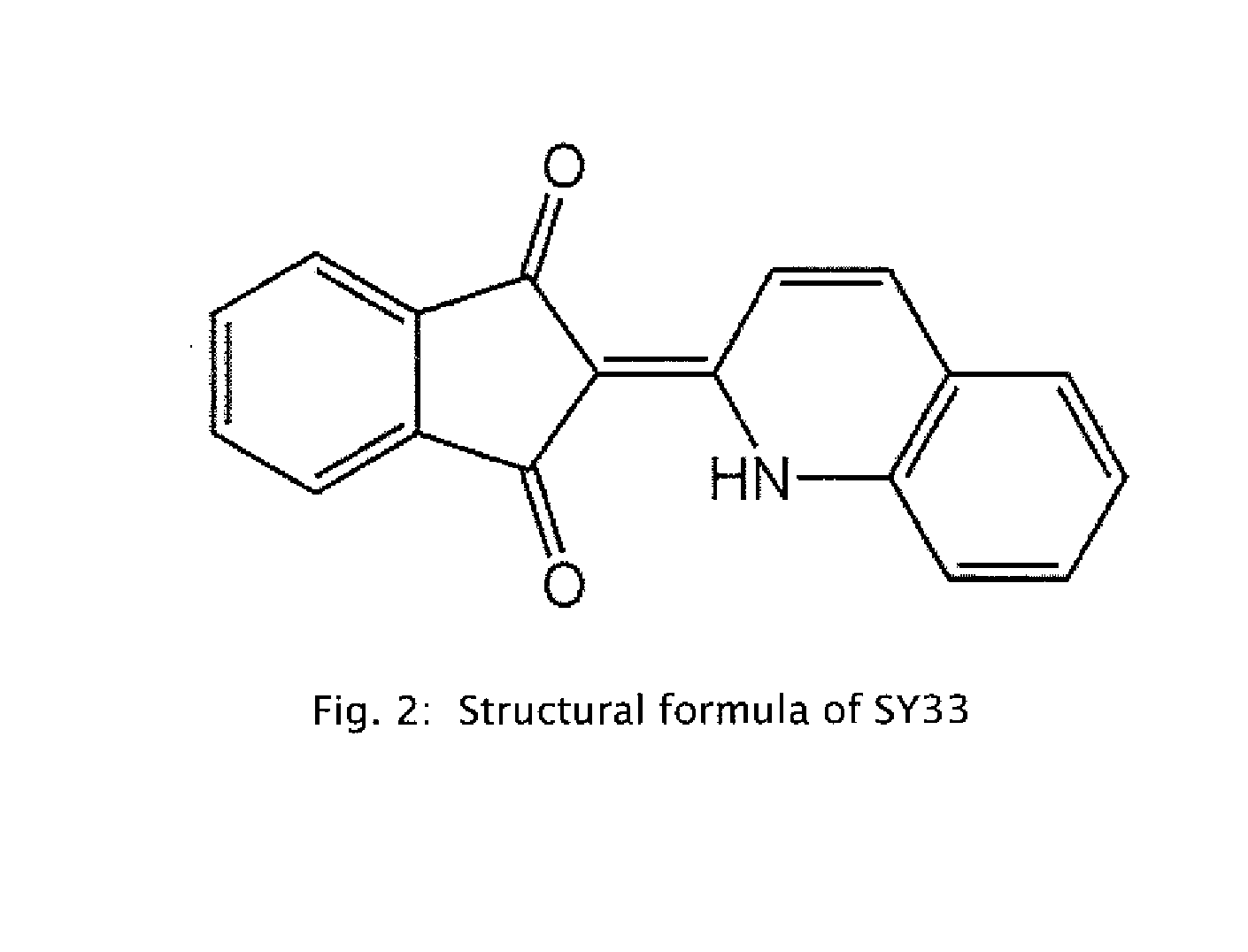
[0017]The present inventive HHS yellow pyrotechnic smoke composition is preferably a mixture of solid materials, including about 34.5 weight percent of potassium chlorate (KClO3), an oxidizing agent; about 21.5 to about 22.0 weight percent of a sugar (sucrose), a fuel (reducing agent); about 36 to about 37 weight percent of solvent yellow 33 (SY33, also known as quinoline yellow ss, or as D&C Yellow No. 11), the yellow smoke agent; about 5.5 weight percent hydromagnesite (Mg5(CO3)4(OH)2.4H2O), a cooling agent; about 0 to about 1.0 weight percent stearic acid, a lubricant; and about 0 to about 0.5 weight percent hydrophobic fumed silica, an anti-caking agent. To this mixture of solid powdered materials, a binder or combination of binders may be added, where the most preferred binder is about 0 to about 1.0 weight percent polyvinyl alcohol (PVA), also a solid (such that the resulting mixture need only be dry-tumbled to be completed).
[0018]As stated above, in an alternative embodiment ...
PUM
| Property | Measurement | Unit |
|---|---|---|
| burn time | aaaaa | aaaaa |
| weight percent | aaaaa | aaaaa |
| weight percent | aaaaa | aaaaa |
Abstract
Description
Claims
Application Information
 Login to View More