This helps you quickly interpret patents by identifying the three key elements:
Problems solved by technology
Method used
Benefits of technology
Benefits of technology
The present invention provides a method for manufacturing a double container with a rigid outer container and a flexible inner container that can hold more or less content. This method can use a conventional molding apparatus and make it easy to form the external air introducing opening, which is important but often difficult in conventional techniques. This method is cost-effective and reliable.
Problems solved by technology
On the other hand, in a situation where the container is opened to consume a part of the content, so that an unused part of the content remains in the container, external air generally enters the container in a volume corresponding to an amount of consumption of the content, causing oxidation of the remaining content.
A problem to be solved in the above conventional double container configured to reduce the capacity of the flexible inner container by an amount corresponding to an amount of consumption of a content thereof to thereby prevent external air from entering the flexible inner container, without causing deformation of the outer container is that the flexible inner container needs to be in contact with an inner surface of the outer container during manufacturing, and then to be separated from the inner surface of the outer container in response to consumption of the content to thereby allow external air to be introduced into a space between the flexible inner container and the outer container.
Method used
the structure of the environmentally friendly knitted fabric provided by the present invention; figure 2 Flow chart of the yarn wrapping machine for environmentally friendly knitted fabrics and storage devices; image 3 Is the parameter map of the yarn covering machine
View more
Image
Smart Image Click on the blue labels to locate them in the text.
Viewing Examples
Smart Image
Click on the blue label to locate the original text in one second.
Reading with bidirectional positioning of images and text.
Smart Image
Examples
Experimental program
Comparison scheme
Effect test
first embodiment
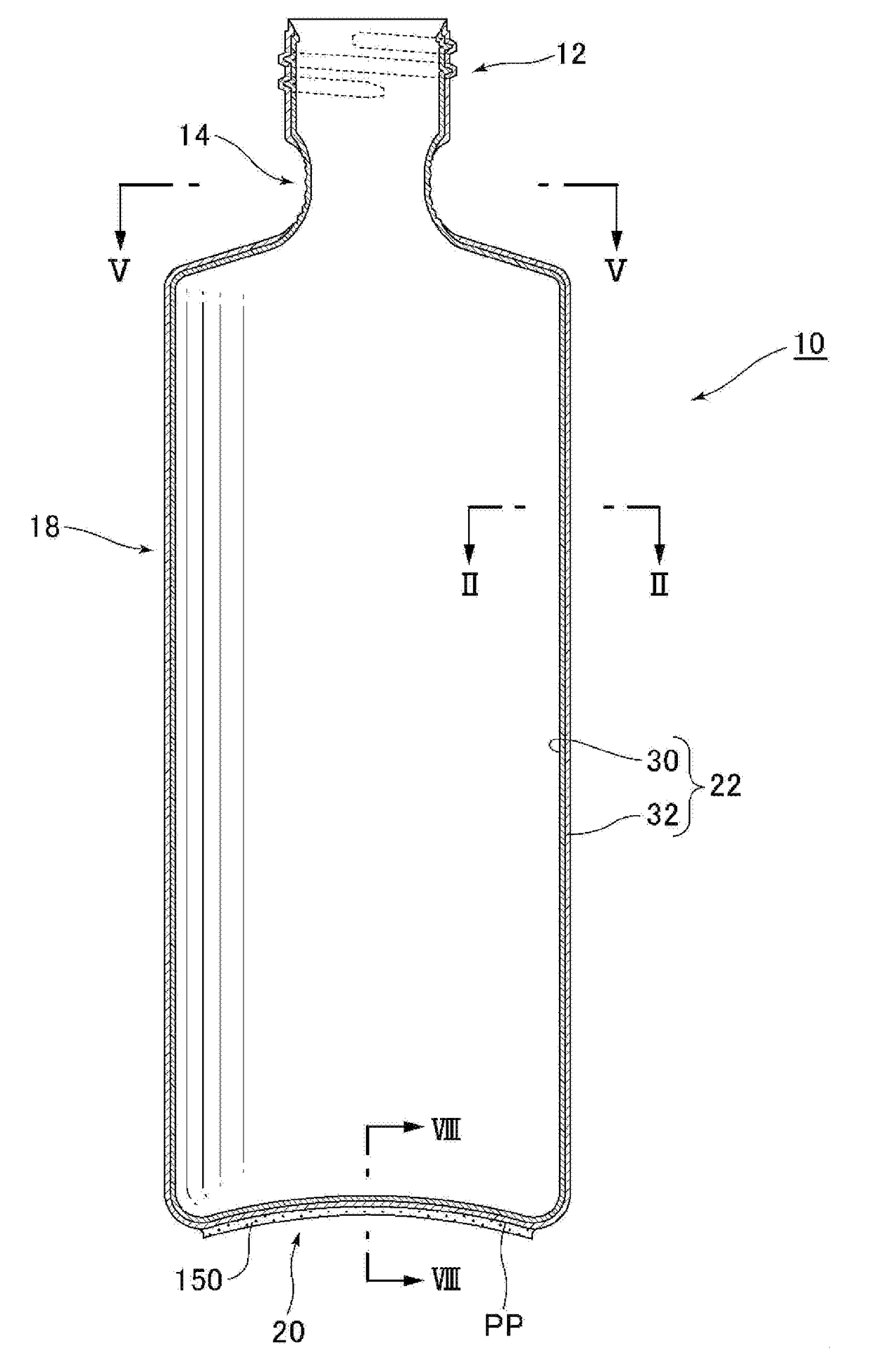
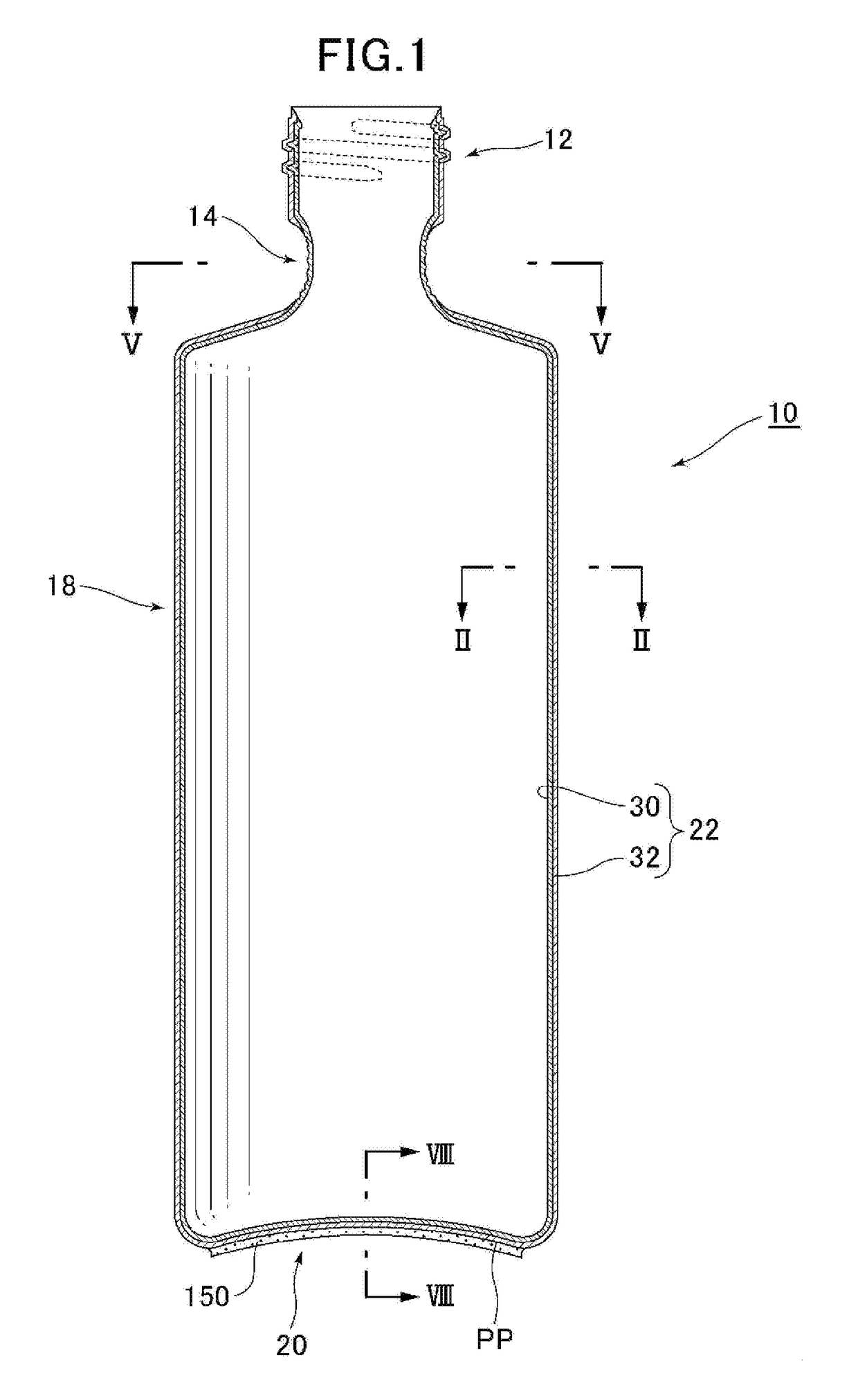
[0045]A double container 10 produced by a manufacturing method according to a first embodiment of the present invention comprises a mouth portion 12, a neck-shoulder portion 14, a cylindrical portion 18, and a bottom portion 20.
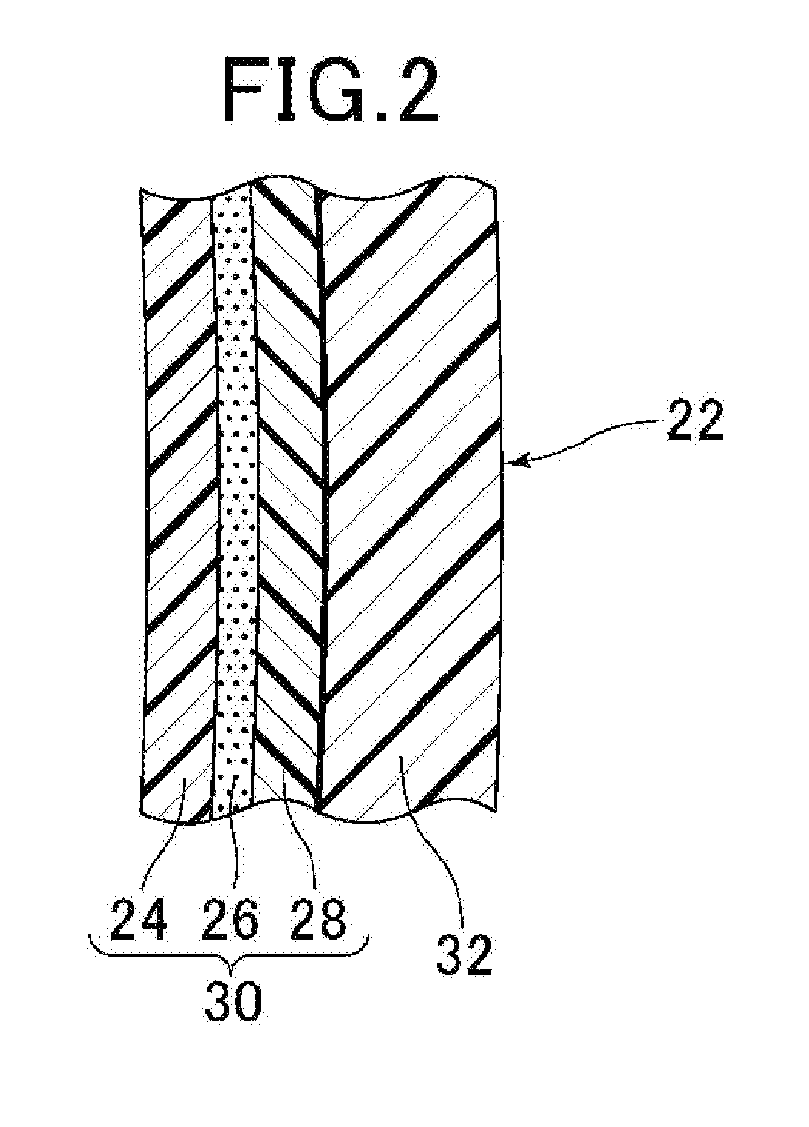
[0046]In the double container 10 produced by the manufacturing method according to a first embodiment, for example, a cylindrical sidewall 22 of the cylindrical portion 18 comprises: a three-layered flexible inner layer 30 consisting of a low-density polyethylene (LDPE) sub-layer 24, an adhesive sub-layer 26 such as a polyolefin-based adhesive resin, and an ethylene-vinylalcohol copolymer (EVOH) sub-layer 28; and a rigid outer layer 32 made of polypropylene (PP), which are arranged in this order in an outward direction, as depicted in FIGS. 1 and 2. There is no adhesivity between the flexible inner layer 30 and the rigid outer layer 32, so that they are easily separable from each other.
[0047]In the manufacturing method according to a first embodiment, a split...
second embodiment
[0070]A double container 10 produced by a manufacturing method according to a second embodiment of the present invention comprises a flexible inner layer 30 made of polyamide (PA), and a rigid outer layer 32 made of polypropylene (PP). There is no adhesivity between the flexible inner layer 30 and the rigid outer layer 32, so that they are easily separable from each other. There is no adhesivity between the flexible inner layer 30 and the rigid outer layer 32, so that they are easily separable from each other.
[0071]The mouth mold portion 100 and the neck-shoulder mold portion 112 are made of dice steel SKD11, and integrally formed.
[0072]As regards the neck-shoulder region 68 of the partial molds 60 for molding the neck-shoulder portion 14 of the double container 10, when the parison P has an inner diameter of 16.5 mm and an outer diameter R of 20.5 mm, and the mouth portion 12 of the molded product has an outer diameter PR of 21.5 mm and an inner diameter of 17.3 mm, a distance RS b...
third embodiment
[0074]A double container 10 produced by the manufacturing method according to a third embodiment comprises: a three-layered flexible inner layer 30 consisting of a low-density polyethylene (LDPE) sub-layer, an adhesive sub-layer such as a polyolefin-based adhesive resin, and an ethylene-vinylalcohol copolymer (EVOH) sub-layer; and a rigid outer layer 32 made of polycarbonate (PC), which are arranged in this order in an outward direction. There is no adhesivity between the flexible inner layer 30 and the rigid outer layer 32, so that they are easily separable from each other.
[0075]The mouth mold portion 100 and the neck-shoulder mold portion 112 are made of dice steel SKD11, and integrally formed.
[0076]As regards the neck-shoulder region 68 of the partial molds 60 for molding the neck-shoulder portion 14 of the double container 10, when the parison P has an inner diameter of 23.5 mm and an outer diameter R of 28.5 mm, and the mouth portion 12 of the molded product has an outer diamet...
the structure of the environmentally friendly knitted fabric provided by the present invention; figure 2 Flow chart of the yarn wrapping machine for environmentally friendly knitted fabrics and storage devices; image 3 Is the parameter map of the yarn covering machine
Login to View More
PUM
Property
Measurement
Unit
Flexibility
aaaaa
aaaaa
Login to View More
Abstract
The present invention is a double-walled container manufacturing method in which when a pair of partial molds is brought towards each other to be assembled to form a split mold, at least a portion of the mating surfaces of the pair of partial molds clamp a parison at two side portions that are at horizontal positions facing each other. The method is able to manufacture the container easily with a molding device that does not differ significantly from the past and, in a double-walled container obtained from a relatively rigid outer container and a flexible inner container the volume of which can change according to the amount of contents filled inside said outer container, an opening for introducing outside air can be formed very easily and reliably at a lower cost than the processing cost of prior art.
Description
TECHNICAL FIELD[0001]The present invention relates to a method for manufacturing a double-walled container or a double container. More specifically, the present invention relates to a method for manufacturing a double container which comprises a relatively-rigid outer container, and a flexible inner container disposed inside the outer container and capacity-variable in response to an amount of a content thereof, wherein the method is capable of enabling a double container to be easily manufactured using a molding apparatus which is not largely different from a conventional type.BACKGROUND ART[0002]It is ideal that a container is capable of, even after using or consuming a part of a content thereof, keeping the remaining content from contacting with external air and thereby preventing oxidation of the remaining content.[0003]Specifically, in a commonly-used liquid container, it is easy to prevent oxidation of a content thereof during a period after hermetically closing the container ...
Claims
the structure of the environmentally friendly knitted fabric provided by the present invention; figure 2 Flow chart of the yarn wrapping machine for environmentally friendly knitted fabrics and storage devices; image 3 Is the parameter map of the yarn covering machine
Login to View More
Application Information
Patent Timeline
Application Date:The date an application was filed.
Publication Date:The date a patent or application was officially published.
First Publication Date:The earliest publication date of a patent with the same application number.
Issue Date:Publication date of the patent grant document.
PCT Entry Date:The Entry date of PCT National Phase.
Estimated Expiry Date:The statutory expiry date of a patent right according to the Patent Law, and it is the longest term of protection that the patent right can achieve without the termination of the patent right due to other reasons(Term extension factor has been taken into account ).
Invalid Date:Actual expiry date is based on effective date or publication date of legal transaction data of invalid patent.


 Login to View More