
Thermomechanical processing of alpha-beta titanium alloys
a titanium alloy and alpha-beta technology, applied in the direction of metal-working apparatus, etc., can solve the problems of excessive cumulative time taken to perform maf or ecap steps in a commercial setting, the open die press forging equipment may not have the capability to achieve ultra-slow strain rates,
- Summary
- Abstract
- Description
- Claims
- Application Information
AI Technical Summary
Benefits of technology
Problems solved by technology
Method used
Image

Examples
example 1
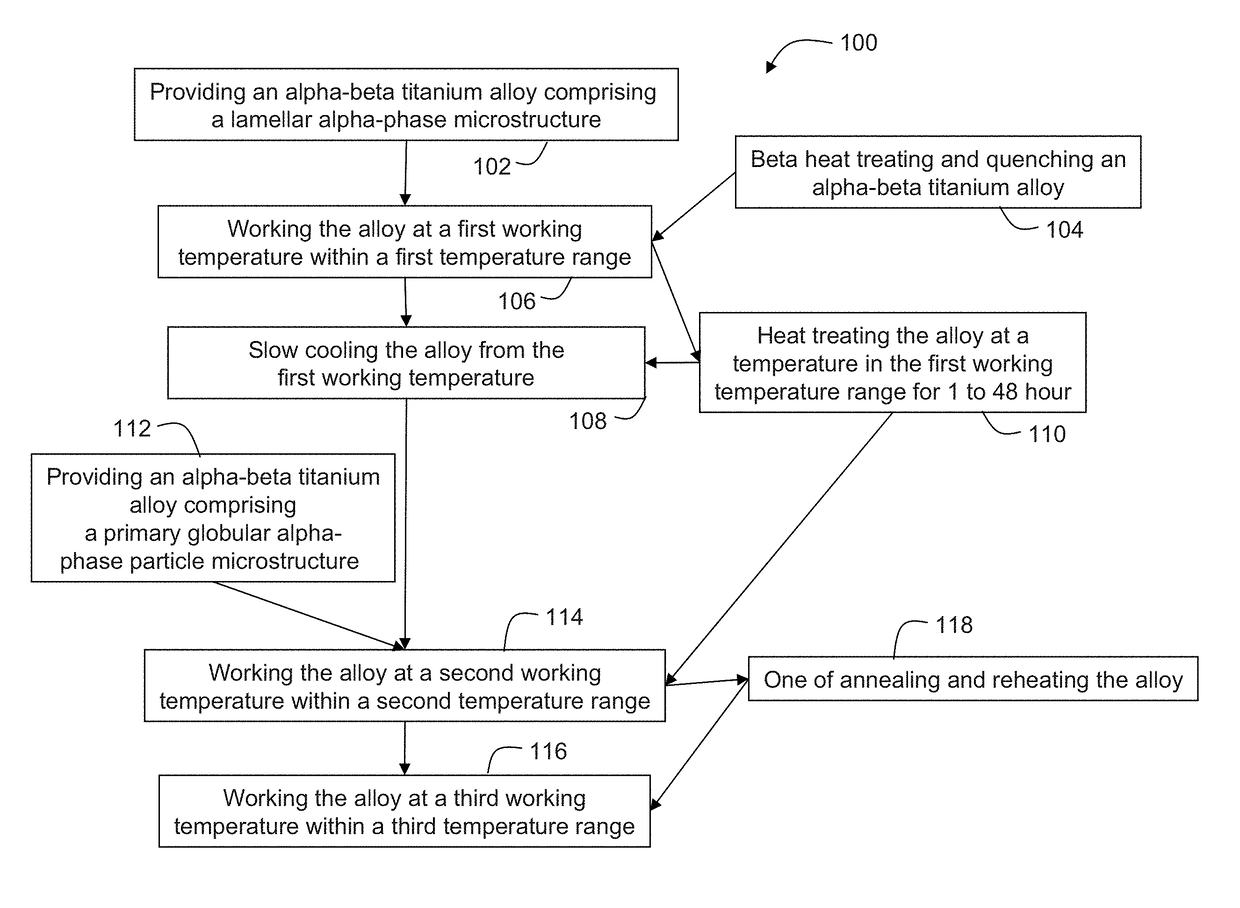
[0088]A workpiece comprising Ti-6Al-4V alloy was heated and forged in the first working temperature range according to usual methods to those familiar in the art of forming a substantially globularized primary alpha microstructure. The workpiece was then heated to a temperature of 1800° F., which is in the first forging temperature range, for 18 hours (as per box 110 in FIG. 1). Then it was slow cooled in the furnace at −100° F. per hour or between 1.5 and 2° F. per minute down to 1200° F. and then air cooled to ambient temperature. Backscattered electron (BSE) micrographs of the microstructure of the forged and slow cooled alloy are presented in FIGS. 3 and 4.
[0089]In the BSE micrographs of FIGS. 3 and 4, it is observed that after forging at a relatively high temperature in the alpha-beta phase field, followed by slow cooling, the microstructure comprises primary globularized alpha-phase particles interspersed with beta-phase. In the micrographs, levels of grey shading are related ...
example 2
[0090]Two workpieces in the shape of 4″ cubes of Ti-6-4 material produced using similar method as for Example 1 was heated to 1300° F. and forged through two cycles (6 hits to 3.5″ height) of rather rapid, open-die multi-axis forging operated at strain rates of about 0.1 to 1 / s to reach a center strain of at least 3. Fifteen second holds were made between hits to allow for some dissipation of adiabatic heating. The workpieces were subsequently annealed at 1450° F. for almost 1 hour and then moved to a furnace at 1300° F. to be soaked for about 20 minutes. The first workpiece was finally air cooled. The second workpiece was forged again through two cycles (6 hits to 3.5″ height) of rather rapid, open-die multi-axis forging operated at strain rates of about 0.1 to 1 / s to impart a center strain of at least 3, viz. a total strain of 6. Fifteen second holds were made as well between hits to allow for some dissipation of adiabatic heating. FIGS. 6A and 6B are BSE micrographs of the first ...
example 3
[0093]Two workpieces shaped as a 4″ cube of ATI 425° alloy material produced using similar method as for Example 1 was heated to 1300° F. and forged through one cycle (3 hits to 3.5″ height) of rather rapid, open-die multi-axis forging operated at strain rates of about 0.1 to 1 / s to reach a center strain of at least 1.5. Fifteen second holds were made between hits to allow for some dissipation of adiabatic heating. The workpieces were subsequently annealed at 1400° F. for 1 hour and then moved to a furnace at 1300° F. to be soaked for 30 minutes. The first workpiece was finally air cooled. The second workpiece was forged again through one cycle (3 hits to 3.5″ height) of rather rapid, open-die multi-axis forging operated at strain rates of about 0.1 to 1 / s to impart a center strain of at least 1.5, viz. a total strain of 3. Fifteen second holds were made as well between hits to allow for some dissipation of adiabatic heating.
[0094]FIGS. 10A and 10B are BSE micrographs of respectivel...
PUM
| Property | Measurement | Unit |
|---|---|---|
| alpha grain sizes | aaaaa | aaaaa |
| alpha grain sizes | aaaaa | aaaaa |
| size | aaaaa | aaaaa |
Abstract
Description
Claims
Application Information
 Login to View More