

Electrode for sodium-ion battery
- Summary
- Abstract
- Description
- Claims
- Application Information
AI Technical Summary
Benefits of technology
Problems solved by technology
Method used
Image

Examples
example 1
Synthesis of Na3+xV2−xMx(PO4)2F3 Electrode Material by Hydrothermal Method
[0023]The Na3+8V2−xMx(PO4)2F3 compounds [wherein “M” is a divalent cation that can be chosen from, but is not limited to, Mg, Cr, Mn, Fe, Co, Ni, Cu, and (04VO3 (Aldrich, ≥99.99%), M(CH3COO)3.xH2O, (Aldrich, ≥99.99%), NH4H2PO4 (Aldrich, 99.99%) and citric acid (C6H8O7) (CA). CA was employed as carbon source and reducing agent. First NH4VO3 and CA with a mole ratio of 1:2 were dissolved in 40 ml of water to form a clear blue solution, and then M(CH3COO)3.xH2O was added (Solution A). The NaF and NH4H2PO4 were dissolved together in 40 ml of H2O (Solution B). Solution B was then added dropwise to solution A under continuous stirring. The solution is finally poured in a 100 mL autoclave, which was then heated at 200° C. for 20 h. The powder obtained after filtering the solution was dried at 100° C. for 12 h under vacuum. The progress of the reaction was followed by PXRD.
example 2
Synthesis of Na3+xV2−xMx(PO4)2F3 Electrode Material by Sol-Gel or Solid-State Method
[0024]The Na3+xV2−xMx(PO4)2F3 compounds [wherein “M” is a divalent cation that can be chosen from, but is not limited to, Mg, Cr, Mn, Fe, Co, Ni, Cu, and (04VO3 (Aldrich, ≥99.99%), NH4H2PO4 (Aldrich, 99.99%) and citric acid (C6H8O7) (CA). CA was employed as carbon source and reducing agent. First NH4VO3 and CA were dissolved in 100 ml of water to form a clear blue solution (Solution A). M(CH3COO)3xH2O (Aldrich, ≥99.99%) is dissolved in 50 ml of water and then added to Solution A. The NaF and NH4H2PO4 were mixed together under continuous stirring in 50 ml of H2O (Solution B). Solution B was then added dropwise to solution A under continuous stirring. The resulting solution was then slowly evaporated to dryness at 100° C. The residue was ground in an agate mortar and heated in Ar atmosphere in an alumina crucible at 400° C. for 24 h and at 650° C. for 24 h.
[0025]In the above syntheses, the precursors f...
example 3
Crystallographic Studies of Synthesized Samples
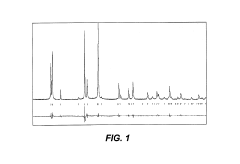
[0026]To ensure the purity of the Na3+xV2−xMx(PO4)2F3 powders, PXRD measurements were performed. The data were collected at room temperature over the 2θ angle range of 10°≤2θ≤70° with a step size of 0.01° using a Bruker d8 Avanced diffractometer operating with CuKα radiations. Full pattern matching refinement was performed with the Jana2006 program package. The background was estimated by a Legendre function, and the peak shapes were described by a pseudo-Voigt function. An exemplary diffractogram for the electrode material of formula Na3.2V1.8Ni0.2(PO4)2F3 is shown in FIG. 1. Evaluation of these data for the various samples of electrode material that were synthesized revealed the refined cell parameters listed in Tables 1 and 2.
TABLE 1Crystallographic data for Na3+xV2−xMx(PO4)2F3 compoundsNa3.5V1.5Ni0.5(PO4)2F3Na3.2V1.8Ni0.2(PO4)2F3Na3.2V1.8Mn0.2(PO4)2F3a (Å)6.39949(8)6.39429(18)9.03660(14)b (Å)6.39949(8)6.39429(18)9.03660(14)c (Å)10.6...
PUM
 Login to View More
 Abstract
Description
Claims
Application Information
 Login to View More