
High performance merge sort with scalable parallelization and full-throughput reduction
a merge sort and scalable technology, applied in the field of high-performance merge sort with scalable parallelization and full-throughput reduction, can solve the problems of not easily scalable and parallelizable, require exponentially more compute and storage resources, and achieve high throughput for mms binary tree hardware implementation, accelerate matrix/graph operations, and improve performan
- Summary
- Abstract
- Description
- Claims
- Application Information
AI Technical Summary
Benefits of technology
Problems solved by technology
Method used
Image

Examples
Embodiment Construction
[0023]Many important kernels, such as Sparse Matrix dense Vector multiplication (SpMV) and Sparse General Matrix-Matrix multiplication (SpGEMM), require a large parallel and scalable multi-way merge network. Disclosed herein is a novel, multi-way merge network, referred to herein as “Hybrid Comparison Look Ahead Merge” (HCLAM), which incurs significantly less resources as it is scaled to handle larger problems. Also disclosed is a parallelization scheme, referred to herein as “Parallelization by Radix Pre-sorter” (PRaP), which enables an increased streaming throughput of the merge network without prohibitive demand of on-chip memory.
[0024]Scalability
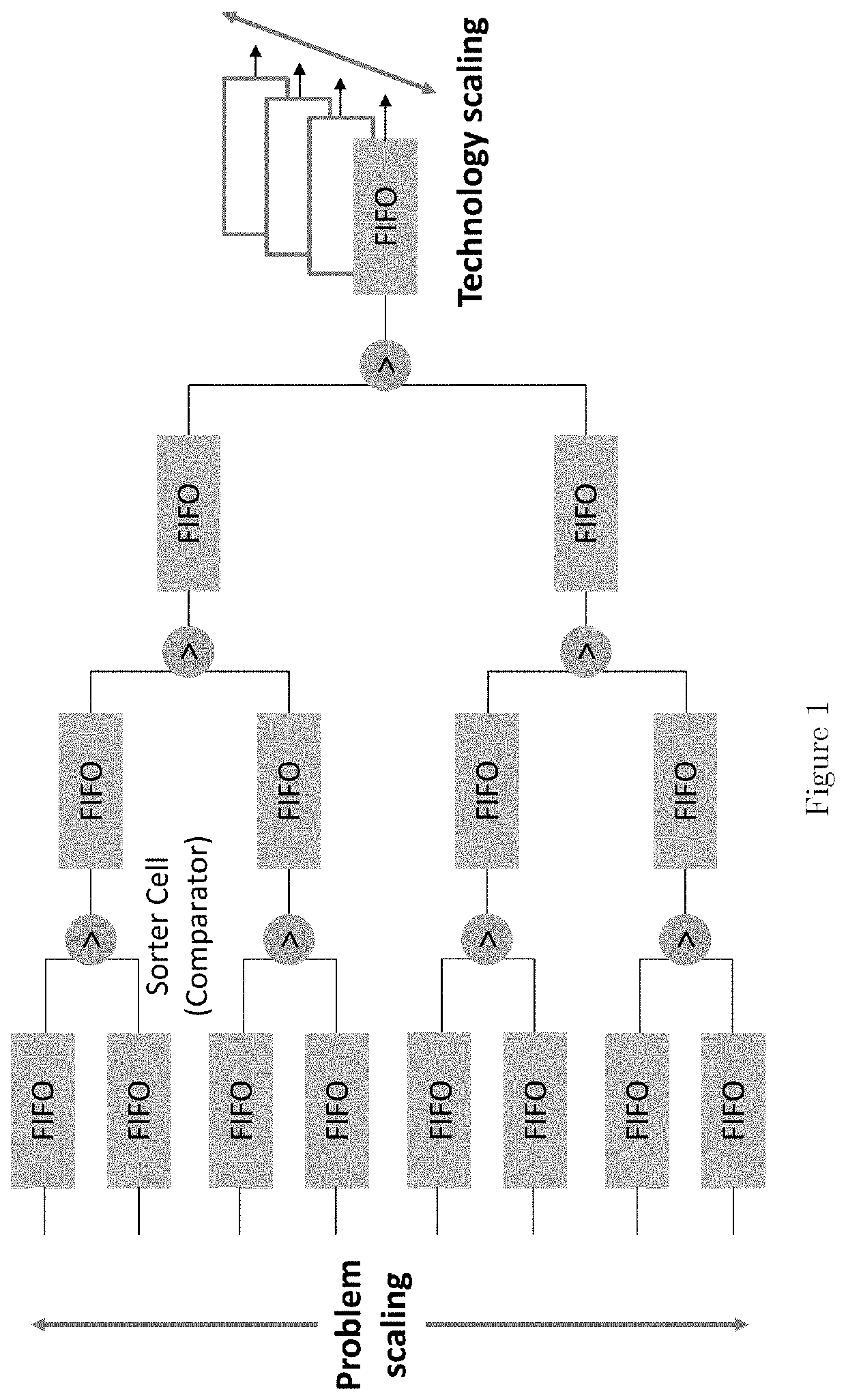
[0025]From the perspective of hardware implementation and performance, scalability can be viewed from two distinct aspects, which are (1) problem scaling and (2) technology scaling. FIG. 1 shows how problem scaling and technology scaling affect a multi-way merge binary tree implementation. Problem scaling is a phenomenon wherein the inpu...
PUM
 Login to View More
 Abstract
Description
Claims
Application Information
 Login to View More