
Liquid crystal film structures with phase-retardation surface regions formed therein and methods of fabricating the same
a liquid crystal film and surface region technology, applied in the direction of polarising elements, door/window protective devices, instruments, etc., can solve the problems of cholesteric polarizers that are limited in the field of clc-based polarizers to optical applications, and the reduction of brightness inherent in at least 50 percent of the factor of the polarizer
- Summary
- Abstract
- Description
- Claims
- Application Information
AI Technical Summary
Benefits of technology
Problems solved by technology
Method used
Image

Examples
second embodiment
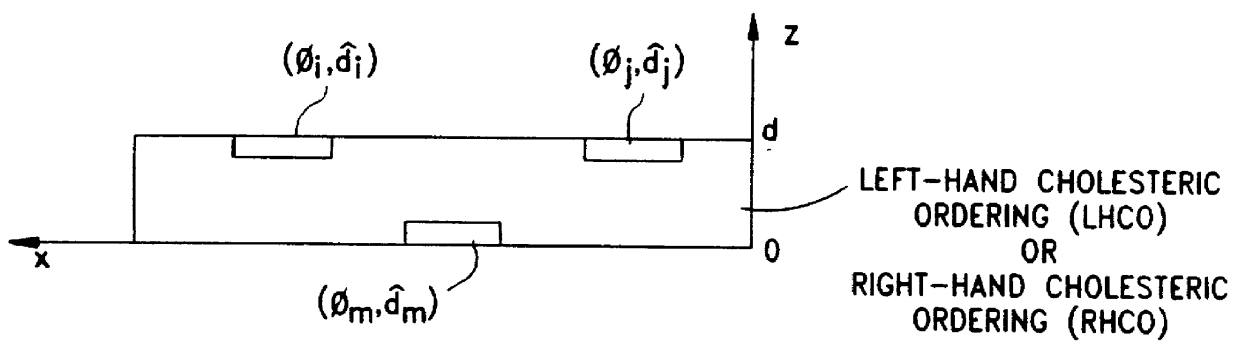
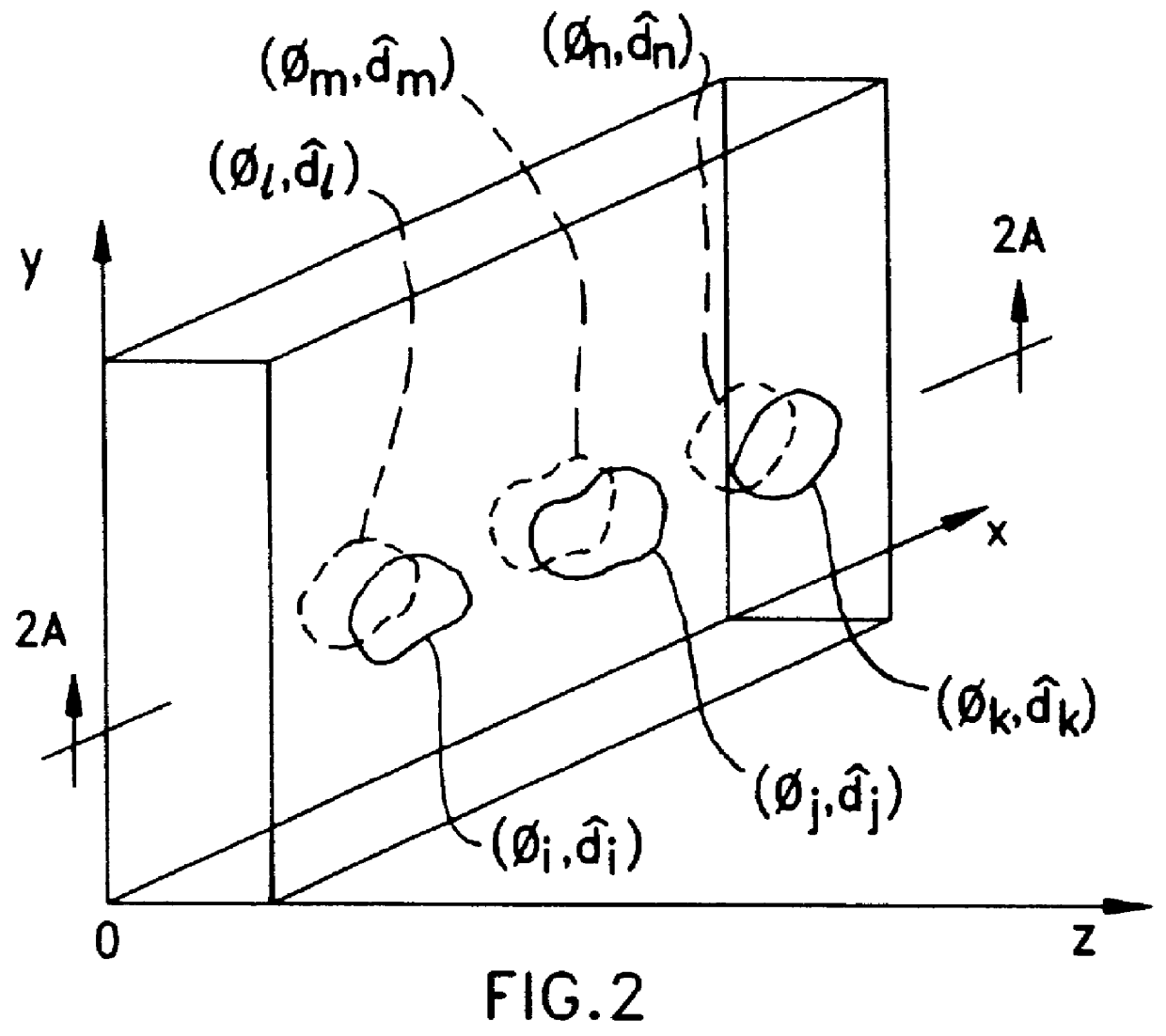
In FIGS. 2 and 2A, the liquid crystal structure of the present invention is schematically illustrated in the form of liquid crystal polarizer. As shown in these figures, the liquid crystal polarizer is realized in the form of a single film structure having (i) a first plurality of birefringent phase retardation regions formed at arbitrary locations on the top surface thereof, (ii) a second plurality of birefringent phase retardation regions formed at spatially-corresponding locations on the top surface thereof in registration with the phase retardation regions on the top surface thereof, and (iii) LH or RH cholesterically ordered molecules disposed therebetween. Each of the birefringent phase retardation regions formed on the top surface of the film structure impart an amount of phase retardation to incident light (of wavelength .lambda.) proportional to depth of reorientation of the cholesterically ordered molecules in the film structure and have an optical axis extending along the...
first embodiment
In FIG. 4B, a fourth broadband embodiment of the liquid crystal polarizer shown in FIG. 4 is shown realized in the form of a single film structure (i.e. sheet) having cholesterically ordered molecules throughout the bulk structure thereof. As shown, the cholesterically ordered molecules have a non-linear pitch between the top and bottom surfaces thereof. Also, a first phase retardation surface is formed on the top surface thereof by orienting the cholesterically ordered molecules at a first depth thereof along a first molecular orientation direction. FIG. 4B1 shows a graphical representation of the pitch characteristics of the cholesterically ordered molecules of the super broadband liquid crystal polarizer of FIG. 4B. As illustrated in this figure, there is the large increase in cholesteric pitch along the surface of the liquid crystal polarizer where the cholesterically ordered molecules have been selectively reoriented to form the birefringent phase-retardation surface structure ...
PUM
| Property | Measurement | Unit |
|---|---|---|
| Phase | aaaaa | aaaaa |
| Wavelength | aaaaa | aaaaa |
| Reflection | aaaaa | aaaaa |
Abstract
Description
Claims
Application Information
 Login to View More