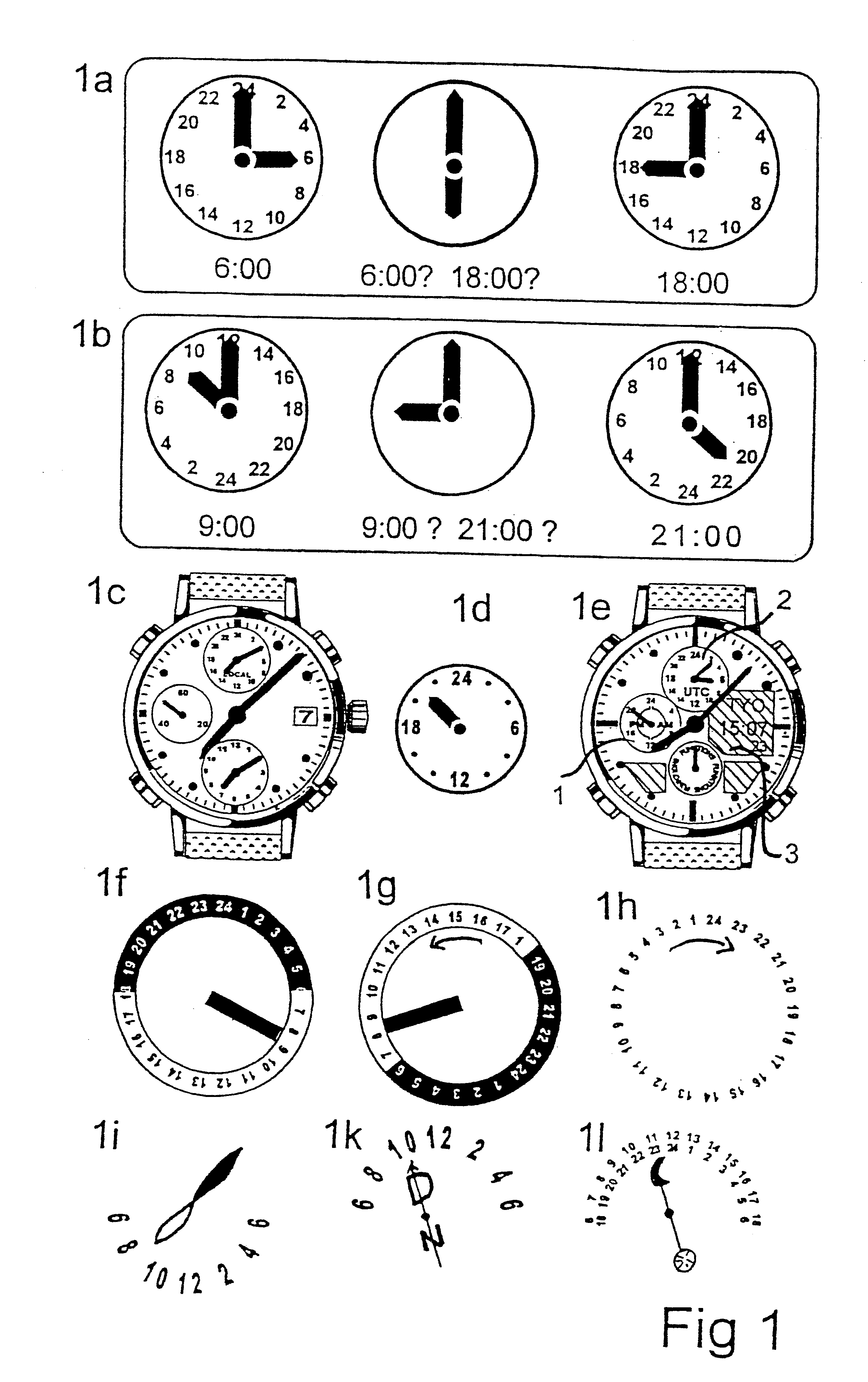
Objectively, the time cannot, however, be determined exactly if only the information is used that can be read from the watch /
clock.
Without knowing whether it is
evening or
morning, the mere information of the position of the hands in the middle illustration of the watch /
clock does not permit an unambiguous statement of the time.
Nevertheless, the display of the times 9.00 and 12.00 midday is just as confusing and cannot be read without figures.
y here. Curiously, only the two digital presentations permit a rapid
perception or comparison of the times and the determination of where it is now day or night, but these as a matter of principle cannot be read
The fact, however, that the dial turns means that the representation of 8.30 cannot be perceived automatically and at a glance.
It is not possible to distingush rapidly which is
daytime and which is night-time.
Such a display confuses the unfamiliar user.
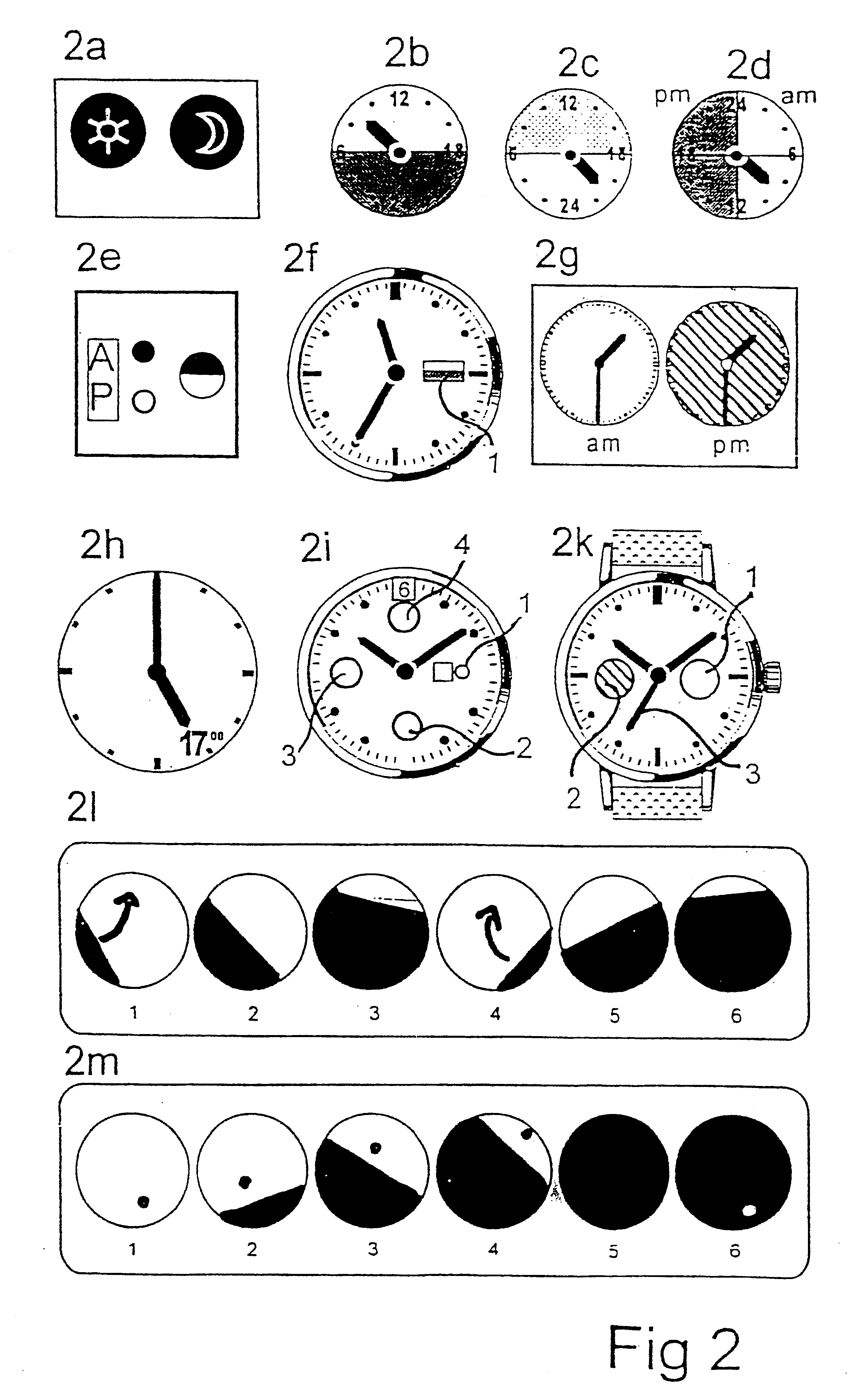
The dark shade shows the p.m. time, the light the a.m. time, with the result that it is no longer possible to conclude what is day or night.
Here, too, there is a
gradual transition and for this reason the time is not easy to identity.
However, in no case is the display unambiguous, since the change takes place gradually and very slowly without any movement being perceptible towards light or dark, thus making the time specification ambiguous.
However, a great
disadvantage is the
ambiguity over a relatively long period of time, since here, too, the transition from day to night takes place gradually as described under FIG. 2l.
The background is not, as in the drawing, light, but instead the sun and the moon and their rays and
stars stand against a blue
sky, making the transition from day to night difficult to see--and unuambigiity is only the case when the sun or the moon is fill.
Although the fact that the window belongs to the half-day dial is very well solved, and also that the display is very good at fill day or full night, the area of doubt in the transitional period from light to dark or dark to light applies for a very long time and is thus unsuitable for a general, unambiguous and doubt-free 24-hour display.
Although, compared with other systems, this represents by far the best solution, it is entirely unsuitable for a generally understandable representation of an unambiguous natural 24-hour
analog watch / clock.
This attempt to solve the problem and represent an unambiguous generally understandable and immediately perceptible time or local time must also be regarded as unsuccessful.
All previous attempts, either by using the 24-hour dial or the auxiliary displays, do not provide an even approximately satisfactory solution, Neither the colour nor the light or dark fields nor the movements of direction, whether from left to right top to bottom, show any
logical relationship with time.
Thus the day or night symbols and even illustrations of the moon or the sun have to date not achieved a solution to the problem.
However, using the means of distinction only unsatisfactorily solved above to determine whether it is day or night, it is nevertheless possible to suggest a possibility of entering date-specified appointments as target times in the watch / clock.
If one wishes to set more distant times on analog clocks or watches, for instance 5 or 20 hours away from the
current time, this is a problem with the current systems, since they either move very slowly or in a very confused
mower towards such a time.
This does not permit the rapid display of a time, and in addition, the real time within a full 24-hour day can only be represented with the assistance of a second 24-hour auxiliary display or the like.
Nor is it possible to follow this process mentally, since the movements of the hands are completely independent of the distance of the target time to be aimed at.


 Login to View More
  Login to View More