
Microbe and cell function control device, a microbial ecology detector device, and a method of controlling a microbe and cell function control device
a cell function and control device technology, applied in the field of microbe and cell function control devices, can solve the problems of adversely affecting human health, difficult to appropriately diagnose individual patients in dental clinics, and hardly known about the precise control devi
- Summary
- Abstract
- Description
- Claims
- Application Information
AI Technical Summary
Benefits of technology
Problems solved by technology
Method used
Image

Examples
second embodiment
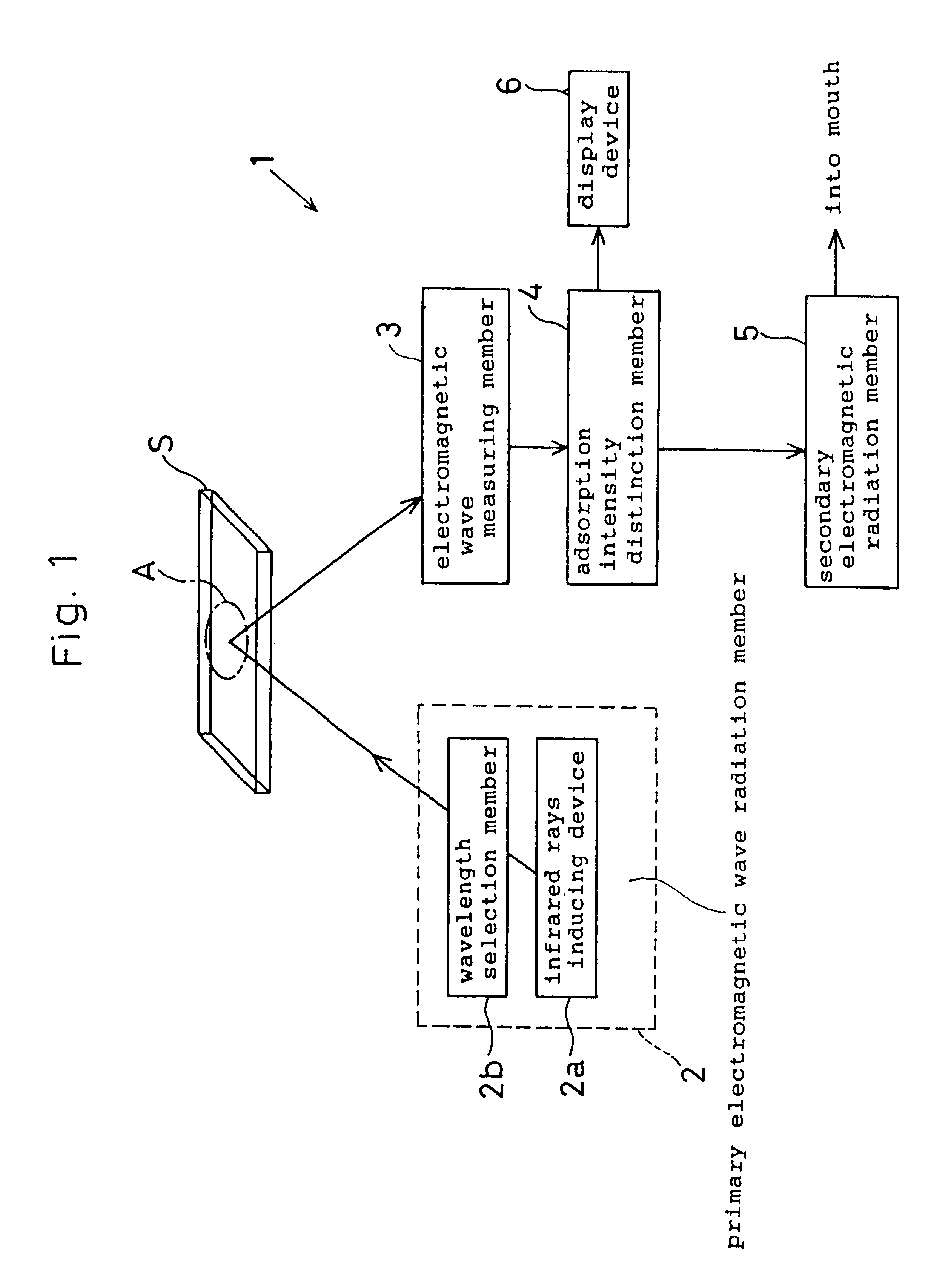
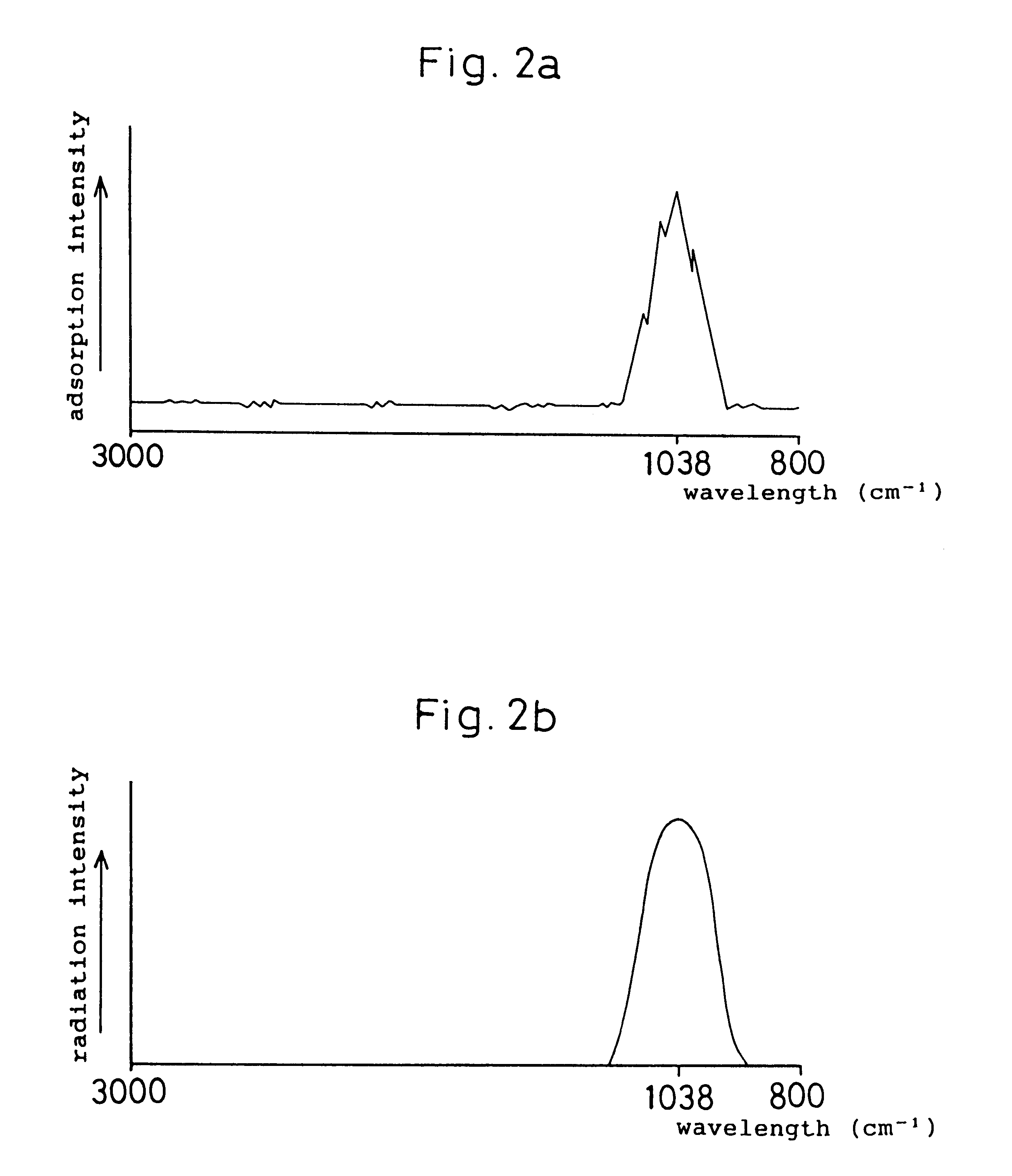
When the absorption peaks of the cariogenic bacteria are known, it is possible to radiate the electromagnetic wave (e.g., 1038 cm.sup.-1) inside the patient's mouth with the use of the single secondary electromagnetic wave radiation member 5 as the invention. That is, when the absorption peaks (FIG. 3a) of the plaque (A) in the mouth is unknown, it is possible to emanate the electromagnetic wave (e.g., 1038 cm.sup.-1 in FIG. 3b) inside the patient's mouth with the use of the secondary electromagnetic wave radiation member.
It is to be noted that a multiple wavelength light source, Fabry-Perot etalon, diffraction grating band path filter, low path filter and high path filter may be used as the wavelength selection member 2b. A Globar light source, ceramic light source and infrared ray lamp can be used as the electromagnetic wave source of the electromagnetic wave radiation members. When using the electromagnetic wave having the wavelength other than 1038 cm.sup.-1, an appropriate elec...
first embodiment
In the invention, the absorption intensity distinction member 4 uses the average value. Instead of the average value, the absorption intensity distinction member 4 may use an integral calculation between wavelength sections appropriately predetermined so as to obtain the graphic representation of FIG. 2b from FIG. 2a. A threshold value or offset may be used. Alternatively, the other band regions may be eliminated except for the absorption band region.
In the second embodiment of the invention, a single spectrum type electromagnetic wave is used as shown in FIG. 3b. Instead of the single spectrum, a plurality of spectra may be used. The electromagnetic wave may be radiated on each of the strains at the same time or different time. The range of the electromagnetic wave may be broadened. With the use of the peak isolation member, the graphic representation of FIG. 2b (FIG. 3b) may be obtained from FIG. 2a (FIG. 3b). Upon using the frequency analysis and synthesis procedures, Fourier tra...
PUM
| Property | Measurement | Unit |
|---|---|---|
| wavelength | aaaaa | aaaaa |
| wavelength absorption band | aaaaa | aaaaa |
| peak wavelength absorption band | aaaaa | aaaaa |
Abstract
Description
Claims
Application Information
 Login to View More