
Method to form reduced dimension pattern with good edge roughness
a technology of edge roughness and dimension pattern, which is applied in the field of lithography, can solve the problems of many cd (critical dimension) reduction methods in the prior art that do not have sufficient cd tolerance, and achieve the effects of improving edge roughness, reducing edge roughness, and strengthening the development process
- Summary
- Abstract
- Description
- Claims
- Application Information
AI Technical Summary
Benefits of technology
Problems solved by technology
Method used
Image

Examples
Embodiment Construction
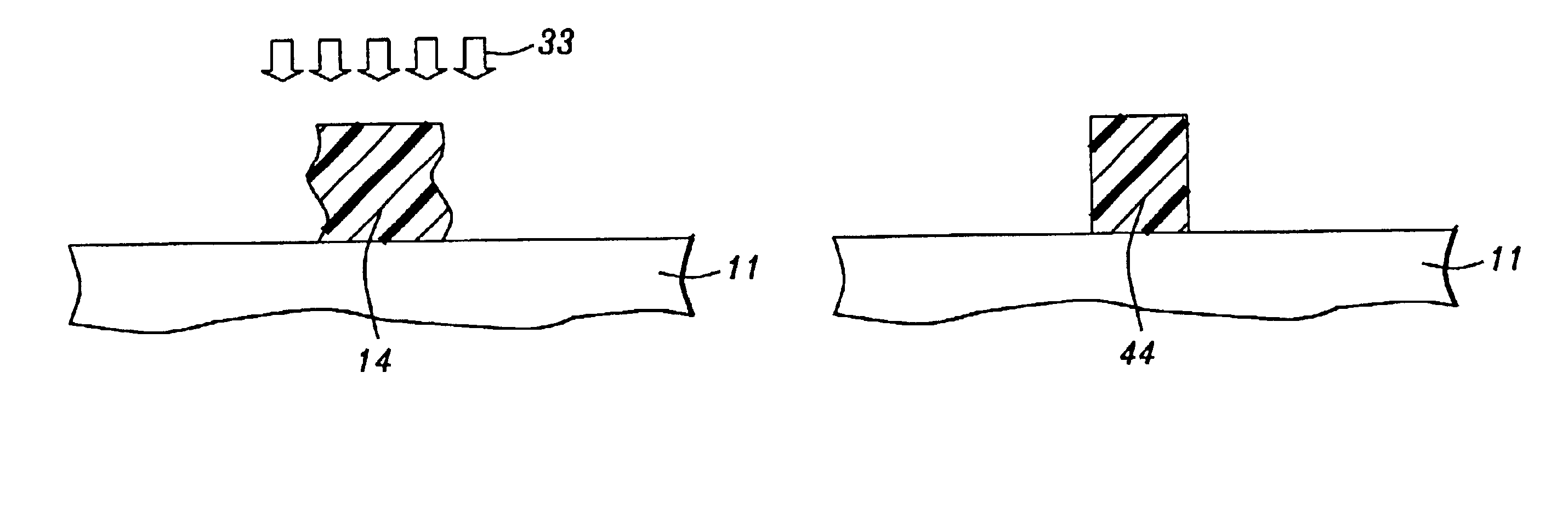
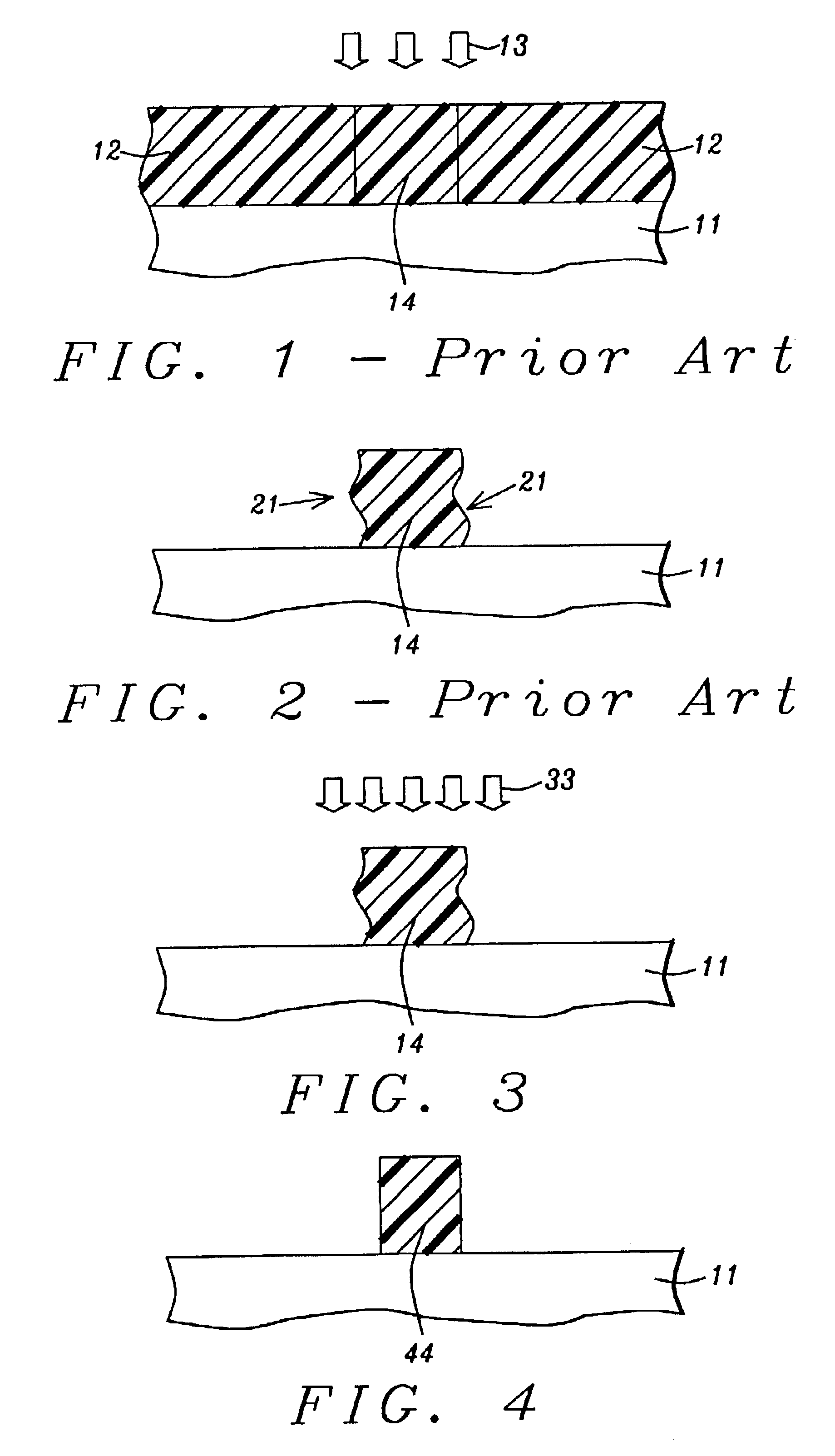
[0023]In the present invention, we apply an extra Ebeam exposure to provide further curing of the developed resist. The disclosed CD-slimming process incorporates additional E-beam exposure, post exposure bake, and resist development steps to the conventional process. Since fewer forward scattering electrons are generated at the edge of resist features, the edge resists will have less degree of cross-linking as compared to the bulk resists. Therefore, only edge resists will be dissolved in the concentrated developer. The disclosed dimension-slimming process allows us to preserve the feature shape without reducing resist thickness or increasing its LER.
[0024]Referring once more to FIG. 1, the process of the present invention begins with providing substrate 11 and then coating with layer of resist 12. Under software control, resist layer 12 is then selectively exposed to electron beam 13 so that region 14 becomes polymerized, as described above, thereby forming a latent image, in this...
PUM
| Property | Measurement | Unit |
|---|---|---|
| roughness | aaaaa | aaaaa |
| roughness | aaaaa | aaaaa |
| width | aaaaa | aaaaa |
Abstract
Description
Claims
Application Information
 Login to View More