Wireless communications system that supports multiple modes of operation

a wireless communication and multiple mode technology, applied in the field of wireless communications systems, can solve the problems of not all base transceiver stations and subscriber units support spatial multiplexing, subject to channel degradation, and not all base transceiver stations and subscriber units can utilize spatial multiplexing for every transmission,
US6937592B1Inactive Publication Date: 2005-08-30APPLE INC

Patent Information

Authority / Receiving Office
US ยท United States
Patent Type
Patents(United States)
Current Assignee / Owner
APPLE INC
Publication Date
2005-08-30
Estimated Expiration
Not applicable ยท inactive patent

Smart Images

  • Figure 1
    Figure 1
  • Figure 2
    Figure 2
  • Figure 3
    Figure 3
Patent Text Reader

Abstract

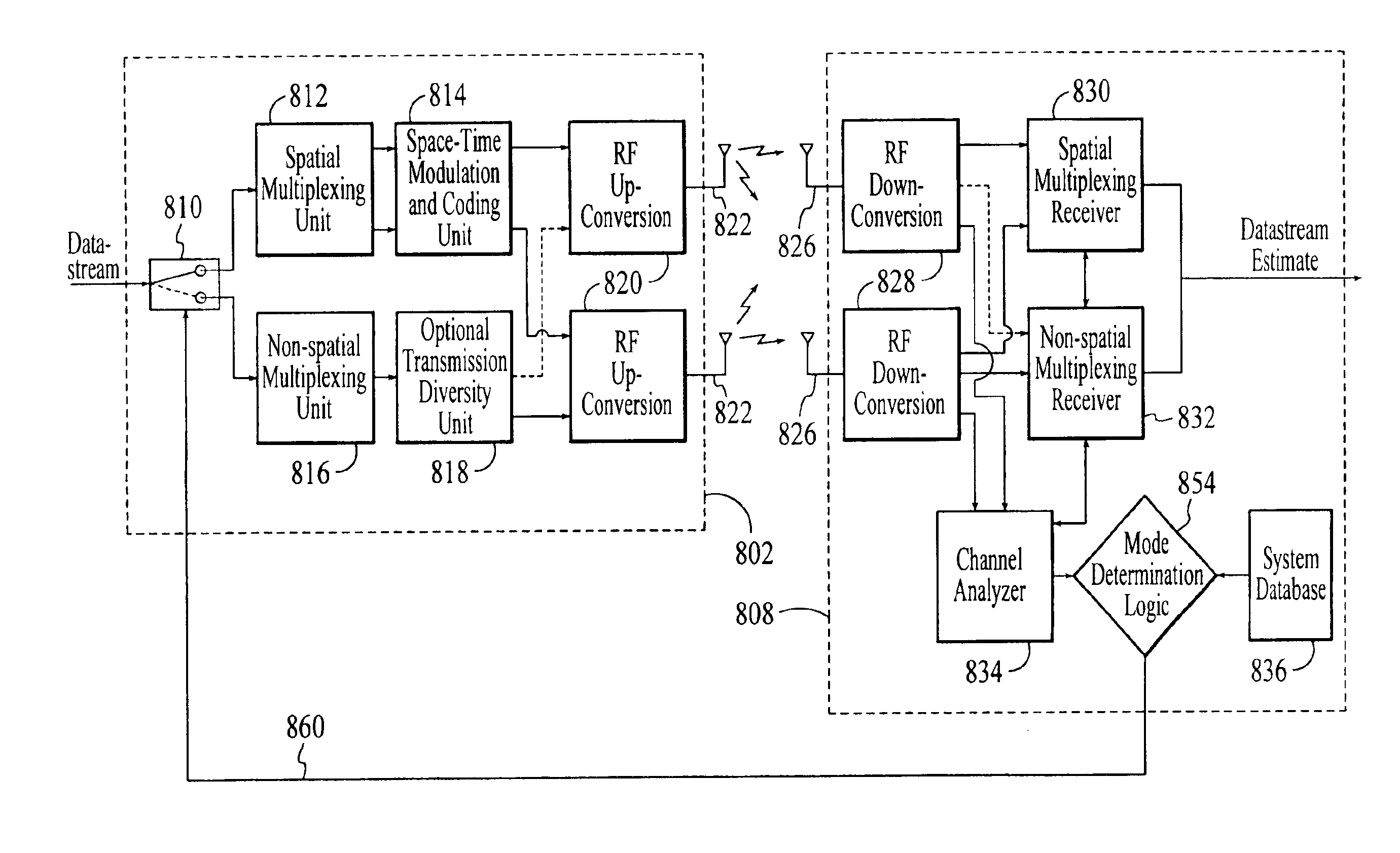
A wireless communications adapts its mode of operation between spatial multiplexing and non-spatial multiplexing in response to transmission-specific variables. An embodiment of a wireless communications system for transmitting information between a base transceiver station and a subscriber unit includes mode determination logic. The mode determination logic is in communication with the base transceiver station and the subscriber unit. The mode determination logic determines, in response to a received signal, if a subscriber datastream should be transmitted between the base transceiver station and the subscriber unit utilizing spatial multiplexing or non-spatial multiplexing. In an embodiment, the mode determination logic has an input for receiving a measure of a transmission characteristic related to the received signal. In an embodiment, the mode determination logic includes logic for comparing the measured transmission characteristic to a transmission characteristic threshold and for selecting one of spatial multiplexing and non-spatial multiplexing in response to the comparison of the measured transmission characteristic to the transmission characteristic threshold. In an embodiment, the transmission characteristic includes at least one of delay spread, post-processing signal-to-noise ratio, cyclical redundancy check (CRC) failure, residual inter-symbol interference, mean square error, coherence time, and path loss. By adapting the mode of operation in response to transmission-specific variables, the use of spatial multiplexing can be discontinued in unfavorable conditions. Additionally, because the wireless communications system can adapt its mode of operation between spatial multiplexing and non-spatial multiplexing, the communications system is compatible with both subscriber units that support spatial multiplexing and subscriber units that do not support spatial multiplexing.
Need to check novelty before this filing date? Find Prior Art

Description

FIELD OF THE INVENTION

[0001] The invention relates generally to wireless communications systems that use multiple access protocols. More particularly, the invention relates to a wireless communications system that supports wireless transmissions with spatial multiplexing and without spatial multiplexing.BACKGROUND OF THE INVENTION

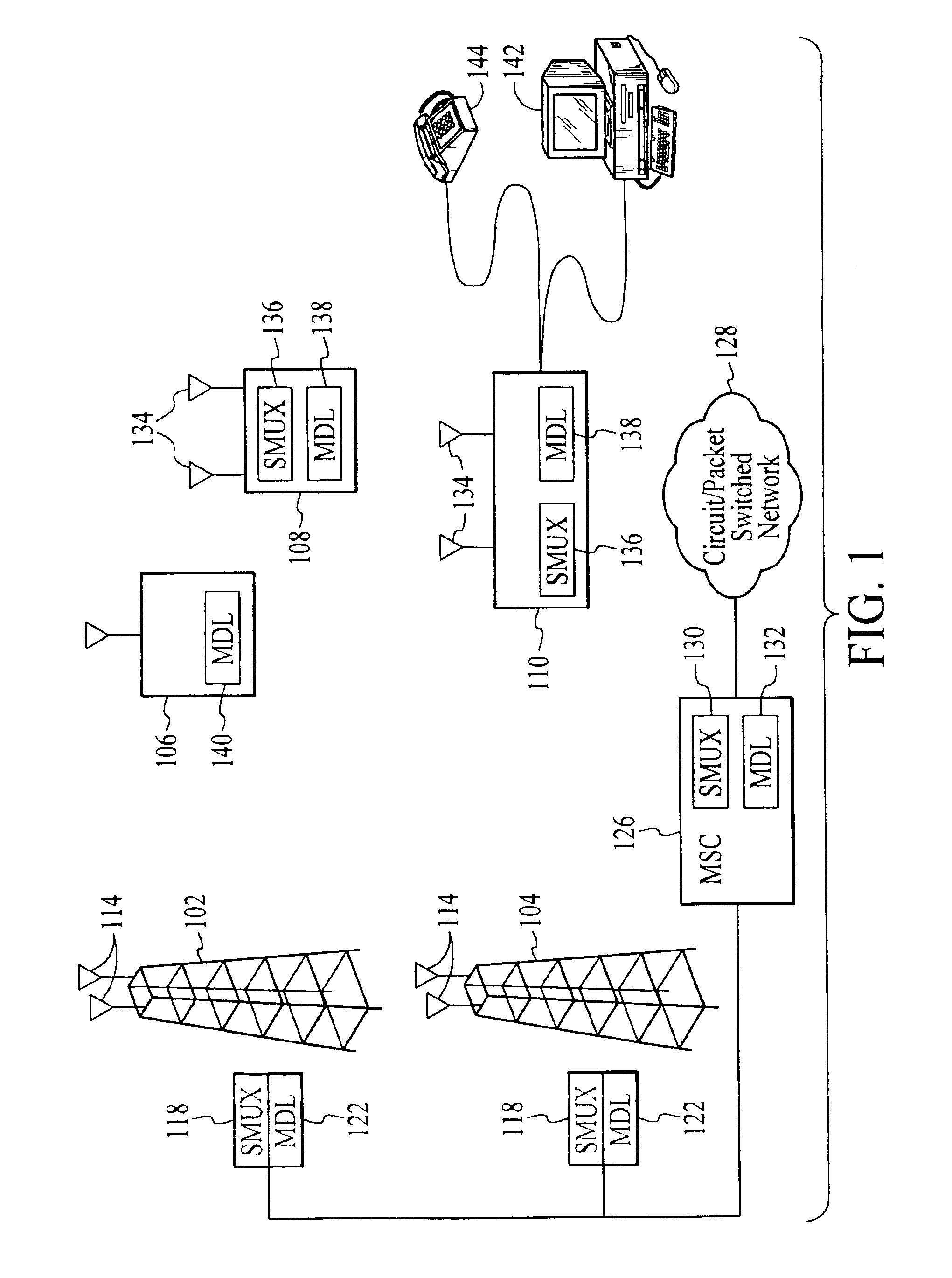
[0002] Wireless communications systems use multiple access protocols, such as time-division multiple access (TDMA), frequency-division multiple access (FDMA), code-division multiple access (CDMA), and space-division multiple access (SDMA) protocols, to enable wireless communications between base transceiver stations and multiple subscriber units. Typically, a wireless communications system includes multiple base transceiver stations that are spaced to create subscriber cells. Subscriber units, which may include mobile or fixed units, exchange information between a nearby base transceiver station over a dedicated radio frequency.

[0003] First generation wireless...

Claims

the structure of the environmentally friendly knitted fabric provided by the present invention; figure 2 Flow chart of the yarn wrapping machine for environmentally friendly knitted fabrics and storage devices; image 3 Is the parameter map of the yarn covering machine
Login to View More