Method of performing approximate substring indexing

a substring indexing and substring technology, applied in the field of approximate substring indexing, can solve the problems of unable to find this well-known database textbook, the querying agent may make errors in specifying the pattern desired, and the quality of string information residing in various databases can be degraded, so as to achieve the effect of efficient finding approximately all database strings

US7010522B1Inactive Publication Date: 2006-03-07AMERICAN TELEPHONE & TELEGRAPH CO
10 Cites 68 Cited by

Patent Information

Authority / Receiving Office
US · United States
Patent Type
Patents(United States)
Current Assignee / Owner
Publication Date
2006-03-07
Estimated Expiration
Not applicable · inactive patent

Smart Images

  • Figure 1
    Figure 1
  • Figure 2
    Figure 2
  • Figure 3
    Figure 3
Patent Text Reader

Abstract

Approximate substring indexing is accomplished by decomposing each string in a database into overlapping “positional q-grams”, sequences of a predetermined length q, and containing information regarding the “position” of each q-gram within the string (i.e., 1st q-gram, 4th q-gram, etc.). An index is then formed of the tuples of the positional q-gram data (such as, for example, a B-tree index or a hash index). Each query applied to the database is similarly parsed into a plurality of positional q-grams (of the same length), and a candidate set of matches is found. Position-directed filtering is used to remove the candidates which have the q-grams in the wrong order and / or too far apart to form a “verified” output of matching candidates. If errors are permitted (defined in terms of an edit distance between each candidate and the query), an edit distance calculation can then be performed to produce the final set of matching strings.
Need to check novelty before this filing date? Find Prior Art

Description

TECHNICAL FIELD

[0001] The present invention relates to performing matches of substrings to large collections of string data in a database and, more particularly, to the use of positional q-grams, maintained in an index structure, to efficiently find approximately all database strings that contain a particular query substring.BACKGROUND OF THE INVENTION

[0002] String data is ubiquitous. For example, product catalog databases (for books, music, software and the like), electronic white and yellow page directories, and specialized information sources such as patent databases and bibliographic databases, all of which deal with string (text) data, are proliferating on the Internet. Most applications now have a prominent interface that allows string-based querying and searching. A critical requirement in this context is the ability to use a specified substring (referred to as a “query” substring) to find all of its occurrences in a particular database. Sometimes, one may be interested in a pr...

Examples

Embodiment Construction

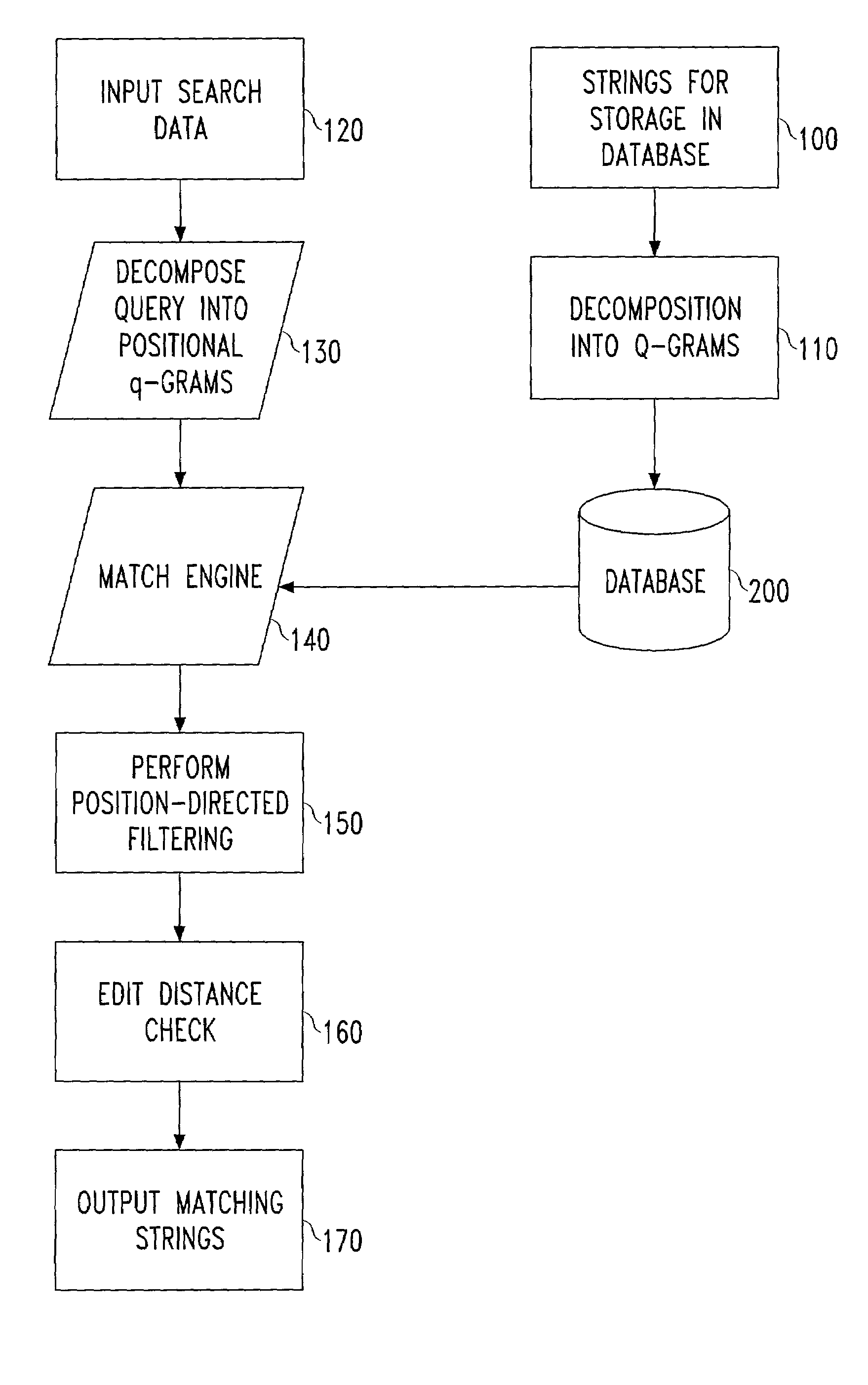
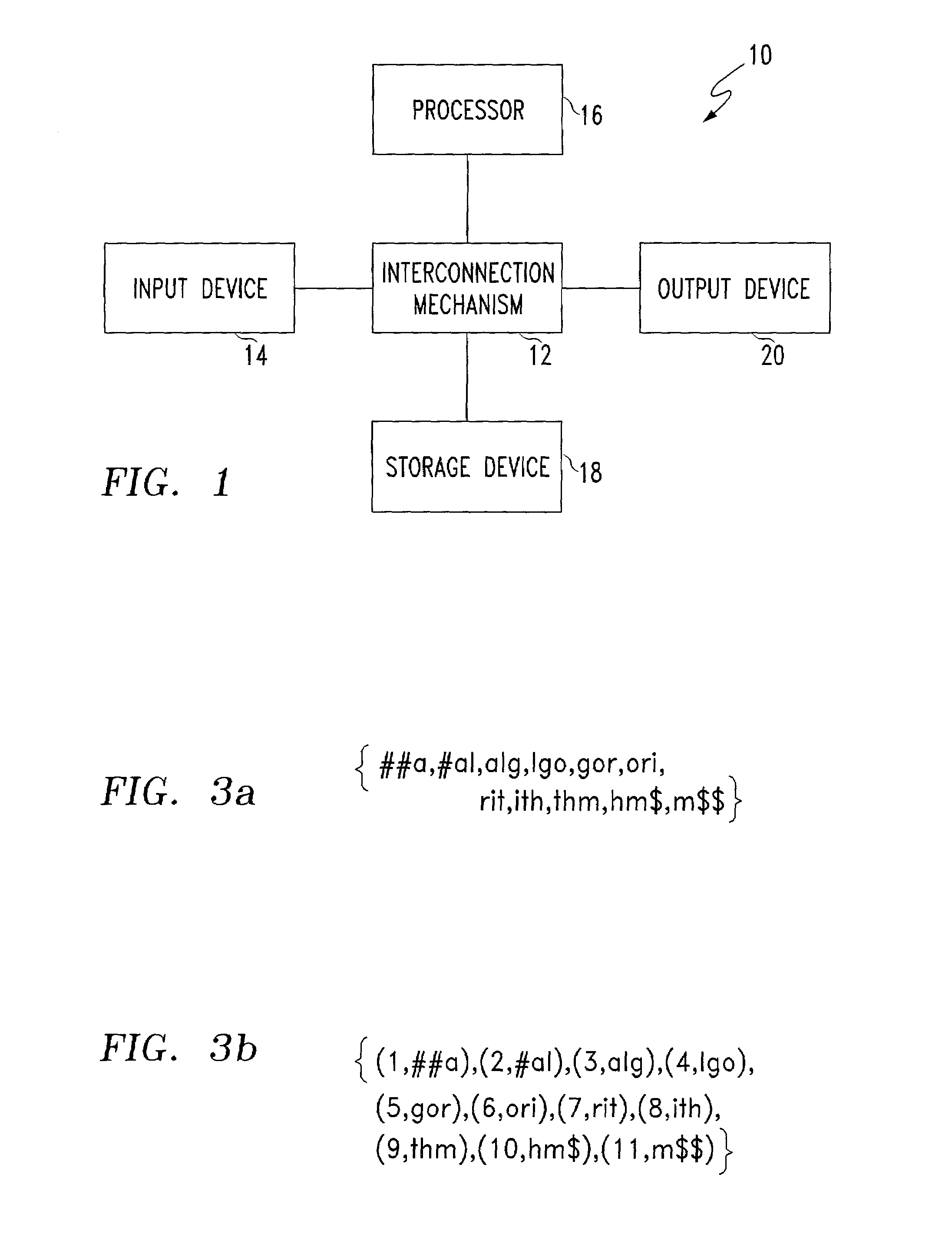
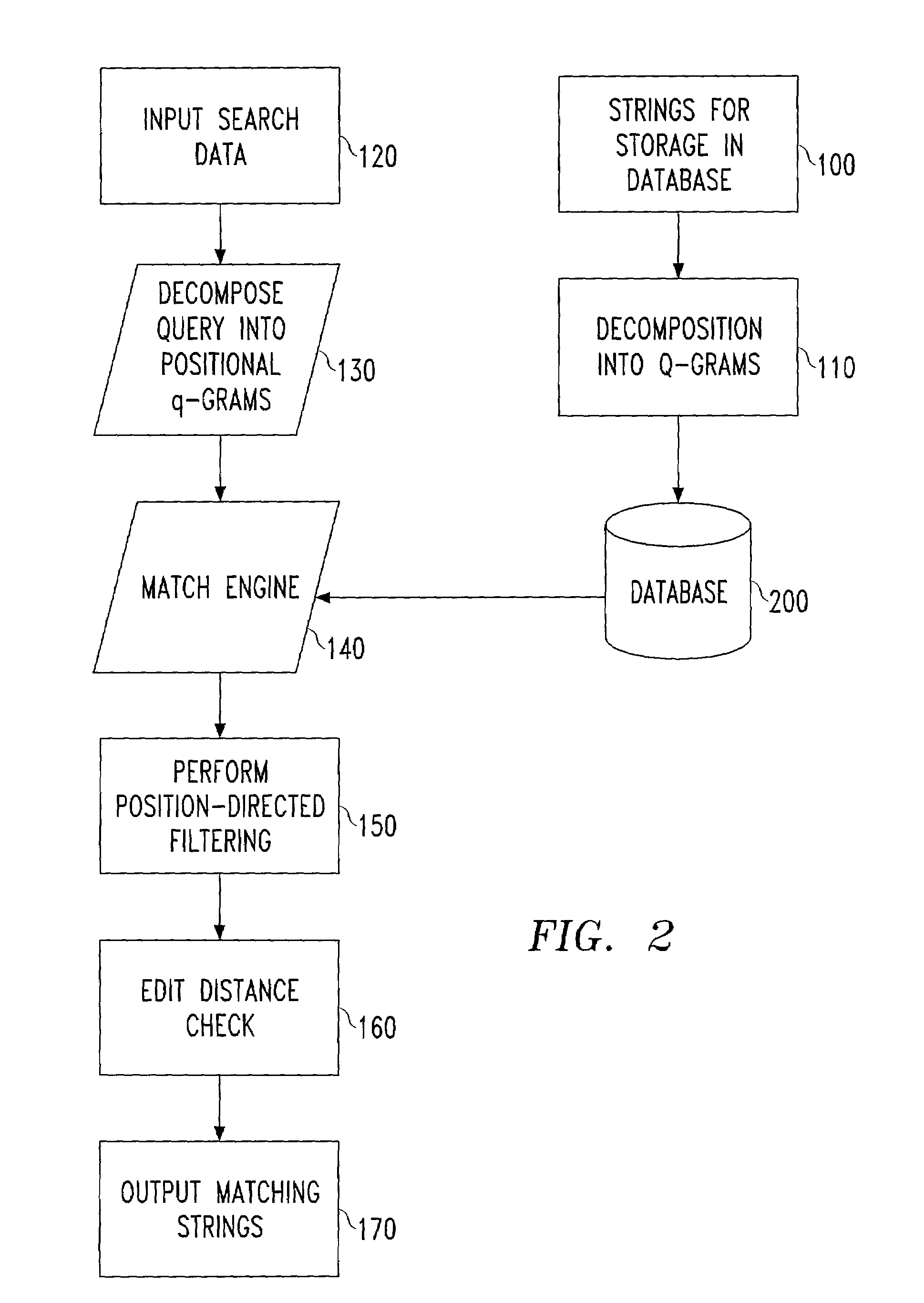
[0020]The present invention generally comprises a system and method for searching and matching input search data against a database of records. The invention may be implemented on a computer system such as that represented in FIG. 1. Computer system 10 of FIG. 1 is represented by a set of generic components 12, 14, 16, 18 and 20 as found in most general-purpose computers. In particular, computer system 10 comprises an interconnection mechanism 12 such as a bus or circuitry which couples an input device 14 (such as a keyboard), a processor 16 (such as a microprocessor), a storage device 18 (such as a computer disk or memory) and an output device 20 (such as a monitor or screen). Various embodiments of the invention will be described below in conjunction with these components, interconnected in the manner shown in FIG. 1.

[0021]FIG. 2 shows the general nature of processing data in accordance with the present invention. Initially, a set of string data is collected for storage in a datab...