
Method and apparatus for controlling hydrocarbon injection into engine exhaust to reduce NOx
a technology of hydrocarbon injection and engine exhaust, which is applied in the direction of mechanical equipment, engines, machines/engines, etc., can solve the problems of not directly measuring the nox reduction effectiveness, the fb>2/b> is not accurate, and the amount of hc added to the reaction may not be optimal, so as to achieve the peak nox reduction efficiency, reduce nox, and reduce nox
- Summary
- Abstract
- Description
- Claims
- Application Information
AI Technical Summary
Benefits of technology
Problems solved by technology
Method used
Image

Examples
Embodiment Construction
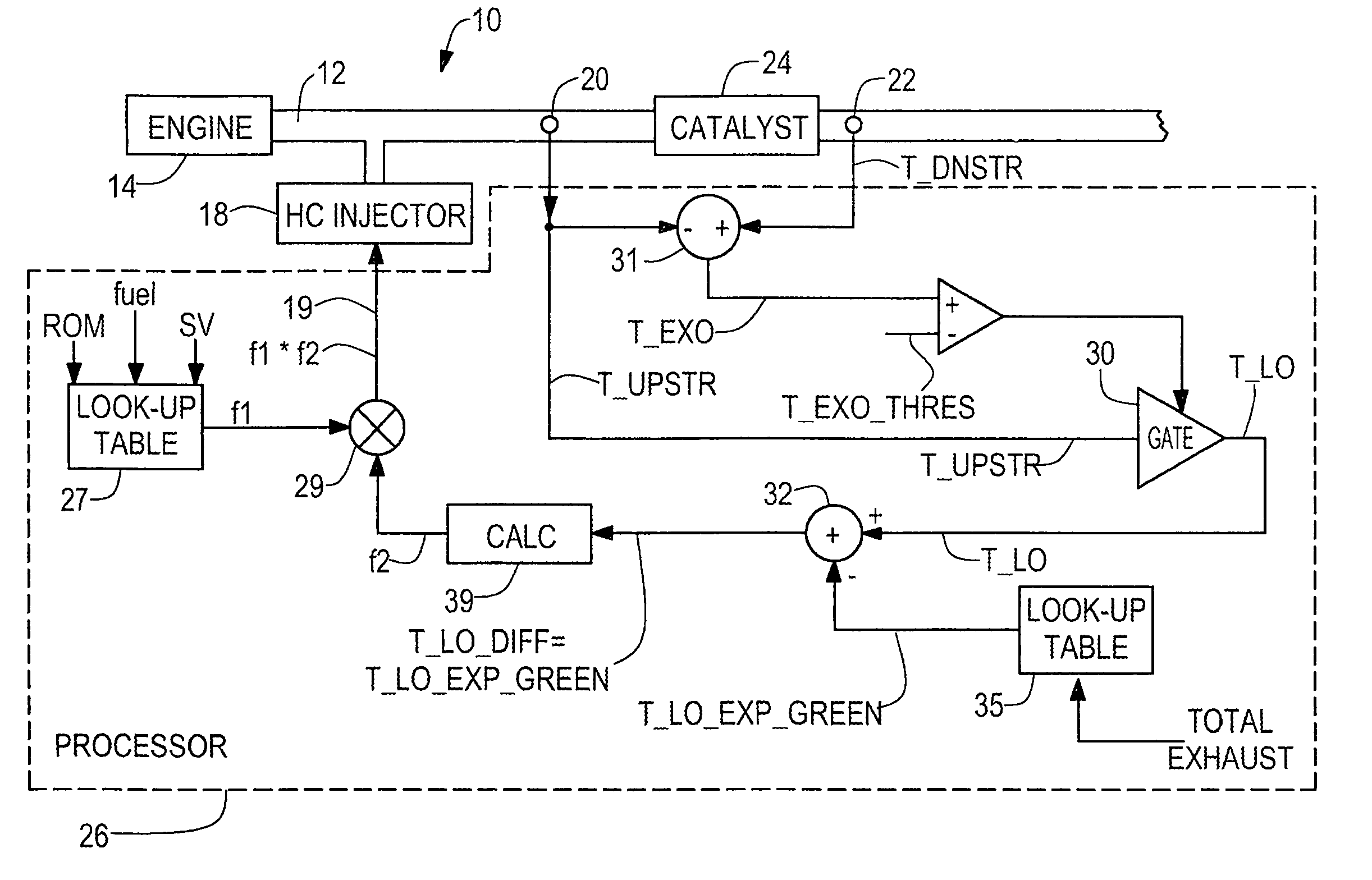
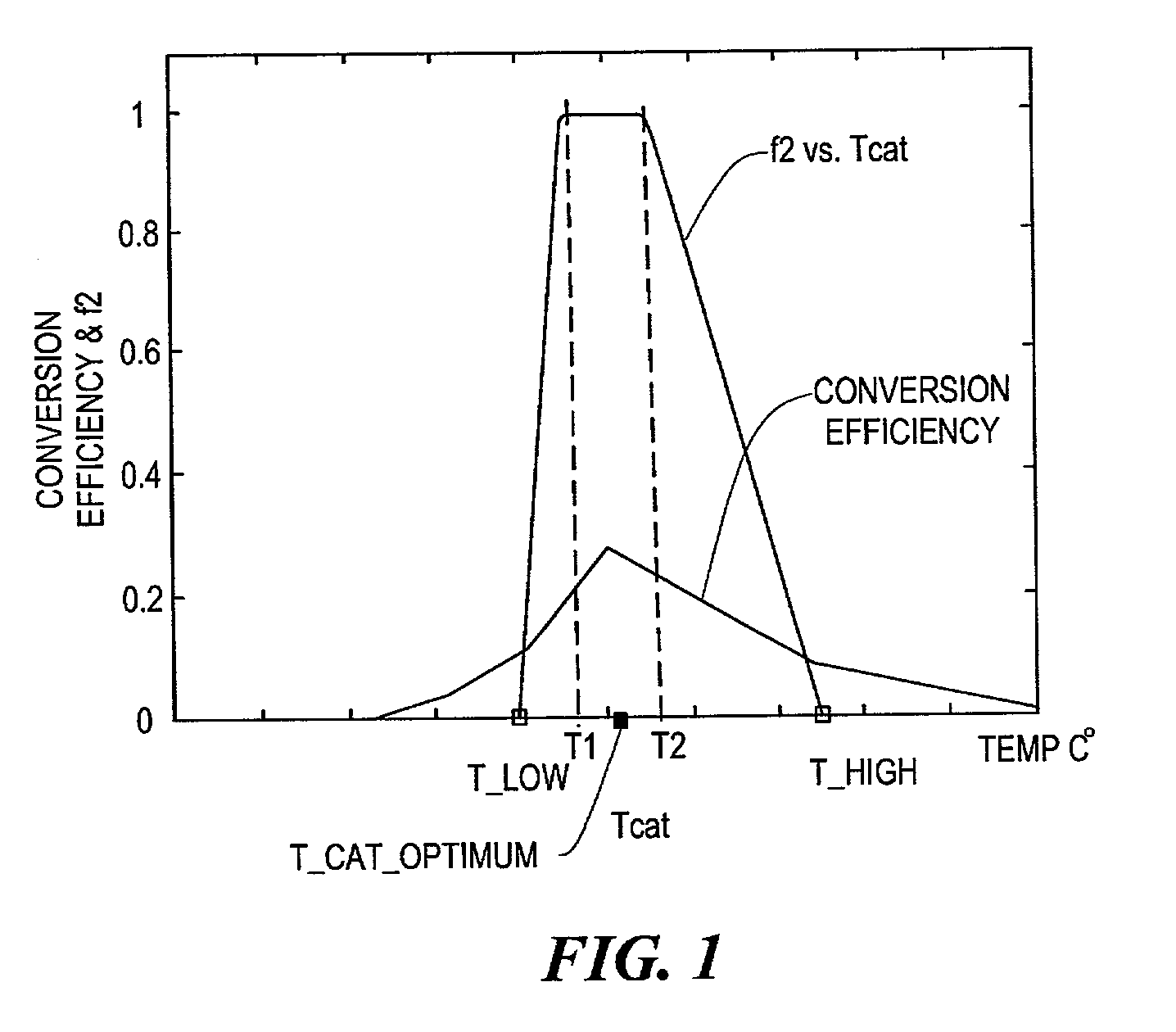
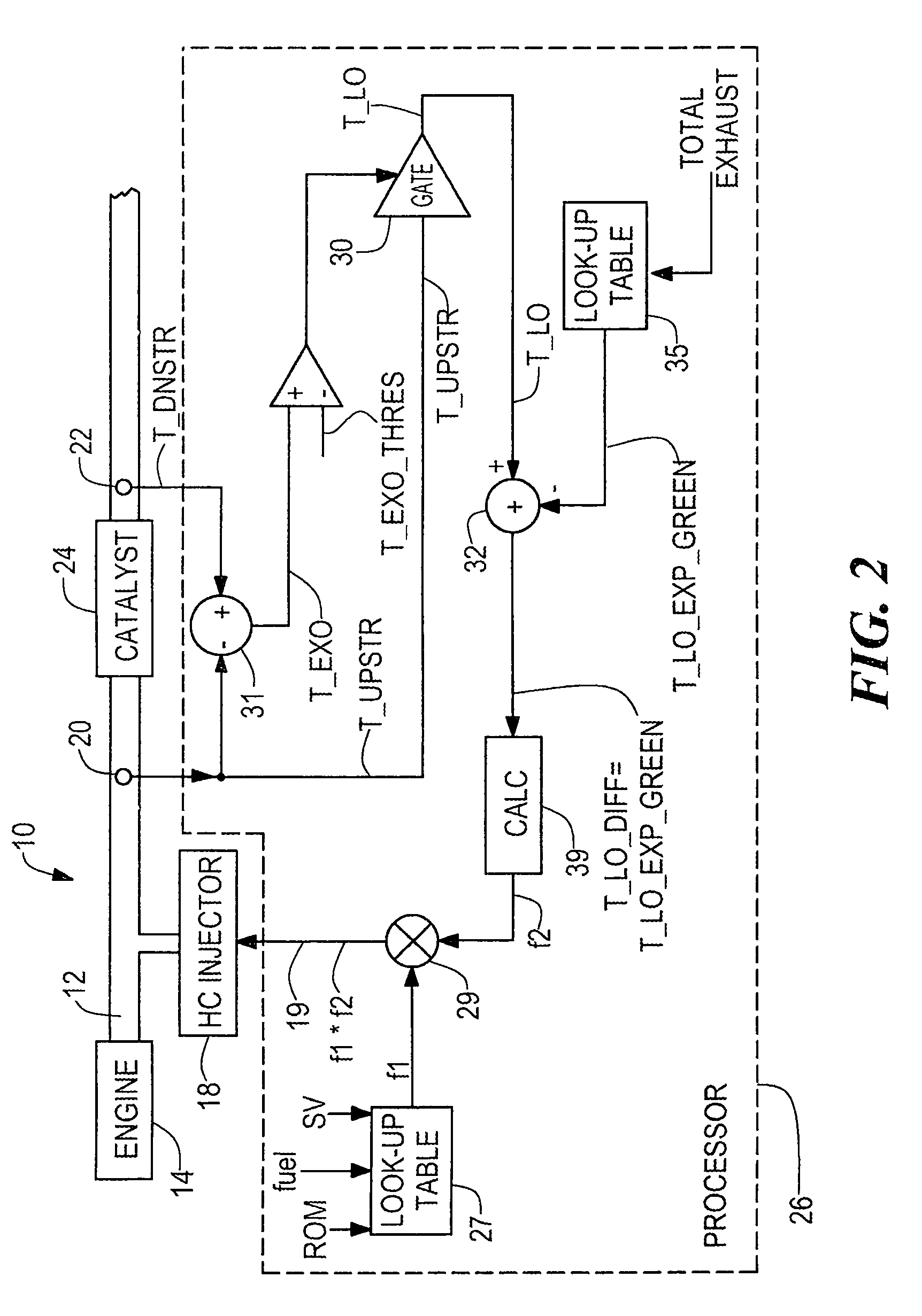
[0018]Referring now to FIG. 2, a functional block diagram of an exhaust system 10 for reducing and controlling hydrocarbon (HC) injection into the exhaust 12 of an engine 14 via an HC injector 18 to reduce NOx in such exhaust is shown. The system 10 includes a catalyst 24 to facilitate the reaction between the HC and the NOx in the engine exhaust. More particularly, the system 10 includes the injector 18 for introducing hydrocarbons (HC) into the exhaust 18 in response to a control signal fed to the injector 18 on line 19 in a manner to be described in more detail hereinafter. Suffice it to say here that while the temperature T_CAT_OPTIMUM at which the hydrocarbon should react with the NOx in the exhaust for maximum NOx reduction efficiency may be established for a new or so-called green catalyst, as described above in connection with FIG. 1, the temperature T_CAT_OPTIMUM for optimum NOx reduction efficiency increases with catalyst age. This is illustrated in FIG. 3. Thus, it is not...
PUM
 Login to View More
 Abstract
Description
Claims
Application Information
 Login to View More