
Holographic data-storage medium
a technology of holographic data and storage media, which is applied in the field of holographic data storage media, can solve the problems of loss of data, impairment of the resolution of reconstructed holographic images, and material change in the polymer film leading to local change in the interface structure, etc., and achieves the effect of reducing the cost of production, facilitating the reading out of stored holographic information, and simplifying the operation of setting the focus
- Summary
- Abstract
- Description
- Claims
- Application Information
AI Technical Summary
Benefits of technology
Problems solved by technology
Method used
Image

Examples
first embodiment
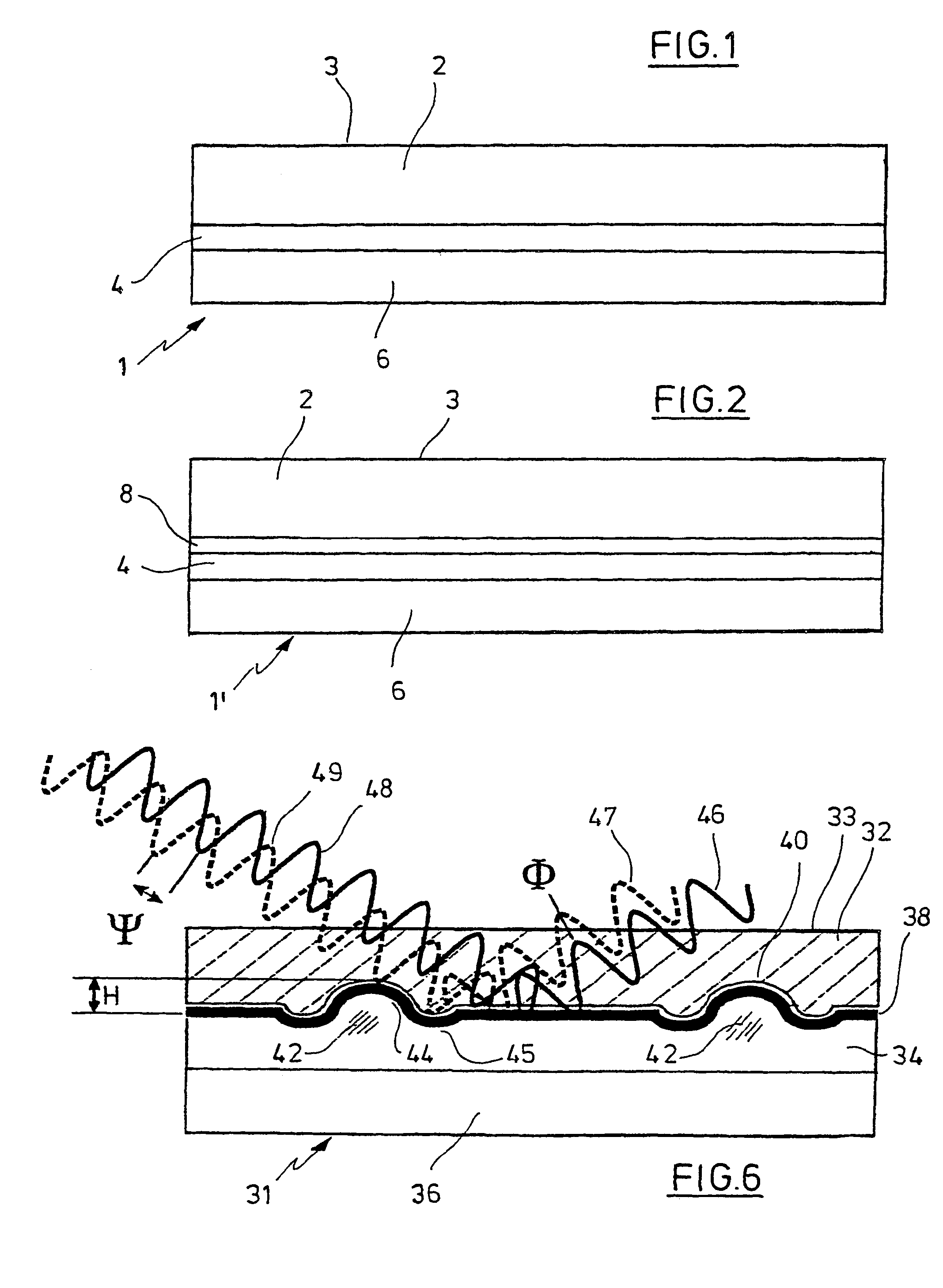
[0040]FIG. 1 illustrates, in a schematic way and not to scale, a detail from a holographic data storage medium 1 in longitudinal section. The data storage medium 1 contains a polymer film 2 which serves simultaneously as a storage layer and as a top layer with an exposed outer side 3. In the exemplary embodiment, the polymer film 2 is self-supporting. Arranged underneath the polymer film 2 and adjacent to the polymer film 2 is an absorber layer 4 with an absorber dye. Underneath it there is an adhesive layer 6 which, in the delivered state of the data storage medium 1, is preferably covered by a film that can be pulled off or silicone paper. The terms “above” and “below” relate here and in the following text to the illustration in the figures; however, the data storage medium can also be arranged in any other orientation.
[0041]In the exemplary embodiment, the polymer film 2 is a biaxially oriented film of polypropylene (BOPP) with a thickness of 35 μm. Thinner or thicker films are ...
second embodiment
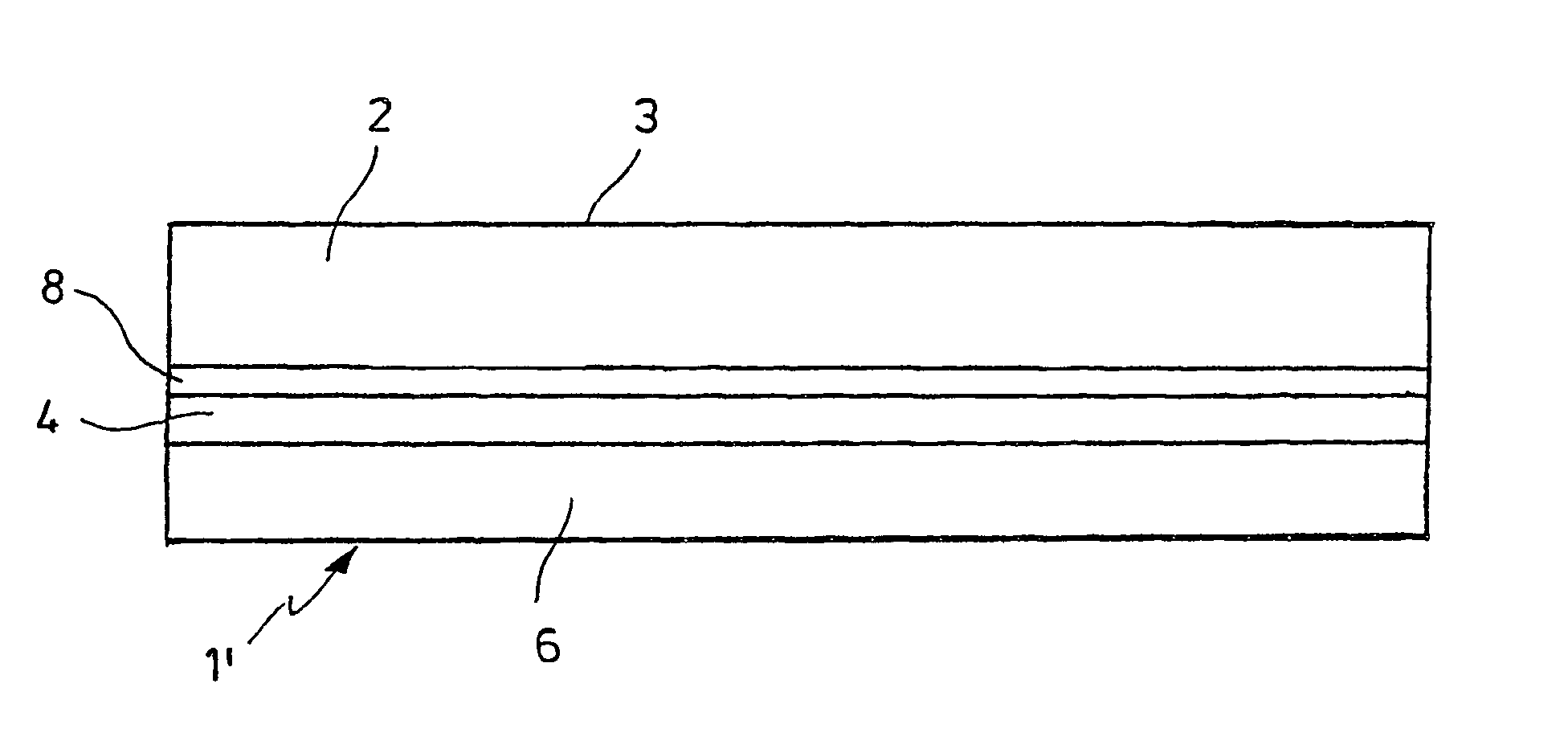
[0045]FIG. 2 is an illustration similar to FIG. 1 of a holographic data storage medium, which is designated 1′ here. Just like the data storage medium 1, the data storage medium 1′ has a polymer film 2 (here made of polyethylene terephthalate), which is set up as a storage layer and top layer with an exposed outer side 3, an absorber layer 4 and an adhesive layer 6. In addition, there is a reflective layer 8 between the polymer film 2 and the absorber layer 4.
[0046]In the exemplary embodiment, the reflective layer 8 consists of aluminum vapor-deposited on the underside of the polymer film 2 with a thickness such that the result is a transmission of 50%. Preferred layer thicknesses lie in the range from 1 nm to 50 nm, but smaller or larger values are also possible. Given such a low thickness, the reflective layer 8 is partly transparent, so that a write beam aimed at the outer side 3 of the polymer film 2 (for example from a laser lithograph, see below) can pass through the reflectiv...
PUM
| Property | Measurement | Unit |
|---|---|---|
| thickness | aaaaa | aaaaa |
| thicknesses | aaaaa | aaaaa |
| thicknesses | aaaaa | aaaaa |
Abstract
Description
Claims
Application Information
 Login to View More